

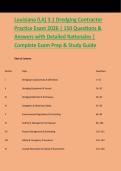
Louisiana (LA) 3.1 Dredging Contractor
Practice Exam 2026 | 150 Questions &
Answers with Detailed Rationales |
Complete Exam Prep & Study Guide
Table of Contents
Section Topic Questions
I Dredging Fundamentals & Definitions 1–15
II Dredging Equipment & Vessels 16–35
III Dredging Methods & Techniques 36–50
IV Navigation & Waterway Safety 51–65
V Environmental Regulations & Permitting 66–85
VI Sediment Management & Disposal 86–100
VII Project Management & Estimating 101–115
VIII Safety & Emergency Procedures 116–130
IX Coastal Restoration & Habitat Enhancement 131–140
,Section Topic Questions
X Legal, Contractual & Business Practices 141–150
SECTION I: DREDGING FUNDAMENTALS & DEFINITIONS
• Q1. What is the primary purpose of dredging in navigation projects?
A. To increase shoreline vegetation and promote aquatic plant growth
B. To remove sediment or other material from underwater areas to maintain adequate
depth for vessels
C. To construct permanent underwater structures for marine research
D. To prevent rainfall runoff from entering navigable waterways
CorreCt answer : B
Rationale: Dredging is primarily performed to excavate, remove, relocate, or dispose of
sediment and other submerged materials to maintain or improve waterways, channels, harbors,
and other aquatic areas. Maintaining adequate depth for vessels is the core objective of
navigation dredging.
• Q2. According to the Louisiana State Licensing Board for Contractors (LSLBC), how is
"dredging" officially defined?
A. The excavation of dry land for foundation preparation
B. The dredging of waterways for navigation, erosion control, coastal restoration and
associated sediment removal, disposal, and relocation
C. The construction of marine vessels for commercial transport
D. The installation of underwater pipelines and cable systems
CorreCt answer : B
Rationale: The LSLBC officially defines dredging as "the dredging of waterways for navigation,
erosion control, coastal restoration and associated sediment removal, disposal, and relocation.
Also includes sludge removal from treatment ponds using dredging technologies". Dredging is a
subclassification of Heavy Construction.
,• Q3. Which of the following BEST describes the difference between maintenance dredging and
capital dredging?
A. Maintenance dredging removes new sediment; capital dredging removes existing
sediment
B. Maintenance dredging maintains existing depths; capital dredging creates new or deeper
channels
C. Maintenance dredging is always performed by hydraulic dredges only
D. Capital dredging requires no environmental permits
CorreCt answer : B
Rationale: Maintenance dredging is performed to maintain existing navigable depths by
removing accumulated sediment. Capital dredging involves creating new channels, deepening
existing ones, or excavating for new construction projects. Both types require environmental
permits and careful planning.
• Q4. What does the term "overdepth" refer to in dredging operations?
A. The height of a crane above the water surface
B. The vertical distance from the water surface or reference elevation to the excavation
bottom
C. The depth of sediment that must be left in place for environmental reasons
D. The maximum safe operating depth of a dredge vessel
CorreCt answer : B
Rationale: Overdepth occurs when excavation extends below the specified bottom elevation.
Contractors must control dredging to avoid unnecessary excavation and potential project
violations.
• Q5. Why is overdepth control critically important in dredging contracts?
A. It increases fuel consumption and project profitability
B. It prevents unnecessary excavation and potential environmental or contractual problems
C. It eliminates the need for post-dredge surveying
D. It allows contractors to dispose of more material in permitted sites
, CorreCt answer : B
Rationale: Overdepth control is essential because excessive excavation can lead to
environmental damage, increased disposal costs, contractual disputes, and potential violations
of permit conditions. Proper depth control ensures project compliance and cost efficiency.
• Q6. Which material is most commonly removed during routine maintenance dredging
operations?
A. Structural steel and construction debris
B. Sediment (silt, mud, sand, and other deposited materials)
C. Concrete columns and underwater foundations
D. Roofing materials and land-based debris
CorreCt answer : B
Rationale: Silt, mud, sand, and other deposited sediments commonly accumulate in waterways
and are frequently removed by maintenance dredging. These fine materials settle over time and
reduce navigable depths.
• Q7. Under Louisiana law, which classification does dredging fall under?
A. Building Construction
B. Highway, Street, and Bridge Construction
C. Heavy Construction
D. Municipal and Public Works Construction
CorreCt answer : C
Rationale: Dredging is a subclassification of Heavy Construction. Heavy Construction includes
large-scale industrial projects, dredging, and heavy civil work.
• Q8. What is the minimum passing score for the Louisiana 3.1 Dredging Contractor
examination?
A. 60%
B. 65%
C. 70%
D. 75%
Practice Exam 2026 | 150 Questions &
Answers with Detailed Rationales |
Complete Exam Prep & Study Guide
Table of Contents
Section Topic Questions
I Dredging Fundamentals & Definitions 1–15
II Dredging Equipment & Vessels 16–35
III Dredging Methods & Techniques 36–50
IV Navigation & Waterway Safety 51–65
V Environmental Regulations & Permitting 66–85
VI Sediment Management & Disposal 86–100
VII Project Management & Estimating 101–115
VIII Safety & Emergency Procedures 116–130
IX Coastal Restoration & Habitat Enhancement 131–140
,Section Topic Questions
X Legal, Contractual & Business Practices 141–150
SECTION I: DREDGING FUNDAMENTALS & DEFINITIONS
• Q1. What is the primary purpose of dredging in navigation projects?
A. To increase shoreline vegetation and promote aquatic plant growth
B. To remove sediment or other material from underwater areas to maintain adequate
depth for vessels
C. To construct permanent underwater structures for marine research
D. To prevent rainfall runoff from entering navigable waterways
CorreCt answer : B
Rationale: Dredging is primarily performed to excavate, remove, relocate, or dispose of
sediment and other submerged materials to maintain or improve waterways, channels, harbors,
and other aquatic areas. Maintaining adequate depth for vessels is the core objective of
navigation dredging.
• Q2. According to the Louisiana State Licensing Board for Contractors (LSLBC), how is
"dredging" officially defined?
A. The excavation of dry land for foundation preparation
B. The dredging of waterways for navigation, erosion control, coastal restoration and
associated sediment removal, disposal, and relocation
C. The construction of marine vessels for commercial transport
D. The installation of underwater pipelines and cable systems
CorreCt answer : B
Rationale: The LSLBC officially defines dredging as "the dredging of waterways for navigation,
erosion control, coastal restoration and associated sediment removal, disposal, and relocation.
Also includes sludge removal from treatment ponds using dredging technologies". Dredging is a
subclassification of Heavy Construction.
,• Q3. Which of the following BEST describes the difference between maintenance dredging and
capital dredging?
A. Maintenance dredging removes new sediment; capital dredging removes existing
sediment
B. Maintenance dredging maintains existing depths; capital dredging creates new or deeper
channels
C. Maintenance dredging is always performed by hydraulic dredges only
D. Capital dredging requires no environmental permits
CorreCt answer : B
Rationale: Maintenance dredging is performed to maintain existing navigable depths by
removing accumulated sediment. Capital dredging involves creating new channels, deepening
existing ones, or excavating for new construction projects. Both types require environmental
permits and careful planning.
• Q4. What does the term "overdepth" refer to in dredging operations?
A. The height of a crane above the water surface
B. The vertical distance from the water surface or reference elevation to the excavation
bottom
C. The depth of sediment that must be left in place for environmental reasons
D. The maximum safe operating depth of a dredge vessel
CorreCt answer : B
Rationale: Overdepth occurs when excavation extends below the specified bottom elevation.
Contractors must control dredging to avoid unnecessary excavation and potential project
violations.
• Q5. Why is overdepth control critically important in dredging contracts?
A. It increases fuel consumption and project profitability
B. It prevents unnecessary excavation and potential environmental or contractual problems
C. It eliminates the need for post-dredge surveying
D. It allows contractors to dispose of more material in permitted sites
, CorreCt answer : B
Rationale: Overdepth control is essential because excessive excavation can lead to
environmental damage, increased disposal costs, contractual disputes, and potential violations
of permit conditions. Proper depth control ensures project compliance and cost efficiency.
• Q6. Which material is most commonly removed during routine maintenance dredging
operations?
A. Structural steel and construction debris
B. Sediment (silt, mud, sand, and other deposited materials)
C. Concrete columns and underwater foundations
D. Roofing materials and land-based debris
CorreCt answer : B
Rationale: Silt, mud, sand, and other deposited sediments commonly accumulate in waterways
and are frequently removed by maintenance dredging. These fine materials settle over time and
reduce navigable depths.
• Q7. Under Louisiana law, which classification does dredging fall under?
A. Building Construction
B. Highway, Street, and Bridge Construction
C. Heavy Construction
D. Municipal and Public Works Construction
CorreCt answer : C
Rationale: Dredging is a subclassification of Heavy Construction. Heavy Construction includes
large-scale industrial projects, dredging, and heavy civil work.
• Q8. What is the minimum passing score for the Louisiana 3.1 Dredging Contractor
examination?
A. 60%
B. 65%
C. 70%
D. 75%


