

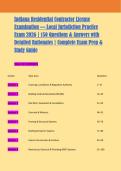
Indiana Residential Contractor License
Examination — Local Jurisdiction Practice
Exam 2026 | 150 Questions & Answers with
Detailed Rationales | Complete Exam Prep &
Study Guide
TABLE OF CONTENTS
Section Topic Area Questions
Section 1 Licensing, Jurisdiction & Regulatory Authority 1–15
Section 2 Building Codes & Standards (IRC/IBC) 16–30
Section 3 Site Work, Excavation & Foundations 31–45
Section 4 Concrete & Masonry 46–55
Section 5 Framing & Structural Systems 56–70
Section 6 Roofing & Exterior Systems 71–80
Section 7 Interior Construction & Finishes 81–90
Section 8 Mechanical, Electrical & Plumbing (MEP) Systems 91–100
,Section Topic Area Questions
Section 9 Safety Standards (OSHA 29 CFR Part 1926) 101–110
Section 10 Estimating, Math & Project Planning 111–125
Section 11 Contracts, Business Law & Liens 126–140
Section 12 Project Management & Contractor Responsibilities 141–150
SECTION 1: LICENSING, JURISDICTION & REGULATORY AUTHORITY
• Question 1. A residential contractor is preparing to begin work on a new home in an Indiana
municipality. Which of the following is the most important consideration before relying on a
statewide licensing assumption?
A. The contractor's preferred material supplier relationship
B. The municipality's adopted licensing, registration, permit, and building requirements
C. The homeowner's insurance policy deductible amount
D. The contractor's annual advertising budget
•• B — Local jurisdictions throughout Indiana may impose their own contractor registration,
licensing, permitting, inspection, and administrative requirements. Contractors must verify the
specific requirements of the Authority Having Jurisdiction (AHJ) before beginning any work, as
Indiana does not issue one broad statewide general contractor license for residential
construction.
• Question 2. Under Indiana law, which statute establishes written contract requirements and
consumer protections for home improvement work?
A. IC 24-5-11 (Indiana Home Improvement Contract Act)
B. IC 25-28.5 (Plumbers Licensing)
,C. IC 22-12 (Safety Standards)
D. IC 36-1-22 (Local Government Regulation)
•• A — The Indiana Home Improvement Contract Act (IC 24-5-11) establishes written contract
requirements and consumer protections for home improvement work. It requires written
contracts for home improvement projects valued at $150 or more.
• Question 3. Which entity is the primary regulatory authority for state-regulated trade
contractor licensing in Indiana?
A. Local county building departments
B. Indiana Department of Transportation
C. Indiana Professional Licensing Agency (IPLA)
D. Indiana State Board of Health
•• C — The Indiana Professional Licensing Agency (IPLA) administers licensing for state-
regulated trades including plumbing, electrical, and fire sprinkler contractors through various
commissions and boards.
• Question 4. An applicant for a plumbing contractor license in Indiana must provide evidence
of how many years of experience in the plumbing trade?
A. 2 years
B. 3 years
C. 4 years
D. 5 years
•• C — Indiana requires that an applicant who is an Indiana resident must provide evidence of
completing at least four (4) years in an approved apprenticeship program or present a notarized
statement providing evidence of at least four years of experience in the plumbing trade.
• Question 5. After February 28, 2013, what restriction applies to political subdivisions in
Indiana regarding contractor licensing?
A. They must license all residential builders
B. They may not adopt ordinances requiring builders or remodelers to be licensed by the
political subdivision
, C. They must adopt statewide licensing standards
D. They may only license commercial contractors
•• B — Under Indiana Code 36-1-22-5, after February 28, 2013, a political subdivision may not
adopt an ordinance, rule, policy, or other requirement providing that a builder or remodeler
must be licensed, certified, permitted, registered, or listed by the political subdivision as a
condition to constructing a new residential dwelling.
• Question 6. What is the minimum passing score typically required for Indiana contractor
licensing examinations?
A. 50%
B. 60%
C. 70%
D. 80%
•• C — Most Indiana contractor licensing examinations, including plumbing and other trade
categories, require a minimum passing score of approximately 70%.
• Question 7. A contractor working in St. Joseph County and the City of South Bend must
comply with which requirement?
A. No registration is required for residential work
B. All contractors, including subcontractors, must be registered or licensed with the Building
Department
C. Only general contractors must register
D. Registration is optional for projects under $50,000
•• B — All contractors, including subcontractors, must be registered or licensed with the
Building Department in order to perform work in St. Joseph County and the City of South Bend.
• Question 8. Which Indiana code governs minimum standards for residential construction in
the state?
A. OSHA 29 CFR Part 1926
B. Indiana Residential Code (IRC)
Examination — Local Jurisdiction Practice
Exam 2026 | 150 Questions & Answers with
Detailed Rationales | Complete Exam Prep &
Study Guide
TABLE OF CONTENTS
Section Topic Area Questions
Section 1 Licensing, Jurisdiction & Regulatory Authority 1–15
Section 2 Building Codes & Standards (IRC/IBC) 16–30
Section 3 Site Work, Excavation & Foundations 31–45
Section 4 Concrete & Masonry 46–55
Section 5 Framing & Structural Systems 56–70
Section 6 Roofing & Exterior Systems 71–80
Section 7 Interior Construction & Finishes 81–90
Section 8 Mechanical, Electrical & Plumbing (MEP) Systems 91–100
,Section Topic Area Questions
Section 9 Safety Standards (OSHA 29 CFR Part 1926) 101–110
Section 10 Estimating, Math & Project Planning 111–125
Section 11 Contracts, Business Law & Liens 126–140
Section 12 Project Management & Contractor Responsibilities 141–150
SECTION 1: LICENSING, JURISDICTION & REGULATORY AUTHORITY
• Question 1. A residential contractor is preparing to begin work on a new home in an Indiana
municipality. Which of the following is the most important consideration before relying on a
statewide licensing assumption?
A. The contractor's preferred material supplier relationship
B. The municipality's adopted licensing, registration, permit, and building requirements
C. The homeowner's insurance policy deductible amount
D. The contractor's annual advertising budget
•• B — Local jurisdictions throughout Indiana may impose their own contractor registration,
licensing, permitting, inspection, and administrative requirements. Contractors must verify the
specific requirements of the Authority Having Jurisdiction (AHJ) before beginning any work, as
Indiana does not issue one broad statewide general contractor license for residential
construction.
• Question 2. Under Indiana law, which statute establishes written contract requirements and
consumer protections for home improvement work?
A. IC 24-5-11 (Indiana Home Improvement Contract Act)
B. IC 25-28.5 (Plumbers Licensing)
,C. IC 22-12 (Safety Standards)
D. IC 36-1-22 (Local Government Regulation)
•• A — The Indiana Home Improvement Contract Act (IC 24-5-11) establishes written contract
requirements and consumer protections for home improvement work. It requires written
contracts for home improvement projects valued at $150 or more.
• Question 3. Which entity is the primary regulatory authority for state-regulated trade
contractor licensing in Indiana?
A. Local county building departments
B. Indiana Department of Transportation
C. Indiana Professional Licensing Agency (IPLA)
D. Indiana State Board of Health
•• C — The Indiana Professional Licensing Agency (IPLA) administers licensing for state-
regulated trades including plumbing, electrical, and fire sprinkler contractors through various
commissions and boards.
• Question 4. An applicant for a plumbing contractor license in Indiana must provide evidence
of how many years of experience in the plumbing trade?
A. 2 years
B. 3 years
C. 4 years
D. 5 years
•• C — Indiana requires that an applicant who is an Indiana resident must provide evidence of
completing at least four (4) years in an approved apprenticeship program or present a notarized
statement providing evidence of at least four years of experience in the plumbing trade.
• Question 5. After February 28, 2013, what restriction applies to political subdivisions in
Indiana regarding contractor licensing?
A. They must license all residential builders
B. They may not adopt ordinances requiring builders or remodelers to be licensed by the
political subdivision
, C. They must adopt statewide licensing standards
D. They may only license commercial contractors
•• B — Under Indiana Code 36-1-22-5, after February 28, 2013, a political subdivision may not
adopt an ordinance, rule, policy, or other requirement providing that a builder or remodeler
must be licensed, certified, permitted, registered, or listed by the political subdivision as a
condition to constructing a new residential dwelling.
• Question 6. What is the minimum passing score typically required for Indiana contractor
licensing examinations?
A. 50%
B. 60%
C. 70%
D. 80%
•• C — Most Indiana contractor licensing examinations, including plumbing and other trade
categories, require a minimum passing score of approximately 70%.
• Question 7. A contractor working in St. Joseph County and the City of South Bend must
comply with which requirement?
A. No registration is required for residential work
B. All contractors, including subcontractors, must be registered or licensed with the Building
Department
C. Only general contractors must register
D. Registration is optional for projects under $50,000
•• B — All contractors, including subcontractors, must be registered or licensed with the
Building Department in order to perform work in St. Joseph County and the City of South Bend.
• Question 8. Which Indiana code governs minimum standards for residential construction in
the state?
A. OSHA 29 CFR Part 1926
B. Indiana Residential Code (IRC)


