

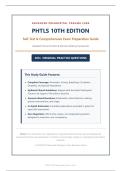
A D VA N C E D P R E H O S P I TA L T R A U M A C A R E
PHTLS 10TH EDITION
Self-Test & Comprehensive Exam Preparation Guide
Updated Clinical Content & Decision-Making Frameworks
200+ ORIGINAL PRACTICE QUESTIONS
This Study Guide Features:
Complete Coverage: Kinematics, Airway, Breathing, Circulation,
Disability, and Special Populations.
Updated Clinical Guidelines: Aligned with the latest Prehospital
Trauma Life Support 10th Edition doctrine.
Scenario-Based Questions: Emphasizes critical decision-making,
priority interventions, and triage.
In-Depth Rationales: Complete explanations provided in green for
rapid self-assessment.
Zero Repetition: 200 strictly unique, non-duplicated questions
designed to maximize core competency.
Notice: This document is an independent, original educational study resource designed for
prehospital trauma care preparation. It contains no proprietary, leaked, or copyrighted examination
materials.
© 2026/2027 Advanced Emergency Care Education Series
PHTLS 10th Edition Study Guide - Page 1
,TABLE OF CONTENTS
Module 1: Trauma Assessment & Kinematics of Trauma Questions 001 - 035
Module 2: Airway Management & Ventilation Questions 036 - 070
Module 3: Shock & Fluid Resuscitation (Circulation) Questions 071 - 105
Module 4: Head & Spinal Cord Trauma Questions 106 - 140
Module 5: Thoracic & Abdominal Trauma Questions 141 - 175
Module 6: Musculoskeletal Trauma & Burn Management Questions 176 - 210
Module 7: Special Populations & Environmental Emergencies Questions 211 - 245
PHTLS 10th Edition Study Guide - Page 2
, MODULE 1: TRAUMA ASSESSMENT & KINEMATICS OF
TRAUMA
Question 1
According to PHTLS principles, what is the primary goal of the primary survey in a
trauma patient?
A. To perform a comprehensive head-to-toe physical examination
B. To identify and immediately manage life-threatening conditions
C. To obtain a complete past medical history and list of medications
D. To establish a definitive diagnosis before initiating transport
Correct Answer: B
RATIONALE:
The primary survey (XABCDE) focuses specifically on rapidly identifying and managing immediate
threats to life. Detailed physical examinations and history taking are deferred to the secondary
survey.
Question 2
When evaluating the kinematics of a high-speed frontal impact motor vehicle
collision, which injury pattern is most commonly associated with the "up-and-over"
pathway?
A. Femur fractures and knee dislocations
B. Laryngeal trauma, flail chest, and myocardial contusion
C. Calcaneus fractures and lumbar spine compression
D. Posterior hip dislocation and patellar trauma
Correct Answer: B
RATIONALE:
In an up-and-over pathway, the occupant moves forward and upward over the steering wheel,
impacting the head on the windshield and the chest/abdomen on the steering wheel, leading to
head, neck, thoracic, and abdominal injuries.
PHTLS 10th Edition Study Guide - Page 3
, Question 3
During a trauma scene assessment, you identify active, pulsatile hemorrhage from a
groin wound. What is the immediate priority intervention under the PHTLS XABCDE
sequence?
A. Open and clear the airway using a jaw-thrust maneuver
B. Apply high-flow oxygen via a non-rebreather mask
C. Control the life-threatening hemorrhage using direct pressure or a junctional tourniquet
D. Perform a rapid neurological assessment using the Glasgow Coma Scale
Correct Answer: C
RATIONALE:
The "X" in XABCDE stands for Exsanguinating External Hemorrhage. Catastrophic external
bleeding must be controlled immediately before addressing airway, breathing, or circulation.
Question 4
A unrestrained driver strikes a tree at high speed. The steering wheel is bent. Which
underlying injury should the provider suspect highest based on mechanism of injury?
A. Traumatic rupture of the aorta
B. Renal artery laceration
C. Femoral artery thrombosis
D. Lumbar spine chance fracture
Correct Answer: A
RATIONALE:
Rapid deceleration forces combined with direct impact against a deformed steering wheel create
shearing forces at the ligamentum arteriosum, significantly increasing the risk of traumatic aortic
disruption.
PHTLS 10th Edition Study Guide - Page 4
PHTLS 10TH EDITION
Self-Test & Comprehensive Exam Preparation Guide
Updated Clinical Content & Decision-Making Frameworks
200+ ORIGINAL PRACTICE QUESTIONS
This Study Guide Features:
Complete Coverage: Kinematics, Airway, Breathing, Circulation,
Disability, and Special Populations.
Updated Clinical Guidelines: Aligned with the latest Prehospital
Trauma Life Support 10th Edition doctrine.
Scenario-Based Questions: Emphasizes critical decision-making,
priority interventions, and triage.
In-Depth Rationales: Complete explanations provided in green for
rapid self-assessment.
Zero Repetition: 200 strictly unique, non-duplicated questions
designed to maximize core competency.
Notice: This document is an independent, original educational study resource designed for
prehospital trauma care preparation. It contains no proprietary, leaked, or copyrighted examination
materials.
© 2026/2027 Advanced Emergency Care Education Series
PHTLS 10th Edition Study Guide - Page 1
,TABLE OF CONTENTS
Module 1: Trauma Assessment & Kinematics of Trauma Questions 001 - 035
Module 2: Airway Management & Ventilation Questions 036 - 070
Module 3: Shock & Fluid Resuscitation (Circulation) Questions 071 - 105
Module 4: Head & Spinal Cord Trauma Questions 106 - 140
Module 5: Thoracic & Abdominal Trauma Questions 141 - 175
Module 6: Musculoskeletal Trauma & Burn Management Questions 176 - 210
Module 7: Special Populations & Environmental Emergencies Questions 211 - 245
PHTLS 10th Edition Study Guide - Page 2
, MODULE 1: TRAUMA ASSESSMENT & KINEMATICS OF
TRAUMA
Question 1
According to PHTLS principles, what is the primary goal of the primary survey in a
trauma patient?
A. To perform a comprehensive head-to-toe physical examination
B. To identify and immediately manage life-threatening conditions
C. To obtain a complete past medical history and list of medications
D. To establish a definitive diagnosis before initiating transport
Correct Answer: B
RATIONALE:
The primary survey (XABCDE) focuses specifically on rapidly identifying and managing immediate
threats to life. Detailed physical examinations and history taking are deferred to the secondary
survey.
Question 2
When evaluating the kinematics of a high-speed frontal impact motor vehicle
collision, which injury pattern is most commonly associated with the "up-and-over"
pathway?
A. Femur fractures and knee dislocations
B. Laryngeal trauma, flail chest, and myocardial contusion
C. Calcaneus fractures and lumbar spine compression
D. Posterior hip dislocation and patellar trauma
Correct Answer: B
RATIONALE:
In an up-and-over pathway, the occupant moves forward and upward over the steering wheel,
impacting the head on the windshield and the chest/abdomen on the steering wheel, leading to
head, neck, thoracic, and abdominal injuries.
PHTLS 10th Edition Study Guide - Page 3
, Question 3
During a trauma scene assessment, you identify active, pulsatile hemorrhage from a
groin wound. What is the immediate priority intervention under the PHTLS XABCDE
sequence?
A. Open and clear the airway using a jaw-thrust maneuver
B. Apply high-flow oxygen via a non-rebreather mask
C. Control the life-threatening hemorrhage using direct pressure or a junctional tourniquet
D. Perform a rapid neurological assessment using the Glasgow Coma Scale
Correct Answer: C
RATIONALE:
The "X" in XABCDE stands for Exsanguinating External Hemorrhage. Catastrophic external
bleeding must be controlled immediately before addressing airway, breathing, or circulation.
Question 4
A unrestrained driver strikes a tree at high speed. The steering wheel is bent. Which
underlying injury should the provider suspect highest based on mechanism of injury?
A. Traumatic rupture of the aorta
B. Renal artery laceration
C. Femoral artery thrombosis
D. Lumbar spine chance fracture
Correct Answer: A
RATIONALE:
Rapid deceleration forces combined with direct impact against a deformed steering wheel create
shearing forces at the ligamentum arteriosum, significantly increasing the risk of traumatic aortic
disruption.
PHTLS 10th Edition Study Guide - Page 4


