
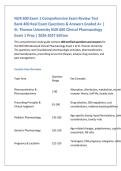
NUR 600 Exam 1 Comprehensive Exam Review Test
Bank 400 Real Exam Questions & Answers Graded A+ |
St. Thomas University NUR 600 Clinical Pharmacology
Exam 1 Prep | 2026-2027 Edition
This comprehensive study guide contains 400 verified questions and answers for
the NUR 600 Advanced Clinical Pharmacology Exam 1 at St. Thomas University.
The questions cover foundational pharmacologic principles, pharmacokinetics,
pharmacodynamics, prescribing across the lifespan, adverse drug reactions, and
pain management.
Content Area Overview
Question
Topic Area Key Concepts
Range
Pharmacokinetics & Absorption, distribution, metabolism, excretio
1-80
Pharmacodynamics receptor theory, half-life, steady state
Prescribing Principles & Drug selection, DEA regulations, cost
81-140
Clinical Judgment considerations, evidence-based guidelines
Age-specific dosing, liquid formulations, safet
Pediatric Pharmacology 141-180
considerations, toxicity risks
Age-related changes, polypharmacy, cognitive
Geriatric Pharmacology 181-220
assessment, fall risks
Teratogens, FDA pregnancy categories, safety
Pregnancy & Lactation 221-250
considerations
, Question
Topic Area Key Concepts
Range
Type A-F reactions, hypersensitivity,
Adverse Drug Reactions 251-290
pharmacovigilance
Opioid safety, multimodal analgesia, neuropa
Pain Management 291-330
pain, older adult considerations
Drug Interactions & CYP450 system, therapeutic drug monitoring,
331-400
Monitoring drug-drug interactions
SECTION 1: PHARMACOKINETICS & PHARMACODYNAMICS (Questions 1-80)
Question 1: Which cellular change is characteristic of reversible cell injury?
A) Nuclear pyknosis
B) Loss of membrane integrity
C) Cellular swelling and fatty change
D) Lysosomal rupture
Correct Answer: C) Cellular swelling and fatty change
Rationale: Reversible cell injury manifests as cellular swelling (due to failure of
Na+/K+ pumps) and fatty change (lipid accumulation). Pyknosis, membrane
rupture, and lysosomal rupture indicate irreversible injury (necrosis).
Question 2: What is the primary difference between pharmacokinetics and
pharmacodynamics?
A) Pharmacokinetics is the study of drug costs; pharmacodynamics is the study of
drug benefits
B) Pharmacokinetics is "what the body does to the drug"; pharmacodynamics is
"what the drug does to the body"
C) They are the same process
D) Pharmacokinetics applies only to IV drugs
, Correct Answer: B) Pharmacokinetics is "what the body does to the drug";
pharmacodynamics is "what the drug does to the body"
Rationale: Pharmacokinetics encompasses absorption, distribution, metabolism,
and excretion (ADME). Pharmacodynamics includes the mechanisms of action and
biochemical/physiologic effects at the receptor and cellular level.
Question 3: Why is the "first-pass effect" clinically significant?
A) It increases drug absorption in the stomach
B) It significantly reduces the bioavailability of orally administered drugs
metabolized by the liver before reaching systemic circulation
C) It only affects IV medications
D) It increases drug excretion
Correct Answer: B) It significantly reduces the bioavailability of orally
administered drugs metabolized by the liver before reaching systemic
circulation
Rationale: Drugs absorbed from the GI tract pass through the portal circulation to
the liver, where extensive metabolism can occur before the drug reaches systemic
circulation. This often necessitates higher oral doses or alternative routes of
administration (e.g., sublingual, transdermal).
Question 4: What is the time required for the amount of drug in the body to
decrease by 50% called?
A) Steady state
B) Half-life
C) Phase II metabolism
D) Reduced bioavailability time
Correct Answer: B) Half-life
Rationale: Half-life is the time required for the amount of drug in the body to
decrease by 50%. It is a key pharmacokinetic parameter used to determine dosing
intervals.
Question 5: How does renal impairment alter the dosing of most medications?
Bank 400 Real Exam Questions & Answers Graded A+ |
St. Thomas University NUR 600 Clinical Pharmacology
Exam 1 Prep | 2026-2027 Edition
This comprehensive study guide contains 400 verified questions and answers for
the NUR 600 Advanced Clinical Pharmacology Exam 1 at St. Thomas University.
The questions cover foundational pharmacologic principles, pharmacokinetics,
pharmacodynamics, prescribing across the lifespan, adverse drug reactions, and
pain management.
Content Area Overview
Question
Topic Area Key Concepts
Range
Pharmacokinetics & Absorption, distribution, metabolism, excretio
1-80
Pharmacodynamics receptor theory, half-life, steady state
Prescribing Principles & Drug selection, DEA regulations, cost
81-140
Clinical Judgment considerations, evidence-based guidelines
Age-specific dosing, liquid formulations, safet
Pediatric Pharmacology 141-180
considerations, toxicity risks
Age-related changes, polypharmacy, cognitive
Geriatric Pharmacology 181-220
assessment, fall risks
Teratogens, FDA pregnancy categories, safety
Pregnancy & Lactation 221-250
considerations
, Question
Topic Area Key Concepts
Range
Type A-F reactions, hypersensitivity,
Adverse Drug Reactions 251-290
pharmacovigilance
Opioid safety, multimodal analgesia, neuropa
Pain Management 291-330
pain, older adult considerations
Drug Interactions & CYP450 system, therapeutic drug monitoring,
331-400
Monitoring drug-drug interactions
SECTION 1: PHARMACOKINETICS & PHARMACODYNAMICS (Questions 1-80)
Question 1: Which cellular change is characteristic of reversible cell injury?
A) Nuclear pyknosis
B) Loss of membrane integrity
C) Cellular swelling and fatty change
D) Lysosomal rupture
Correct Answer: C) Cellular swelling and fatty change
Rationale: Reversible cell injury manifests as cellular swelling (due to failure of
Na+/K+ pumps) and fatty change (lipid accumulation). Pyknosis, membrane
rupture, and lysosomal rupture indicate irreversible injury (necrosis).
Question 2: What is the primary difference between pharmacokinetics and
pharmacodynamics?
A) Pharmacokinetics is the study of drug costs; pharmacodynamics is the study of
drug benefits
B) Pharmacokinetics is "what the body does to the drug"; pharmacodynamics is
"what the drug does to the body"
C) They are the same process
D) Pharmacokinetics applies only to IV drugs
, Correct Answer: B) Pharmacokinetics is "what the body does to the drug";
pharmacodynamics is "what the drug does to the body"
Rationale: Pharmacokinetics encompasses absorption, distribution, metabolism,
and excretion (ADME). Pharmacodynamics includes the mechanisms of action and
biochemical/physiologic effects at the receptor and cellular level.
Question 3: Why is the "first-pass effect" clinically significant?
A) It increases drug absorption in the stomach
B) It significantly reduces the bioavailability of orally administered drugs
metabolized by the liver before reaching systemic circulation
C) It only affects IV medications
D) It increases drug excretion
Correct Answer: B) It significantly reduces the bioavailability of orally
administered drugs metabolized by the liver before reaching systemic
circulation
Rationale: Drugs absorbed from the GI tract pass through the portal circulation to
the liver, where extensive metabolism can occur before the drug reaches systemic
circulation. This often necessitates higher oral doses or alternative routes of
administration (e.g., sublingual, transdermal).
Question 4: What is the time required for the amount of drug in the body to
decrease by 50% called?
A) Steady state
B) Half-life
C) Phase II metabolism
D) Reduced bioavailability time
Correct Answer: B) Half-life
Rationale: Half-life is the time required for the amount of drug in the body to
decrease by 50%. It is a key pharmacokinetic parameter used to determine dosing
intervals.
Question 5: How does renal impairment alter the dosing of most medications?


