

__________________________________________________________________
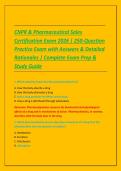
CNPR & Pharmaceutical Sales
Certification Exam 2026 | 250-Question
Practice Exam with Answers & Detailed
Rationales | Complete Exam Prep &
Study Guide
1. Which statement best describes pharmacodynamics?
A. How the body absorbs a drug
B. How the body eliminates a drug
C. How a drug produces its effects on the body
D. How a drug is distributed through wholesalers
Rationale: Pharmacodynamics concerns the biochemical and physiological
effects of a drug and its mechanisms of action. Pharmacokinetics, in contrast,
describes what the body does to the drug.
2. Which pharmacokinetic process describes movement of a drug from the
administration site into systemic circulation?
A. Metabolism
B. Excretion
C. Distribution
D. Absorption
,Rationale: Absorption is the movement of a drug from its administration site
into the bloodstream. The extent and rate of absorption can affect the onset and
intensity of drug effects.
3. What does drug efficacy refer to?
A. The amount of drug required to produce an effect
B. The speed at which a drug is absorbed
C. The maximum effect a drug can produce
D. The time required for elimination
Rationale: Efficacy refers to the maximum therapeutic effect achievable with a
drug. Potency refers instead to the amount of drug needed to produce a
particular effect.
4. What is meant by drug potency?
A. The maximum possible therapeutic effect
B. The amount of drug required to produce a specified effect
C. The percentage of drug excreted unchanged
D. The duration of patent protection
Rationale: Potency describes how much drug is necessary to achieve a specified
response. A highly potent drug produces a given effect at a lower dose than a
less potent drug.
5. Which organ is primarily responsible for drug metabolism?
A. Heart
B. Spleen
C. Liver
D. Pancreas
Rationale: The liver is the major site of drug metabolism because it contains
numerous enzymes, particularly the cytochrome P450 system, that chemically
modify many medications.
,6. Which organ is most commonly associated with elimination of drugs through
urine?
A. Liver
B. Stomach
C. Kidneys
D. Gallbladder
Rationale: The kidneys filter blood and eliminate many drugs and metabolites
through urine. Renal impairment can therefore alter the clearance of certain
medications.
7. What does a drug's half-life represent?
A. Time needed to reach maximum concentration
B. Time needed for complete elimination
C. Time required for the drug concentration to decrease by approximately 50%
D. Time required for absorption to begin
Rationale: Half-life is the time required for the plasma concentration or amount
of drug in the body to decline by one-half. It is important when determining
dosing intervals and time to steady state.
8. Which route of administration generally provides the most direct access to
systemic circulation?
A. Oral
B. Topical
C. Intravenous
D. Rectal
Rationale: Intravenous administration delivers the drug directly into the
bloodstream, resulting in essentially complete systemic bioavailability and
avoiding gastrointestinal absorption.
9. What is bioavailability?
, A. Drug toxicity at high doses
B. The fraction of an administered dose that reaches systemic circulation in
active form
C. The percentage of a drug bound to protein
D. The rate at which a patent expires
Rationale: Bioavailability describes the proportion of an administered dose that
reaches systemic circulation and is available to exert systemic effects.
Intravenous drugs generally have 100% bioavailability.
10. Which term describes a drug that binds to a receptor and activates it?
A. Antagonist
B. Inhibitor
C. Agonist
D. Metabolite
Rationale: An agonist binds to a receptor and activates it to produce a biological
response. An antagonist binds but generally prevents receptor activation.
11. Which term describes a substance that binds to a receptor and prevents
activation by an agonist?
A. Agonist
B. Enzyme
C. Antagonist
D. Metabolite
Rationale: An antagonist occupies a receptor without producing the activating
response associated with an agonist, thereby reducing or blocking the agonist's
effect.
12. What is a therapeutic index used to evaluate?
A. Drug patent duration
B. The relationship between a drug's therapeutic and toxic doses
CNPR & Pharmaceutical Sales
Certification Exam 2026 | 250-Question
Practice Exam with Answers & Detailed
Rationales | Complete Exam Prep &
Study Guide
1. Which statement best describes pharmacodynamics?
A. How the body absorbs a drug
B. How the body eliminates a drug
C. How a drug produces its effects on the body
D. How a drug is distributed through wholesalers
Rationale: Pharmacodynamics concerns the biochemical and physiological
effects of a drug and its mechanisms of action. Pharmacokinetics, in contrast,
describes what the body does to the drug.
2. Which pharmacokinetic process describes movement of a drug from the
administration site into systemic circulation?
A. Metabolism
B. Excretion
C. Distribution
D. Absorption
,Rationale: Absorption is the movement of a drug from its administration site
into the bloodstream. The extent and rate of absorption can affect the onset and
intensity of drug effects.
3. What does drug efficacy refer to?
A. The amount of drug required to produce an effect
B. The speed at which a drug is absorbed
C. The maximum effect a drug can produce
D. The time required for elimination
Rationale: Efficacy refers to the maximum therapeutic effect achievable with a
drug. Potency refers instead to the amount of drug needed to produce a
particular effect.
4. What is meant by drug potency?
A. The maximum possible therapeutic effect
B. The amount of drug required to produce a specified effect
C. The percentage of drug excreted unchanged
D. The duration of patent protection
Rationale: Potency describes how much drug is necessary to achieve a specified
response. A highly potent drug produces a given effect at a lower dose than a
less potent drug.
5. Which organ is primarily responsible for drug metabolism?
A. Heart
B. Spleen
C. Liver
D. Pancreas
Rationale: The liver is the major site of drug metabolism because it contains
numerous enzymes, particularly the cytochrome P450 system, that chemically
modify many medications.
,6. Which organ is most commonly associated with elimination of drugs through
urine?
A. Liver
B. Stomach
C. Kidneys
D. Gallbladder
Rationale: The kidneys filter blood and eliminate many drugs and metabolites
through urine. Renal impairment can therefore alter the clearance of certain
medications.
7. What does a drug's half-life represent?
A. Time needed to reach maximum concentration
B. Time needed for complete elimination
C. Time required for the drug concentration to decrease by approximately 50%
D. Time required for absorption to begin
Rationale: Half-life is the time required for the plasma concentration or amount
of drug in the body to decline by one-half. It is important when determining
dosing intervals and time to steady state.
8. Which route of administration generally provides the most direct access to
systemic circulation?
A. Oral
B. Topical
C. Intravenous
D. Rectal
Rationale: Intravenous administration delivers the drug directly into the
bloodstream, resulting in essentially complete systemic bioavailability and
avoiding gastrointestinal absorption.
9. What is bioavailability?
, A. Drug toxicity at high doses
B. The fraction of an administered dose that reaches systemic circulation in
active form
C. The percentage of a drug bound to protein
D. The rate at which a patent expires
Rationale: Bioavailability describes the proportion of an administered dose that
reaches systemic circulation and is available to exert systemic effects.
Intravenous drugs generally have 100% bioavailability.
10. Which term describes a drug that binds to a receptor and activates it?
A. Antagonist
B. Inhibitor
C. Agonist
D. Metabolite
Rationale: An agonist binds to a receptor and activates it to produce a biological
response. An antagonist binds but generally prevents receptor activation.
11. Which term describes a substance that binds to a receptor and prevents
activation by an agonist?
A. Agonist
B. Enzyme
C. Antagonist
D. Metabolite
Rationale: An antagonist occupies a receptor without producing the activating
response associated with an agonist, thereby reducing or blocking the agonist's
effect.
12. What is a therapeutic index used to evaluate?
A. Drug patent duration
B. The relationship between a drug's therapeutic and toxic doses


