

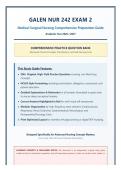
GALEN NUR 242 EXAM 2
Medical-Surgical Nursing Comprehensive Preparation Guide
Academic Year
COMPREHENSIVE PRACTICE QUESTION BANK
Advanced Clinical Concepts, Prioritization, and Safe Nursing Care
This Study Guide Features:
200+ Original, High-Yield Practice Questions covering core Med-Surg
concepts.
NCLEX-Style Formatting including prioritization, delegation, assessment, and
patient education.
Detailed Explanations & Rationales for all answers (formatted in green text)
to ensure deep conceptual mastery.
Correct Answers Highlighted in Red for swift visual self-assessment.
Modular Organization by high-frequency exam domains (Cardiovascular,
Respiratory, Renal, Endocrine, Gastrointestinal, Neurological, and
Perioperative/Oncology Care).
Print-Optimized Layout for seamless A4 page printing or digital PDF studying.
Designed Specifically for Advanced Nursing Concept Mastery
Focus Area: NUR 242 Second Modular Examination
ACADEMIC INTEGRITY & DISCLAIMER NOTICE: This document is an independent, original study guide
created strictly for educational preparation and self-assessment purposes. It does not contain actual, leaked, or
,proprietary test questions from any academic institution or licensing body. All scenario stems, options, and
rationales are originally written to align with current evidence-based medical-surgical nursing standards.
,NUR 242 MED-SURG EXAM 2 STUDY GUIDE ACADEMIC EDITION
TABLE OF CONTENTS
Module 1: Advanced Cardiovascular Concepts & Hemodynamics Questions 1 – 35
Module 2: Advanced Respiratory & Critical Oxygenation Questions 36 – 70
Module 3: Complex Renal, Fluid, & Electrolyte Management Questions 71 – 105
Module 4: Endocrine Disorders & Metabolic Crises Questions 106 – 140
Module 5: Gastrointestinal, Hepatic, & Nutritional Disorders Questions 141 – 170
Module 6: Neurological, Musculoskeletal, & Trauma Nursing Questions 171 – 200
MODULE 1: ADVANCED CARDIOVASCULAR CONCEPTS &
HEMODYNAMICS
CORONARY ARTERY DISEASE, HEART FAILURE, DYSRHYTHMIAS, & VASCULAR DISORDERS
, Question 1
A nurse is caring for a patient admitted with acute decompensated heart failure who is
receiving intravenous furosemide. Which assessment finding requires immediate nursing
intervention?
A. Blood pressure change from 128/82 mmHg to 118/76 mmHg.
B. Serum potassium level of 2.9 mEq/L.
C. Urine output of 180 mL over the past 4 hours.
D. Presence of 2+ pitting bilateral lower extremity edema.
Correct Answer: B
Rationale: Loop diuretics like furosemide cause significant hypokalemia. A potassium level of 2.9 mEq/L
is critically low and places the patient at high risk for lethal ventricular dysrhythmias (e.g., VT, VF). The
nurse must immediately notify the provider to order potassium replacement. The BP drop is mild, urine
output is adequate (>30 mL/hr), and edema is expected in heart failure.
Question 2
A patient with a history of stable angina presents to the emergency room stating, "My chest
pain started while I was watching TV 30 minutes ago, and three nitroglycerin tablets under my
tongue haven't relieved it." How should the nurse interpret this statement?
A. The patient is experiencing a predictable manifestation of stable angina.
B. The nitroglycerin tablets have likely expired and need replacement.
C. The symptoms indicate a transition to unstable angina or an acute coronary syndrome.
D. The pain is non-cardiac in origin since it occurred while resting.
Correct Answer: C
Rationale: Stable angina occurs with exertion and is relieved by rest or nitroglycerin. Pain that occurs at
rest, lasts longer than 15 minutes, or is unresponsive to three sublingual nitroglycerin doses
administered 5 minutes apart indicates unstable angina or Myocardial Infarction (ACS), requiring
immediate emergency protocol initiation.
Medical-Surgical Nursing Comprehensive Preparation Guide
Academic Year
COMPREHENSIVE PRACTICE QUESTION BANK
Advanced Clinical Concepts, Prioritization, and Safe Nursing Care
This Study Guide Features:
200+ Original, High-Yield Practice Questions covering core Med-Surg
concepts.
NCLEX-Style Formatting including prioritization, delegation, assessment, and
patient education.
Detailed Explanations & Rationales for all answers (formatted in green text)
to ensure deep conceptual mastery.
Correct Answers Highlighted in Red for swift visual self-assessment.
Modular Organization by high-frequency exam domains (Cardiovascular,
Respiratory, Renal, Endocrine, Gastrointestinal, Neurological, and
Perioperative/Oncology Care).
Print-Optimized Layout for seamless A4 page printing or digital PDF studying.
Designed Specifically for Advanced Nursing Concept Mastery
Focus Area: NUR 242 Second Modular Examination
ACADEMIC INTEGRITY & DISCLAIMER NOTICE: This document is an independent, original study guide
created strictly for educational preparation and self-assessment purposes. It does not contain actual, leaked, or
,proprietary test questions from any academic institution or licensing body. All scenario stems, options, and
rationales are originally written to align with current evidence-based medical-surgical nursing standards.
,NUR 242 MED-SURG EXAM 2 STUDY GUIDE ACADEMIC EDITION
TABLE OF CONTENTS
Module 1: Advanced Cardiovascular Concepts & Hemodynamics Questions 1 – 35
Module 2: Advanced Respiratory & Critical Oxygenation Questions 36 – 70
Module 3: Complex Renal, Fluid, & Electrolyte Management Questions 71 – 105
Module 4: Endocrine Disorders & Metabolic Crises Questions 106 – 140
Module 5: Gastrointestinal, Hepatic, & Nutritional Disorders Questions 141 – 170
Module 6: Neurological, Musculoskeletal, & Trauma Nursing Questions 171 – 200
MODULE 1: ADVANCED CARDIOVASCULAR CONCEPTS &
HEMODYNAMICS
CORONARY ARTERY DISEASE, HEART FAILURE, DYSRHYTHMIAS, & VASCULAR DISORDERS
, Question 1
A nurse is caring for a patient admitted with acute decompensated heart failure who is
receiving intravenous furosemide. Which assessment finding requires immediate nursing
intervention?
A. Blood pressure change from 128/82 mmHg to 118/76 mmHg.
B. Serum potassium level of 2.9 mEq/L.
C. Urine output of 180 mL over the past 4 hours.
D. Presence of 2+ pitting bilateral lower extremity edema.
Correct Answer: B
Rationale: Loop diuretics like furosemide cause significant hypokalemia. A potassium level of 2.9 mEq/L
is critically low and places the patient at high risk for lethal ventricular dysrhythmias (e.g., VT, VF). The
nurse must immediately notify the provider to order potassium replacement. The BP drop is mild, urine
output is adequate (>30 mL/hr), and edema is expected in heart failure.
Question 2
A patient with a history of stable angina presents to the emergency room stating, "My chest
pain started while I was watching TV 30 minutes ago, and three nitroglycerin tablets under my
tongue haven't relieved it." How should the nurse interpret this statement?
A. The patient is experiencing a predictable manifestation of stable angina.
B. The nitroglycerin tablets have likely expired and need replacement.
C. The symptoms indicate a transition to unstable angina or an acute coronary syndrome.
D. The pain is non-cardiac in origin since it occurred while resting.
Correct Answer: C
Rationale: Stable angina occurs with exertion and is relieved by rest or nitroglycerin. Pain that occurs at
rest, lasts longer than 15 minutes, or is unresponsive to three sublingual nitroglycerin doses
administered 5 minutes apart indicates unstable angina or Myocardial Infarction (ACS), requiring
immediate emergency protocol initiation.


