

SEMMELWEIS UNIVERSITY
Faculty of Medicine | Budapest, Hungary
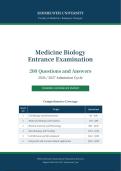
Medicine Biology
Entrance Examination
200 Questions and Answers
Admission Cycle
VERIFIED ANSWERS BY EXPERT
Comprehensive Coverage
Secti
Topic Questions
on
1 Cell Biology and Biochemistry Q1 - Q40
2 Molecular Biology and Genetics Q41 - Q80
3 Human Anatomy and Physiology Q81 - Q130
4 Microbiology and Virology Q131 - Q160
5 Cell Division and Development Q161 - Q180
6 Integrated and Scenario-Based Application Q181 - Q200
Official Entrance Examination Preparation Resource
Aligned with 2026-2027 Admission Cycle
, SEMMELWEIS UNIVERSITY
Faculty of Medicine | Budapest, Hungary
Exam Structure: 20 questions per test | 20-minute time limit | 1 point per correct answer |
Fractional negative scoring for incorrect responses.
Format: Multiple choice with exactly one correct answer (A-D).
Cognitive Distribution: 30% recall | 50% application | 20% analysis.
Reference Texts: Solomon Biology, Lodish Molecular Cell Biology.
Official Entrance Examination Preparation Resource
Aligned with 2026-2027 Admission Cycle
, SEMMELWEIS UNIVERSITY
Faculty of Medicine | Budapest, Hungary
Semmelweis Entrance Exam Medicine Biology Questions
and Answers
Verified Answers by Expert | Comprehensive Practice Resource
Instructions to Candidates: Each question has exactly one correct answer (A-D). The Semmelweis
University entrance examination comprises 20 questions per test with a 20-minute time limit, with
1 point awarded per correct answer and fractional negative scoring applied to incorrect responses.
The cognitive distribution across this practice resource is calibrated to the official exam: 30%
recall, 50% application, and 20% analysis. Detailed rationales explain the correct choice and
clarify why distractors are incorrect, integrating cell biology, genetics, physiology, and
biochemical principles required for medical studies.
SECTION 1: Cell Biology and Biochemistry (Organelles,
Membrane Transport, Macromolecules, Metabolism &
Enzymes) - Q1-Q40
Q1. A researcher examines a pancreatic acinar cell under an electron microscope and notes an
absence of membrane-bound organelles, presence of 70S ribosomes, and a single circular
chromosome. Which conclusion is most consistent with these observations?
A. The cell is a eukaryotic secretory cell with aberrant ribosomes.
B. The cell is prokaryotic and the description is inconsistent with a pancreatic acinar
cell. [CORRECT]
C. The cell is a eukaryote undergoing apoptosis with degraded organelles.
D. The cell is a specialized eukaryotic endocrine cell adapted for protein export.
Correct Answer: B
Rationale: Pancreatic acinar cells are eukaryotic and possess membrane-bound organelles (RER,
Golgi, mitochondria) and 80S ribosomes. The described features (no membrane-bound organelles,
70S ribosomes, circular chromosome) are diagnostic of prokaryotes such as E. coli, so the
description is inconsistent with a pancreatic acinar cell. The other options incorrectly assign
eukaryotic identity to prokaryotic features.
Official Entrance Examination Preparation Resource
Aligned with 2026-2027 Admission Cycle
, Semmelweis University Entrance Examination - Medicine Biology 2026/2027 Verified Expert Answers
Q2. A cell contains a well-developed rough endoplasmic reticulum, prominent Golgi
apparatus, and numerous secretory vesicles. Which functional specialization is most likely
for this cell?
A. Steroid hormone synthesis in the adrenal cortex
B. Storage of glycogen in hepatocytes
C. Production and export of digestive enzymes (e.g., trypsinogen) by pancreatic
acinar cells [CORRECT]
D. Phagocytosis of bacteria by macrophages
Correct Answer: C
Rationale: A prominent RER, Golgi, and secretory vesicles characterize cells specialized for
protein secretion. Pancreatic acinar cells synthesize zymogens such as trypsinogen and
chymotrypsinogen, processing them through RER, Golgi, and condensing vacuoles. Steroid
synthesis uses SER (not RER); glycogen storage does not require secretory machinery;
phagocytosis involves lysosomes, not secretory vesicles.
Q3. Which cellular organelle is the primary site of ATP synthesis via oxidative
phosphorylation in a eukaryotic hepatocyte?
A. Rough endoplasmic reticulum
B. Mitochondrial inner membrane (cristae) [CORRECT]
C. Cytosolic ribosomes
D. Peroxisomal matrix
Correct Answer: B
Rationale: Oxidative phosphorylation occurs at the inner mitochondrial membrane, where
electron transport chain complexes pump protons into the intermembrane space and ATP
synthase harnesses the proton gradient to phosphorylate ADP. The RER synthesizes proteins,
cytosolic ribosomes perform translation, and peroxisomes catalyze fatty acid beta-oxidation and
H2O2 metabolism but do not produce the bulk of cellular ATP.
Q4. A patient inherits a defect in the lysosomal enzyme alpha-L-iduronidase, causing
accumulation of glycosaminoglycans within cells. This disorder (Hurler syndrome) most
directly illustrates which organelle function?
A. Intracellular digestion by hydrolytic enzymes within an acidic compartment
[CORRECT]
B. Oxidative phosphorylation within cristae
C. Protein synthesis on membrane-attached ribosomes
D. Lipid synthesis and detoxification
Correct Answer: A
Rationale: Lysosomes contain acid hydrolases that digest macromolecules in an acidic lumen (pH
~4.5-5.0 maintained by a proton pump). Deficiency of alpha-L-iduronidase causes
glycosaminoglycan accumulation because lysosomal digestion fails. The other options describe
functions of mitochondria, RER, and SER respectively, none of which involve hydrolytic
degradation in an acidic compartment.
Semmelweis University | Faculty of Medicine Page 4
Faculty of Medicine | Budapest, Hungary
Medicine Biology
Entrance Examination
200 Questions and Answers
Admission Cycle
VERIFIED ANSWERS BY EXPERT
Comprehensive Coverage
Secti
Topic Questions
on
1 Cell Biology and Biochemistry Q1 - Q40
2 Molecular Biology and Genetics Q41 - Q80
3 Human Anatomy and Physiology Q81 - Q130
4 Microbiology and Virology Q131 - Q160
5 Cell Division and Development Q161 - Q180
6 Integrated and Scenario-Based Application Q181 - Q200
Official Entrance Examination Preparation Resource
Aligned with 2026-2027 Admission Cycle
, SEMMELWEIS UNIVERSITY
Faculty of Medicine | Budapest, Hungary
Exam Structure: 20 questions per test | 20-minute time limit | 1 point per correct answer |
Fractional negative scoring for incorrect responses.
Format: Multiple choice with exactly one correct answer (A-D).
Cognitive Distribution: 30% recall | 50% application | 20% analysis.
Reference Texts: Solomon Biology, Lodish Molecular Cell Biology.
Official Entrance Examination Preparation Resource
Aligned with 2026-2027 Admission Cycle
, SEMMELWEIS UNIVERSITY
Faculty of Medicine | Budapest, Hungary
Semmelweis Entrance Exam Medicine Biology Questions
and Answers
Verified Answers by Expert | Comprehensive Practice Resource
Instructions to Candidates: Each question has exactly one correct answer (A-D). The Semmelweis
University entrance examination comprises 20 questions per test with a 20-minute time limit, with
1 point awarded per correct answer and fractional negative scoring applied to incorrect responses.
The cognitive distribution across this practice resource is calibrated to the official exam: 30%
recall, 50% application, and 20% analysis. Detailed rationales explain the correct choice and
clarify why distractors are incorrect, integrating cell biology, genetics, physiology, and
biochemical principles required for medical studies.
SECTION 1: Cell Biology and Biochemistry (Organelles,
Membrane Transport, Macromolecules, Metabolism &
Enzymes) - Q1-Q40
Q1. A researcher examines a pancreatic acinar cell under an electron microscope and notes an
absence of membrane-bound organelles, presence of 70S ribosomes, and a single circular
chromosome. Which conclusion is most consistent with these observations?
A. The cell is a eukaryotic secretory cell with aberrant ribosomes.
B. The cell is prokaryotic and the description is inconsistent with a pancreatic acinar
cell. [CORRECT]
C. The cell is a eukaryote undergoing apoptosis with degraded organelles.
D. The cell is a specialized eukaryotic endocrine cell adapted for protein export.
Correct Answer: B
Rationale: Pancreatic acinar cells are eukaryotic and possess membrane-bound organelles (RER,
Golgi, mitochondria) and 80S ribosomes. The described features (no membrane-bound organelles,
70S ribosomes, circular chromosome) are diagnostic of prokaryotes such as E. coli, so the
description is inconsistent with a pancreatic acinar cell. The other options incorrectly assign
eukaryotic identity to prokaryotic features.
Official Entrance Examination Preparation Resource
Aligned with 2026-2027 Admission Cycle
, Semmelweis University Entrance Examination - Medicine Biology 2026/2027 Verified Expert Answers
Q2. A cell contains a well-developed rough endoplasmic reticulum, prominent Golgi
apparatus, and numerous secretory vesicles. Which functional specialization is most likely
for this cell?
A. Steroid hormone synthesis in the adrenal cortex
B. Storage of glycogen in hepatocytes
C. Production and export of digestive enzymes (e.g., trypsinogen) by pancreatic
acinar cells [CORRECT]
D. Phagocytosis of bacteria by macrophages
Correct Answer: C
Rationale: A prominent RER, Golgi, and secretory vesicles characterize cells specialized for
protein secretion. Pancreatic acinar cells synthesize zymogens such as trypsinogen and
chymotrypsinogen, processing them through RER, Golgi, and condensing vacuoles. Steroid
synthesis uses SER (not RER); glycogen storage does not require secretory machinery;
phagocytosis involves lysosomes, not secretory vesicles.
Q3. Which cellular organelle is the primary site of ATP synthesis via oxidative
phosphorylation in a eukaryotic hepatocyte?
A. Rough endoplasmic reticulum
B. Mitochondrial inner membrane (cristae) [CORRECT]
C. Cytosolic ribosomes
D. Peroxisomal matrix
Correct Answer: B
Rationale: Oxidative phosphorylation occurs at the inner mitochondrial membrane, where
electron transport chain complexes pump protons into the intermembrane space and ATP
synthase harnesses the proton gradient to phosphorylate ADP. The RER synthesizes proteins,
cytosolic ribosomes perform translation, and peroxisomes catalyze fatty acid beta-oxidation and
H2O2 metabolism but do not produce the bulk of cellular ATP.
Q4. A patient inherits a defect in the lysosomal enzyme alpha-L-iduronidase, causing
accumulation of glycosaminoglycans within cells. This disorder (Hurler syndrome) most
directly illustrates which organelle function?
A. Intracellular digestion by hydrolytic enzymes within an acidic compartment
[CORRECT]
B. Oxidative phosphorylation within cristae
C. Protein synthesis on membrane-attached ribosomes
D. Lipid synthesis and detoxification
Correct Answer: A
Rationale: Lysosomes contain acid hydrolases that digest macromolecules in an acidic lumen (pH
~4.5-5.0 maintained by a proton pump). Deficiency of alpha-L-iduronidase causes
glycosaminoglycan accumulation because lysosomal digestion fails. The other options describe
functions of mitochondria, RER, and SER respectively, none of which involve hydrolytic
degradation in an acidic compartment.
Semmelweis University | Faculty of Medicine Page 4


