
2026/2027
,2026/2027
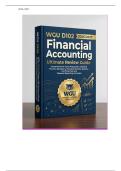
WGU D102 Financial Accounting
2026/2027 All-Inclusive Certification
Study Guide: Extensive Practice
Questions, Complete Test Bank
Review, Detailed Knowledge
Assessment, and Final Exam Prep
Manual
Question 15:
Question 1
Which transaction should be classified as an operating cash flow?
A. Cash received from issuing common stock
B. Cash paid to purchase land
C. Cash received from customers for services
D. Cash received from selling equipment
Correct Answer: C. Cash received from customers for services
Rationale: Operating activities include cash flows arising from the company’s
primary revenue-producing activities, such as collecting cash from customers. Issuing
common stock is a financing activity, while purchasing land and selling equipment are
investing activities because they involve long-term assets.
Question 2
A company reports total assets of $285,000 and stockholders’ equity of $174,000.
Based on the accounting equation, what amount should be reported as total liabilities?
A. $174,000
B. $459,000
C. $111,000
D. $285,000
Correct Answer: C. $111,000
Rationale: The accounting equation is:
,2026/2027
Assets = Liabilities + Stockholders’ Equity
Therefore:
Liabilities = Assets − Stockholders’ Equity
$285,000 − $174,000 = $111,000.
Question 3
Which presentation is characteristic of a single-step income statement?
A. Only cash revenues and cash expenses are reported.
B. Revenues are grouped together, expenses are grouped together, and total expenses
are subtracted from total revenues.
C. Gross profit, operating income, and income before taxes must each be separately
calculated.
D. Cost of goods sold is reported as a deduction from assets.
Correct Answer: B. Revenues are grouped together, expenses are grouped
together, and total expenses are subtracted from total revenues.
Rationale: A single-step income statement combines all revenues into one total and all
expenses into another total. Total expenses are then subtracted from total revenues to
determine net income. A multiple-step statement separately reports measures such as
gross profit and operating income.
Question 4
A manufacturing company owns raw materials, production machinery, office furniture,
and finished products awaiting sale. Which items should be classified as inventory?
A. Office furniture and finished products
B. Raw materials and production machinery
C. Production machinery and office furniture
D. Raw materials and finished products
Correct Answer: D. Raw materials and finished products
Rationale: Inventory includes goods held for sale and materials that will be used to
produce goods for sale. Therefore, raw materials and finished products are classified
as inventory. Production machinery and office furniture are long-term operating assets.
, 2026/2027
Question 5
A corporation reports net income of $360,000 and has 120,000 common shares
outstanding throughout the year. What is its earnings per share?
A. $3.00
B. $0.33
C. $4.80
D. $2.00
Correct Answer: A. $3.00
Rationale: Basic earnings per share is calculated as:
Earnings per Share = Net Income ÷ Common Shares Outstanding
$360,000 ÷ 120,000 = $3.00 per share.
Question 6
A company’s normal operating cycle is 15 months. Which obligation would generally
be classified as a current liability?
A. A mortgage payable due in 10 years
B. An account payable expected to be paid in 12 months
C. A bond payable due in five years
D. A note payable due in 20 months
Correct Answer: B. An account payable expected to be paid in 12 months
Rationale: A current liability is generally expected to be settled within one year or the
company’s normal operating cycle, whichever is longer. Since the operating cycle is
15 months, an account payable due within 12 months qualifies as a current liability.
The other obligations extend beyond the operating cycle.
Question 7
A retailer reports net sales of $760,000 and cost of goods sold of $470,000. What is the
retailer’s gross profit?
A. $760,000
B. $1,230,000
C. $290,000
D. $470,000
,2026/2027
WGU D102 Financial Accounting
2026/2027 All-Inclusive Certification
Study Guide: Extensive Practice
Questions, Complete Test Bank
Review, Detailed Knowledge
Assessment, and Final Exam Prep
Manual
Question 15:
Question 1
Which transaction should be classified as an operating cash flow?
A. Cash received from issuing common stock
B. Cash paid to purchase land
C. Cash received from customers for services
D. Cash received from selling equipment
Correct Answer: C. Cash received from customers for services
Rationale: Operating activities include cash flows arising from the company’s
primary revenue-producing activities, such as collecting cash from customers. Issuing
common stock is a financing activity, while purchasing land and selling equipment are
investing activities because they involve long-term assets.
Question 2
A company reports total assets of $285,000 and stockholders’ equity of $174,000.
Based on the accounting equation, what amount should be reported as total liabilities?
A. $174,000
B. $459,000
C. $111,000
D. $285,000
Correct Answer: C. $111,000
Rationale: The accounting equation is:
,2026/2027
Assets = Liabilities + Stockholders’ Equity
Therefore:
Liabilities = Assets − Stockholders’ Equity
$285,000 − $174,000 = $111,000.
Question 3
Which presentation is characteristic of a single-step income statement?
A. Only cash revenues and cash expenses are reported.
B. Revenues are grouped together, expenses are grouped together, and total expenses
are subtracted from total revenues.
C. Gross profit, operating income, and income before taxes must each be separately
calculated.
D. Cost of goods sold is reported as a deduction from assets.
Correct Answer: B. Revenues are grouped together, expenses are grouped
together, and total expenses are subtracted from total revenues.
Rationale: A single-step income statement combines all revenues into one total and all
expenses into another total. Total expenses are then subtracted from total revenues to
determine net income. A multiple-step statement separately reports measures such as
gross profit and operating income.
Question 4
A manufacturing company owns raw materials, production machinery, office furniture,
and finished products awaiting sale. Which items should be classified as inventory?
A. Office furniture and finished products
B. Raw materials and production machinery
C. Production machinery and office furniture
D. Raw materials and finished products
Correct Answer: D. Raw materials and finished products
Rationale: Inventory includes goods held for sale and materials that will be used to
produce goods for sale. Therefore, raw materials and finished products are classified
as inventory. Production machinery and office furniture are long-term operating assets.
, 2026/2027
Question 5
A corporation reports net income of $360,000 and has 120,000 common shares
outstanding throughout the year. What is its earnings per share?
A. $3.00
B. $0.33
C. $4.80
D. $2.00
Correct Answer: A. $3.00
Rationale: Basic earnings per share is calculated as:
Earnings per Share = Net Income ÷ Common Shares Outstanding
$360,000 ÷ 120,000 = $3.00 per share.
Question 6
A company’s normal operating cycle is 15 months. Which obligation would generally
be classified as a current liability?
A. A mortgage payable due in 10 years
B. An account payable expected to be paid in 12 months
C. A bond payable due in five years
D. A note payable due in 20 months
Correct Answer: B. An account payable expected to be paid in 12 months
Rationale: A current liability is generally expected to be settled within one year or the
company’s normal operating cycle, whichever is longer. Since the operating cycle is
15 months, an account payable due within 12 months qualifies as a current liability.
The other obligations extend beyond the operating cycle.
Question 7
A retailer reports net sales of $760,000 and cost of goods sold of $470,000. What is the
retailer’s gross profit?
A. $760,000
B. $1,230,000
C. $290,000
D. $470,000


