

2026/2027
,2026/2027
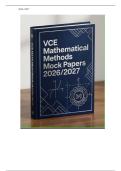
VCE Mathematical Methods Mock
Papers Comprehensive Knowledge
Assessment and Review Guide:
Advanced Test Bank, Detailed
Practice Questions, Final Exam
Preparation, and Complete Study
Companion
Question 1:
Question 1
Which activity most effectively develops subitizing in young children?
A. Asking children to count 18 randomly arranged counters one at a time
B. Briefly displaying dot patterns of three to five objects and asking children how
many they saw
C. Requiring children to write numerals from 1 through 20 repeatedly
D. Teaching children to use a calculator for small sums
Correct Answer: B. Briefly displaying dot patterns of three to five objects and
asking children how many they saw
Rationale: Subitizing is the ability to recognize a small quantity immediately without
counting each object individually. Briefly displaying dice-like patterns, domino
arrangements, or other organized dot patterns helps children recognize quantities
visually and develop number sense. Counting large random collections and writing
numerals do not directly develop subitizing.
Question 2
A fourth-grade student begins solving a multistep word problem but stops after the
first attempt fails. Which teacher response best supports the mathematical practice of
making sense of problems and persevering in solving them?
A. Tell the student which operation to perform first
B. Ask the student to restate the problem, represent it with a drawing, and consider
another approach
,2026/2027
C. Replace the problem with several single-step computation exercises
D. Demonstrate the complete solution and ask the student to copy it
Correct Answer: B. Ask the student to restate the problem, represent it with a
drawing, and consider another approach
Rationale: Making sense of a problem requires students to identify known
information, determine what is being asked, select useful representations, and revise
their strategies when necessary. Asking the student to restate and represent the
problem encourages independence and perseverance. Providing the operation or
complete solution removes the opportunity for productive struggle.
Question 3
Which student response best demonstrates attending to precision?
A. “The answer is about 12.”
B. “The rectangle’s area is 12 because I multiplied.”
C. “The rectangle has an area of 12 square centimeters because (4\text{
cm}\times3\text{ cm}=12\text{ cm}^2).”
D. “The rectangle is 12 centimeters squared around the outside.”
Correct Answer: C. “The rectangle has an area of 12 square centimeters because
(4\text{ cm}\times3\text{ cm}=12\text{ cm}^2).”
Rationale: Attending to precision includes using correct mathematical vocabulary,
showing appropriate calculations, and stating the correct units. The response
correctly identifies area and uses square centimeters. The other choices are vague,
omit units, or confuse area with perimeter.
Question 4
Students are analyzing a situation in which five notebooks cost $17.50. Which
student action best demonstrates reasoning abstractly and quantitatively?
A. Copying the numbers into a calculator without interpreting them
B. Drawing five notebooks but performing no calculation
C. Representing the situation as (17.50\div5) and explaining that the quotient
represents dollars per notebook
D. Memorizing that division is used whenever the word “each” appears
Correct Answer: C. Representing the situation as (17.50\div5) and explaining
that the quotient represents dollars per notebook
, 2026/2027
Rationale: Abstract and quantitative reasoning requires students to move between a
real-world situation and mathematical representations while preserving the meaning
of the quantities and units. The expression models the situation, and the explanation
gives meaning to the quotient. Calculator use without interpretation and reliance on
keywords do not demonstrate meaningful reasoning.
Question 5
A class is investigating whether the relationship between a circle’s circumference and
diameter is constant. Which tool-selection plan is most strategic?
A. Use only mental computation because tools interfere with mathematical thinking
B. Measure several circular objects with string and rulers, record the ratios, and use
technology to compare the results
C. Use a calculator before collecting any measurements
D. Measure one circle and assume the same result applies to all circles
Correct Answer: B. Measure several circular objects with string and rulers,
record the ratios, and use technology to compare the results
Rationale: Strategic tool use means choosing tools that support the mathematical
purpose. String and rulers allow students to collect measurements, while calculators
or spreadsheets can help compare ratios efficiently. Technology should support rather
than replace mathematical reasoning. Measuring only one circle does not provide
enough evidence for a general conclusion.
Question 6
A student claims that multiplying any number by 10 simply requires “adding a zero.”
Which teacher question would best help classmates critique this reasoning?
A. “Can someone repeat the rule more loudly?”
B. “Does the rule work for (3.6\times10)? Explain using place value.”
C. “What is the product of (7\times10)?”
D. “Can everyone memorize the statement before tomorrow?”
Correct Answer: B. “Does the rule work for (3.6\times10)? Explain using place
value.”
Rationale: Critiquing reasoning requires students to examine assumptions, test
claims, and use examples or counterexamples. The decimal example shows that
multiplying by 10 shifts the place value of the digits rather than simply adding a zero.
Repetition and memorization do not help students evaluate the validity of the claim.
,2026/2027
VCE Mathematical Methods Mock
Papers Comprehensive Knowledge
Assessment and Review Guide:
Advanced Test Bank, Detailed
Practice Questions, Final Exam
Preparation, and Complete Study
Companion
Question 1:
Question 1
Which activity most effectively develops subitizing in young children?
A. Asking children to count 18 randomly arranged counters one at a time
B. Briefly displaying dot patterns of three to five objects and asking children how
many they saw
C. Requiring children to write numerals from 1 through 20 repeatedly
D. Teaching children to use a calculator for small sums
Correct Answer: B. Briefly displaying dot patterns of three to five objects and
asking children how many they saw
Rationale: Subitizing is the ability to recognize a small quantity immediately without
counting each object individually. Briefly displaying dice-like patterns, domino
arrangements, or other organized dot patterns helps children recognize quantities
visually and develop number sense. Counting large random collections and writing
numerals do not directly develop subitizing.
Question 2
A fourth-grade student begins solving a multistep word problem but stops after the
first attempt fails. Which teacher response best supports the mathematical practice of
making sense of problems and persevering in solving them?
A. Tell the student which operation to perform first
B. Ask the student to restate the problem, represent it with a drawing, and consider
another approach
,2026/2027
C. Replace the problem with several single-step computation exercises
D. Demonstrate the complete solution and ask the student to copy it
Correct Answer: B. Ask the student to restate the problem, represent it with a
drawing, and consider another approach
Rationale: Making sense of a problem requires students to identify known
information, determine what is being asked, select useful representations, and revise
their strategies when necessary. Asking the student to restate and represent the
problem encourages independence and perseverance. Providing the operation or
complete solution removes the opportunity for productive struggle.
Question 3
Which student response best demonstrates attending to precision?
A. “The answer is about 12.”
B. “The rectangle’s area is 12 because I multiplied.”
C. “The rectangle has an area of 12 square centimeters because (4\text{
cm}\times3\text{ cm}=12\text{ cm}^2).”
D. “The rectangle is 12 centimeters squared around the outside.”
Correct Answer: C. “The rectangle has an area of 12 square centimeters because
(4\text{ cm}\times3\text{ cm}=12\text{ cm}^2).”
Rationale: Attending to precision includes using correct mathematical vocabulary,
showing appropriate calculations, and stating the correct units. The response
correctly identifies area and uses square centimeters. The other choices are vague,
omit units, or confuse area with perimeter.
Question 4
Students are analyzing a situation in which five notebooks cost $17.50. Which
student action best demonstrates reasoning abstractly and quantitatively?
A. Copying the numbers into a calculator without interpreting them
B. Drawing five notebooks but performing no calculation
C. Representing the situation as (17.50\div5) and explaining that the quotient
represents dollars per notebook
D. Memorizing that division is used whenever the word “each” appears
Correct Answer: C. Representing the situation as (17.50\div5) and explaining
that the quotient represents dollars per notebook
, 2026/2027
Rationale: Abstract and quantitative reasoning requires students to move between a
real-world situation and mathematical representations while preserving the meaning
of the quantities and units. The expression models the situation, and the explanation
gives meaning to the quotient. Calculator use without interpretation and reliance on
keywords do not demonstrate meaningful reasoning.
Question 5
A class is investigating whether the relationship between a circle’s circumference and
diameter is constant. Which tool-selection plan is most strategic?
A. Use only mental computation because tools interfere with mathematical thinking
B. Measure several circular objects with string and rulers, record the ratios, and use
technology to compare the results
C. Use a calculator before collecting any measurements
D. Measure one circle and assume the same result applies to all circles
Correct Answer: B. Measure several circular objects with string and rulers,
record the ratios, and use technology to compare the results
Rationale: Strategic tool use means choosing tools that support the mathematical
purpose. String and rulers allow students to collect measurements, while calculators
or spreadsheets can help compare ratios efficiently. Technology should support rather
than replace mathematical reasoning. Measuring only one circle does not provide
enough evidence for a general conclusion.
Question 6
A student claims that multiplying any number by 10 simply requires “adding a zero.”
Which teacher question would best help classmates critique this reasoning?
A. “Can someone repeat the rule more loudly?”
B. “Does the rule work for (3.6\times10)? Explain using place value.”
C. “What is the product of (7\times10)?”
D. “Can everyone memorize the statement before tomorrow?”
Correct Answer: B. “Does the rule work for (3.6\times10)? Explain using place
value.”
Rationale: Critiquing reasoning requires students to examine assumptions, test
claims, and use examples or counterexamples. The decimal example shows that
multiplying by 10 shifts the place value of the digits rather than simply adding a zero.
Repetition and memorization do not help students evaluate the validity of the claim.


