

VIRGINIA STATE INSPECTION TEST QUESTIONS & ANSWERS 2026-2027 | 1… EXAM
P R O F E S S I O N A L P R A C T I C E M AT E R I A L S
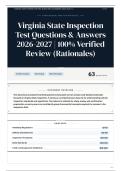
Virginia State Inspection
Test Questions & Answers
2026-2027 | 100% Verified
Review (Rationales)
Verified Answers Exam Ready With Rationales
63 QUESTIONS
DOCUMENT OVERVIEW
This document provides 63 verified questions along with correct answers and detailed rationales
focused on Virginia State Inspection. It serves as a comprehensive resource for understanding vehicle
inspection standards and regulations. The material is suitable for study, review, and certification
preparation, ensuring users can confidently grasp the essential concepts required for success in the
inspection field.
CONTENTS
Headlamp Regulations Q1–Q1
Offense Classifications Q2–Q11
Inspection Procedures Q12–Q21
Brake Standards Q22–Q41
Trailer and Suspension Guidelines Q42–Q63
Page 1
, E XA M Q U EST I O N S
Q1 QUESTION 1 OF 63
Headlamps: except motorcycles: True or false: Rejected if a headlamp visor is over two inches long
unless part of the original body design.
CORRECT ANSWER
True
RATIONALE
Headlamp visors exceeding two inches are considered modifications that can impair the original design and
effectiveness of the headlamp, thus failing to meet regulatory standards. This regulation ensures optimal
visibility and safety for motorcycle operation.
Q2 QUESTION 2 OF 63
How serious are Class I offenses?
CORRECT ANSWER
They are least serious
RATIONALE
Class I offenses represent minor violations with minimal penalties, typically involving infractions that do not
result in significant harm or threat to public safety. Understanding this classification helps differentiate
between varying levels of legal severity and their corresponding consequences.
Q3 QUESTION 3 OF 63
How serious are Class II offenses?
CORRECT ANSWER
They are very serious but are not a cause of accident or injury.
Page 2
, RATIONALE
Class II offenses represent significant violations that may lead to regulatory penalties or sanctions but do not
directly result in accidents or injuries, distinguishing them from more severe classifications. Understanding
this distinction is critical for effective risk management and compliance within regulatory frameworks.
Q4 QUESTION 4 OF 63
How serious are Class III offenses?
CORRECT ANSWER
They are more severe, are most critical from a safety viewpoint, and could cause a crash.
RATIONALE
Class III offenses significantly compromise safety by increasing the risk of accidents, as they often involve
behaviors that can lead to severe consequences on the road. Understanding the gravity of these violations is
essential for promoting safer driving practices and enforcing traffic laws effectively.
Q5 QUESTION 5 OF 63
How serious are Class IV offenses?
CORRECT ANSWER
They are violations most serious and are considered so important to the credibility integrity and of the
Inspection Program.
RATIONALE
Class IV offenses undermine the foundational integrity of the Inspection Program, posing significant risks to
public safety and trust. Their severity necessitates stringent enforcement and accountability to maintain the
program's credibility.
Q6 QUESTION 6 OF 63
What are disciplinary actions for Class I offenses?
CORRECT ANSWER
1st offense: Verbal counseling
2nd: Written reprimand
3rd: Suspension of 15 - 30 days
Offenses remain active for 24 months
Page 3
P R O F E S S I O N A L P R A C T I C E M AT E R I A L S
Virginia State Inspection
Test Questions & Answers
2026-2027 | 100% Verified
Review (Rationales)
Verified Answers Exam Ready With Rationales
63 QUESTIONS
DOCUMENT OVERVIEW
This document provides 63 verified questions along with correct answers and detailed rationales
focused on Virginia State Inspection. It serves as a comprehensive resource for understanding vehicle
inspection standards and regulations. The material is suitable for study, review, and certification
preparation, ensuring users can confidently grasp the essential concepts required for success in the
inspection field.
CONTENTS
Headlamp Regulations Q1–Q1
Offense Classifications Q2–Q11
Inspection Procedures Q12–Q21
Brake Standards Q22–Q41
Trailer and Suspension Guidelines Q42–Q63
Page 1
, E XA M Q U EST I O N S
Q1 QUESTION 1 OF 63
Headlamps: except motorcycles: True or false: Rejected if a headlamp visor is over two inches long
unless part of the original body design.
CORRECT ANSWER
True
RATIONALE
Headlamp visors exceeding two inches are considered modifications that can impair the original design and
effectiveness of the headlamp, thus failing to meet regulatory standards. This regulation ensures optimal
visibility and safety for motorcycle operation.
Q2 QUESTION 2 OF 63
How serious are Class I offenses?
CORRECT ANSWER
They are least serious
RATIONALE
Class I offenses represent minor violations with minimal penalties, typically involving infractions that do not
result in significant harm or threat to public safety. Understanding this classification helps differentiate
between varying levels of legal severity and their corresponding consequences.
Q3 QUESTION 3 OF 63
How serious are Class II offenses?
CORRECT ANSWER
They are very serious but are not a cause of accident or injury.
Page 2
, RATIONALE
Class II offenses represent significant violations that may lead to regulatory penalties or sanctions but do not
directly result in accidents or injuries, distinguishing them from more severe classifications. Understanding
this distinction is critical for effective risk management and compliance within regulatory frameworks.
Q4 QUESTION 4 OF 63
How serious are Class III offenses?
CORRECT ANSWER
They are more severe, are most critical from a safety viewpoint, and could cause a crash.
RATIONALE
Class III offenses significantly compromise safety by increasing the risk of accidents, as they often involve
behaviors that can lead to severe consequences on the road. Understanding the gravity of these violations is
essential for promoting safer driving practices and enforcing traffic laws effectively.
Q5 QUESTION 5 OF 63
How serious are Class IV offenses?
CORRECT ANSWER
They are violations most serious and are considered so important to the credibility integrity and of the
Inspection Program.
RATIONALE
Class IV offenses undermine the foundational integrity of the Inspection Program, posing significant risks to
public safety and trust. Their severity necessitates stringent enforcement and accountability to maintain the
program's credibility.
Q6 QUESTION 6 OF 63
What are disciplinary actions for Class I offenses?
CORRECT ANSWER
1st offense: Verbal counseling
2nd: Written reprimand
3rd: Suspension of 15 - 30 days
Offenses remain active for 24 months
Page 3


