
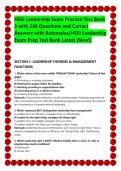
HESI Leadership Exam Practice Test Bank
3 with 240 Questions and Correct
Answers with Rationales/HESI Leadership
Exam Prep Test Bank Latest (New!)
SECTION 1: LEADERSHIP THEORIES & MANAGEMENT
FUNCTIONS
1. Which actions of the nurse exhibit TRANSACTIONAL leadership? (Select all that
apply)
A) Motivating or inspiring employees
B) Meeting the targets within the deadline
C) Working according to organizational rules
D) Correcting errors in a reactive manner
E) Increasing employee commitment
Rationale: Transactional leadership includes meeting targets, following organizational
rules, and correcting errors reactively. Motivating/inspiring and increasing commitment
are characteristics of transformational leadership.
2. Which statement BEST distinguishes leadership from management?
A) Leaders focus on efficiency; managers focus on effectiveness
B) Leaders do the right thing; managers do things right
C) Leaders focus on budgets; managers focus on vision
D) Leaders maintain the status quo; managers create change
Rationale: Leadership focuses on effectiveness and "doing the right thing" (vision),
whereas management focuses on efficiency and "doing things right" (maintaining
order).
3. Which leadership style is MOST effective initially when a unit is in crisis or
experiencing unsafe conditions?
A) Democratic
B) Laissez-faire
,C) Autocratic
D) Transformational
Rationale: During crises or unsafe situations, autocratic leadership allows for quick
decision-making and clear direction, essential for maintaining patient safety.
4. A nurse leader who uses individualized consideration to mentor staff and foster
innovation is demonstrating:
A) Transactional leadership
B) Transformational leadership
C) Laissez-faire leadership
D) Authoritarian leadership
Rationale: Transformational leadership is characterized by individualized consideration,
intellectual stimulation, inspirational motivation, and idealized influence.
5. A nurse demonstrates leadership by advocating for a patient's right to refuse
treatment. Which ethical principle is the nurse upholding?
A) Beneficence
B) Nonmaleficence
C) Autonomy
D) Justice
Rationale: Respecting a patient's right to make their own healthcare decisions,
including refusing treatment, upholds the ethical principle of autonomy.
6. Which characteristic is essential for effective nursing leadership?
A) Making all decisions independently
B) Avoiding conflict at all costs
C) Effective communication and conflict management
D) Maintaining strict hierarchical control
Rationale: Effective communication and conflict management are essential leadership
components that foster teamwork and positive patient outcomes.
7. A nurse leader who focuses on the "what" rather than the "how" of achieving
goals is demonstrating:
A) Management functions
B) Leadership functions
C) Administrative functions
D) Supervisory functions
Rationale: Leadership focuses on vision and direction (the "what"), while management
focuses on the "how" (efficiency).
, 8. Which statement about leadership and management is ACCURATE?
A) All managers are leaders
B) All leaders are managers
C) Leadership and management are the same
D) A person can be a leader without holding a management position
Rationale: Leadership is not dependent on formal position; anyone can demonstrate
leadership qualities regardless of their role or title.
9. A nurse manager counsels a UAP after arriving late for work for the third time
that week. This action is an example of:
A) Leadership
B) Management
C) Transformational leadership
D) Empowerment
Rationale: Counseling staff about performance issues and enforcing policies is a
management function focused on efficiency and compliance.
10. Which action BEST describes a nurse in a leadership role?
A) Delays admission until staff educates a patient
B) Spends time with a newly diagnosed cancer patient to allow communication of
future health concerns
C) Reevaluates staffing needs after an RN calls in sick
D) Counsels staff for attendance issues
Rationale: Spending time with a patient to address emotional and communication
needs demonstrates leadership through patient advocacy and holistic care.
11. The nurse manager notices high staff turnover on the unit. What is the FIRST
action to take?
A) Immediately hire new staff
B) Conduct exit interviews and assess the work environment
C) Ignore the issue as it is common in nursing
D) Blame the staff for leaving
Rationale: The first action is to assess the work environment and understand why staff
are leaving through exit interviews and data collection.
12. A nurse manager is reviewing the characteristics of an effective leader. Which
action demonstrates the use of "referent power"?
A) Rewarding staff with bonuses for meeting targets
B) Using position authority to enforce policies
C) Building trust and respect to influence staff
D) Threatening consequences for poor performance
3 with 240 Questions and Correct
Answers with Rationales/HESI Leadership
Exam Prep Test Bank Latest (New!)
SECTION 1: LEADERSHIP THEORIES & MANAGEMENT
FUNCTIONS
1. Which actions of the nurse exhibit TRANSACTIONAL leadership? (Select all that
apply)
A) Motivating or inspiring employees
B) Meeting the targets within the deadline
C) Working according to organizational rules
D) Correcting errors in a reactive manner
E) Increasing employee commitment
Rationale: Transactional leadership includes meeting targets, following organizational
rules, and correcting errors reactively. Motivating/inspiring and increasing commitment
are characteristics of transformational leadership.
2. Which statement BEST distinguishes leadership from management?
A) Leaders focus on efficiency; managers focus on effectiveness
B) Leaders do the right thing; managers do things right
C) Leaders focus on budgets; managers focus on vision
D) Leaders maintain the status quo; managers create change
Rationale: Leadership focuses on effectiveness and "doing the right thing" (vision),
whereas management focuses on efficiency and "doing things right" (maintaining
order).
3. Which leadership style is MOST effective initially when a unit is in crisis or
experiencing unsafe conditions?
A) Democratic
B) Laissez-faire
,C) Autocratic
D) Transformational
Rationale: During crises or unsafe situations, autocratic leadership allows for quick
decision-making and clear direction, essential for maintaining patient safety.
4. A nurse leader who uses individualized consideration to mentor staff and foster
innovation is demonstrating:
A) Transactional leadership
B) Transformational leadership
C) Laissez-faire leadership
D) Authoritarian leadership
Rationale: Transformational leadership is characterized by individualized consideration,
intellectual stimulation, inspirational motivation, and idealized influence.
5. A nurse demonstrates leadership by advocating for a patient's right to refuse
treatment. Which ethical principle is the nurse upholding?
A) Beneficence
B) Nonmaleficence
C) Autonomy
D) Justice
Rationale: Respecting a patient's right to make their own healthcare decisions,
including refusing treatment, upholds the ethical principle of autonomy.
6. Which characteristic is essential for effective nursing leadership?
A) Making all decisions independently
B) Avoiding conflict at all costs
C) Effective communication and conflict management
D) Maintaining strict hierarchical control
Rationale: Effective communication and conflict management are essential leadership
components that foster teamwork and positive patient outcomes.
7. A nurse leader who focuses on the "what" rather than the "how" of achieving
goals is demonstrating:
A) Management functions
B) Leadership functions
C) Administrative functions
D) Supervisory functions
Rationale: Leadership focuses on vision and direction (the "what"), while management
focuses on the "how" (efficiency).
, 8. Which statement about leadership and management is ACCURATE?
A) All managers are leaders
B) All leaders are managers
C) Leadership and management are the same
D) A person can be a leader without holding a management position
Rationale: Leadership is not dependent on formal position; anyone can demonstrate
leadership qualities regardless of their role or title.
9. A nurse manager counsels a UAP after arriving late for work for the third time
that week. This action is an example of:
A) Leadership
B) Management
C) Transformational leadership
D) Empowerment
Rationale: Counseling staff about performance issues and enforcing policies is a
management function focused on efficiency and compliance.
10. Which action BEST describes a nurse in a leadership role?
A) Delays admission until staff educates a patient
B) Spends time with a newly diagnosed cancer patient to allow communication of
future health concerns
C) Reevaluates staffing needs after an RN calls in sick
D) Counsels staff for attendance issues
Rationale: Spending time with a patient to address emotional and communication
needs demonstrates leadership through patient advocacy and holistic care.
11. The nurse manager notices high staff turnover on the unit. What is the FIRST
action to take?
A) Immediately hire new staff
B) Conduct exit interviews and assess the work environment
C) Ignore the issue as it is common in nursing
D) Blame the staff for leaving
Rationale: The first action is to assess the work environment and understand why staff
are leaving through exit interviews and data collection.
12. A nurse manager is reviewing the characteristics of an effective leader. Which
action demonstrates the use of "referent power"?
A) Rewarding staff with bonuses for meeting targets
B) Using position authority to enforce policies
C) Building trust and respect to influence staff
D) Threatening consequences for poor performance


