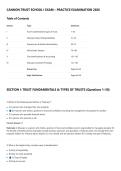
CANNON TRUST SCHOOL I EXAM – PRACTICE EXAMINATION 2026
Table of Contents
Section Topic Questions
I Trust Fundamentals & Types of Trusts 1–30
II Fiduciary Duties & Responsibilities 31–55
III Property Law & Estate Administration 56–75
IV Gift & Estate Taxation 76–100
V Trust Administration & Accounting 101–120
VI Fiduciary Investment Principles 121–130
Answer Key Pages 40–45
High-Yield Review Pages 46–50
SECTION I: TRUST FUNDAMENTALS & TYPES OF TRUSTS (Questions 1–30)
1. Which of the following best defines a "fiduciary"?
A) A person who manages their own property
🔵 B) A person who holds a position of trust and confidence involving the management of property for another
C) A person who provides financial advice
D) A person who executes a will
Correct Answer: B
Rationale: A fiduciary is a person who holds a position of trust and confidence and is responsible for managing property for
the benefit of another person. Examples include trustees, executors, and guardians. A fiduciary does not manage their own
property (Option A). Financial advice (Option C) is too broad, and an executor (Option D) is merely one type of fiduciary.
2. What is the highest duty a trustee owes to beneficiaries?
A) Duty of impartiality
B) Duty to invest prudently
🔵 C) Duty of loyalty
D) Duty to account
,Correct Answer: C
Rationale: The duty of loyalty requires the trustee to act solely in the beneficiaries' interests, avoiding self-dealing or
conflicts of interest. This is considered the highest fiduciary duty.
3. The duty to administer the trust in accordance with its terms is known as:
A) Duty of care
🔵 B) Duty to follow the trust instrument
C) Duty to account
D) Duty of impartiality
Correct Answer: B
Rationale: The trustee must administer the trust strictly in accordance with its terms as set forth in the trust instrument. The
trustee cannot deviate from the trust's provisions unless authorized by law or court order.
4. Under common law, a trust is presumed to be:
A) Revocable unless stated otherwise
🔵 B) Irrevocable unless the power to revoke is specifically reserved
C) Always revocable by the grantor
D) Voidable at the beneficiary's request
Correct Answer: B
Rationale: Common law presumes trusts are irrevocable; the grantor must expressly retain the power to revoke if they want
revocation rights.
5. A "testamentary trust" is created:
A) During the grantor's lifetime
🔵 B) By a provision in a will
C) By operation of law without a written document
D) Only for charitable purposes
Correct Answer: B
Rationale: A testamentary trust is established by the terms of a will and becomes effective upon the testator's death.
6. The "remainderman" of a trust is:
A) The person who creates the trust
B) The person entitled to receive income from the trust
🔵 C) The person entitled to the principal after the prior interest ends
D) The trustee who manages the trust
,Correct Answer: C
Rationale: The remainderman receives the remaining trust assets after the life estate or other preceding interest terminates.
7. Which of the following is a characteristic of a "life estate"?
A) It lasts forever and can be inherited
🔵 B) It is an interest that lasts only for the life of a designated person
C) It gives the holder the right to sell the property in fee simple
D) It cannot be transferred or assigned
Correct Answer: B
Rationale: A life estate grants the holder the right to use and enjoy property during their lifetime (or the life of another), but
it terminates upon death.
8. A trust that can accumulate income, distribute principal, or have charitable beneficiaries is called a:
A) Simple trust
🔵 B) Complex trust
C) Grantor trust
D) Revocable trust
Correct Answer: B
Rationale: A complex trust may accumulate income, distribute principal, and have charitable beneficiaries. A simple trust
must distribute all income and cannot distribute principal.
9. A simple trust is characterized by which of the following?
🔵 A) Mandatory distribution of all income to the beneficiary on an annual basis
B) Ability to accumulate income
C) Power to distribute principal
D) Charitable beneficiaries
Correct Answer: A
Rationale: A simple trust requires mandatory distribution of all income to the beneficiary on an annual basis. It does not
make distributions of principal and does not have charitable beneficiaries.
10. A "grantor trust" is one in which:
A) The trust is irrevocable
B) The beneficiaries are all charities
🔵 C) The grantor retains sufficient control or economic benefit that the trust is taxed to the grantor
D) The trust has no assets
, Correct Answer: C
Rationale: A grantor trust is one in which the grantor retains certain powers or interests that cause the trust's income to be
taxed to the grantor rather than to the trust or beneficiaries.
11. A "spendthrift trust" is designed to:
A) Maximize income distributions
🔵 B) Protect trust assets from the beneficiary's creditors
C) Minimize estate taxes
D) Avoid probate
Correct Answer: B
Rationale: A spendthrift trust contains provisions that restrict the beneficiary's ability to transfer or assign their interest in
the trust, thereby protecting the trust assets from the beneficiary's creditors.
12. Which of the following best describes an "irrevocable life insurance trust" (ILIT)?
A) A trust that holds life insurance policies for the benefit of the grantor
🔵 B) A trust designed to remove life insurance proceeds from the grantor's gross estate
C) A trust that pays income to the grantor for life
D) A trust that can be revoked at any time
Correct Answer: B
Rationale: An irrevocable life insurance trust (ILIT) removes policy proceeds from the grantor's estate if properly structured,
thereby reducing estate tax liability.
13. A "qualified domestic trust" (QDOT) is used to:
🔵 A) Defer estate tax on property passing to a non-citizen surviving spouse
B) Avoid generation-skipping tax
C) Qualify for the annual gift tax exclusion
D) Create a charitable trust
Correct Answer: A
Rationale: A QDOT allows the marital deduction for a surviving spouse who is not a U.S. citizen, with special rules to ensure
estate tax will be collected.
14. The "generation-skipping transfer (GST) tax" applies to:
A) Transfers to a spouse
🔵 B) Transfers to a person two or more generations below the transferor
C) All lifetime gifts regardless of amount
Table of Contents
Section Topic Questions
I Trust Fundamentals & Types of Trusts 1–30
II Fiduciary Duties & Responsibilities 31–55
III Property Law & Estate Administration 56–75
IV Gift & Estate Taxation 76–100
V Trust Administration & Accounting 101–120
VI Fiduciary Investment Principles 121–130
Answer Key Pages 40–45
High-Yield Review Pages 46–50
SECTION I: TRUST FUNDAMENTALS & TYPES OF TRUSTS (Questions 1–30)
1. Which of the following best defines a "fiduciary"?
A) A person who manages their own property
🔵 B) A person who holds a position of trust and confidence involving the management of property for another
C) A person who provides financial advice
D) A person who executes a will
Correct Answer: B
Rationale: A fiduciary is a person who holds a position of trust and confidence and is responsible for managing property for
the benefit of another person. Examples include trustees, executors, and guardians. A fiduciary does not manage their own
property (Option A). Financial advice (Option C) is too broad, and an executor (Option D) is merely one type of fiduciary.
2. What is the highest duty a trustee owes to beneficiaries?
A) Duty of impartiality
B) Duty to invest prudently
🔵 C) Duty of loyalty
D) Duty to account
,Correct Answer: C
Rationale: The duty of loyalty requires the trustee to act solely in the beneficiaries' interests, avoiding self-dealing or
conflicts of interest. This is considered the highest fiduciary duty.
3. The duty to administer the trust in accordance with its terms is known as:
A) Duty of care
🔵 B) Duty to follow the trust instrument
C) Duty to account
D) Duty of impartiality
Correct Answer: B
Rationale: The trustee must administer the trust strictly in accordance with its terms as set forth in the trust instrument. The
trustee cannot deviate from the trust's provisions unless authorized by law or court order.
4. Under common law, a trust is presumed to be:
A) Revocable unless stated otherwise
🔵 B) Irrevocable unless the power to revoke is specifically reserved
C) Always revocable by the grantor
D) Voidable at the beneficiary's request
Correct Answer: B
Rationale: Common law presumes trusts are irrevocable; the grantor must expressly retain the power to revoke if they want
revocation rights.
5. A "testamentary trust" is created:
A) During the grantor's lifetime
🔵 B) By a provision in a will
C) By operation of law without a written document
D) Only for charitable purposes
Correct Answer: B
Rationale: A testamentary trust is established by the terms of a will and becomes effective upon the testator's death.
6. The "remainderman" of a trust is:
A) The person who creates the trust
B) The person entitled to receive income from the trust
🔵 C) The person entitled to the principal after the prior interest ends
D) The trustee who manages the trust
,Correct Answer: C
Rationale: The remainderman receives the remaining trust assets after the life estate or other preceding interest terminates.
7. Which of the following is a characteristic of a "life estate"?
A) It lasts forever and can be inherited
🔵 B) It is an interest that lasts only for the life of a designated person
C) It gives the holder the right to sell the property in fee simple
D) It cannot be transferred or assigned
Correct Answer: B
Rationale: A life estate grants the holder the right to use and enjoy property during their lifetime (or the life of another), but
it terminates upon death.
8. A trust that can accumulate income, distribute principal, or have charitable beneficiaries is called a:
A) Simple trust
🔵 B) Complex trust
C) Grantor trust
D) Revocable trust
Correct Answer: B
Rationale: A complex trust may accumulate income, distribute principal, and have charitable beneficiaries. A simple trust
must distribute all income and cannot distribute principal.
9. A simple trust is characterized by which of the following?
🔵 A) Mandatory distribution of all income to the beneficiary on an annual basis
B) Ability to accumulate income
C) Power to distribute principal
D) Charitable beneficiaries
Correct Answer: A
Rationale: A simple trust requires mandatory distribution of all income to the beneficiary on an annual basis. It does not
make distributions of principal and does not have charitable beneficiaries.
10. A "grantor trust" is one in which:
A) The trust is irrevocable
B) The beneficiaries are all charities
🔵 C) The grantor retains sufficient control or economic benefit that the trust is taxed to the grantor
D) The trust has no assets
, Correct Answer: C
Rationale: A grantor trust is one in which the grantor retains certain powers or interests that cause the trust's income to be
taxed to the grantor rather than to the trust or beneficiaries.
11. A "spendthrift trust" is designed to:
A) Maximize income distributions
🔵 B) Protect trust assets from the beneficiary's creditors
C) Minimize estate taxes
D) Avoid probate
Correct Answer: B
Rationale: A spendthrift trust contains provisions that restrict the beneficiary's ability to transfer or assign their interest in
the trust, thereby protecting the trust assets from the beneficiary's creditors.
12. Which of the following best describes an "irrevocable life insurance trust" (ILIT)?
A) A trust that holds life insurance policies for the benefit of the grantor
🔵 B) A trust designed to remove life insurance proceeds from the grantor's gross estate
C) A trust that pays income to the grantor for life
D) A trust that can be revoked at any time
Correct Answer: B
Rationale: An irrevocable life insurance trust (ILIT) removes policy proceeds from the grantor's estate if properly structured,
thereby reducing estate tax liability.
13. A "qualified domestic trust" (QDOT) is used to:
🔵 A) Defer estate tax on property passing to a non-citizen surviving spouse
B) Avoid generation-skipping tax
C) Qualify for the annual gift tax exclusion
D) Create a charitable trust
Correct Answer: A
Rationale: A QDOT allows the marital deduction for a surviving spouse who is not a U.S. citizen, with special rules to ensure
estate tax will be collected.
14. The "generation-skipping transfer (GST) tax" applies to:
A) Transfers to a spouse
🔵 B) Transfers to a person two or more generations below the transferor
C) All lifetime gifts regardless of amount