

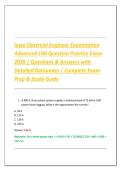
Iowa Electrical Engineer Examination
Advanced 100-Question Practice Exam
2026 | Questions & Answers with
Detailed Rationales | Complete Exam
Prep & Study Guide
1. A 480-V, three-phase system supplies a balanced load of 75 kW at 0.80
power factor lagging. What is the approximate line current?
A. 94 A
B. 113 A
C. 130 A
D. 156 A
Answer: 113 A
Rationale: For a three-phase load, I = P/(√3 V PF) = 75,000/(1.732 × 480 × 0.80) ≈
112.7 A.
, 2. A 13.8-kV generator has a subtransient reactance of 0.20 per unit and is
connected to an infinite bus. If the generator terminal voltage is 1.0 pu,
what is the initial symmetrical fault current in per unit for a three-phase
terminal fault?
A. 2.0 pu
B. 4.0 pu
C. 5.0 pu
D. 10 pu
Answer: 5.0 pu
Rationale: The initial fault current is approximately I = E/X"d = 1.0/0.20 = 5.0 pu.
3. A transformer has a rated primary voltage of 13.8 kV and secondary voltage
of 480 V. If the primary voltage rises to 14.49 kV while the transformer tap
remains unchanged, what is the approximate secondary voltage?
A. 456 V
B. 480 V
C. 504 V
D. 518 V
Answer: 504 V
Rationale: The secondary voltage changes proportionally. 14.49/13.8 = 1.05, so
480 × 1.05 = 504 V.
4. A 60-Hz, three-phase motor draws 45 A at 480 V and 0.85 power factor.
What is its approximate real input power?
A. 26.5 kW
B. 31.8 kW
,C. 35.9 kW
D. 44.1 kW
Answer: 31.8 kW
Rationale: P = √3VI PF = 1.732 × 480 × 45 × 0.85 ≈ 31.8 kW.
5. A balanced three-phase load has a line-to-line voltage of 480 V and is
connected in delta. If each phase impedance is 12 Ω, what is the
approximate line current?
A. 20 A
B. 28.9 A
C. 40 A
D. 69.3 A
Answer: 69.3 A
Rationale: Each delta branch has 480/12 = 40 A. For a balanced delta load, line
current = √3 × 40 ≈ 69.3 A.
6. A power factor correction capacitor is installed on an inductive load. What
is the primary purpose of the capacitor?
A. Increase system frequency
B. Reduce reactive power supplied by the source
C. Increase motor slip
D. Increase transformer impedance
Answer: Reduce reactive power supplied by the source
Rationale: Shunt capacitors provide leading reactive power locally, reducing the
reactive power and current that must be supplied by the utility.
, 7. A 1,000-kVA transformer has a 5% impedance on its nameplate. If
connected to a stiff source and subjected to a secondary short circuit, the
approximate symmetrical fault current in per unit of transformer rated
current is:
A. 5 pu
B. 10 pu
C. 20 pu
D. 50 pu
Answer: 20 pu
Rationale: Short-circuit current in per unit is approximately the reciprocal of
impedance: 1/0.05 = 20 pu.
8. In a symmetrical three-phase system, which sequence component
represents three phasors equal in magnitude and separated by 120° with
the normal phase rotation?
A. Zero sequence
B. Negative sequence
C. Positive sequence
D. Homopolar sequence
Answer: Positive sequence
Rationale: Positive-sequence components have equal magnitude and the same
phase rotation as the original balanced three-phase system.
9. A negative-sequence current in an induction motor is particularly
undesirable because it:
A. Produces no magnetic field
B. Produces a field rotating opposite the rotor direction
Advanced 100-Question Practice Exam
2026 | Questions & Answers with
Detailed Rationales | Complete Exam
Prep & Study Guide
1. A 480-V, three-phase system supplies a balanced load of 75 kW at 0.80
power factor lagging. What is the approximate line current?
A. 94 A
B. 113 A
C. 130 A
D. 156 A
Answer: 113 A
Rationale: For a three-phase load, I = P/(√3 V PF) = 75,000/(1.732 × 480 × 0.80) ≈
112.7 A.
, 2. A 13.8-kV generator has a subtransient reactance of 0.20 per unit and is
connected to an infinite bus. If the generator terminal voltage is 1.0 pu,
what is the initial symmetrical fault current in per unit for a three-phase
terminal fault?
A. 2.0 pu
B. 4.0 pu
C. 5.0 pu
D. 10 pu
Answer: 5.0 pu
Rationale: The initial fault current is approximately I = E/X"d = 1.0/0.20 = 5.0 pu.
3. A transformer has a rated primary voltage of 13.8 kV and secondary voltage
of 480 V. If the primary voltage rises to 14.49 kV while the transformer tap
remains unchanged, what is the approximate secondary voltage?
A. 456 V
B. 480 V
C. 504 V
D. 518 V
Answer: 504 V
Rationale: The secondary voltage changes proportionally. 14.49/13.8 = 1.05, so
480 × 1.05 = 504 V.
4. A 60-Hz, three-phase motor draws 45 A at 480 V and 0.85 power factor.
What is its approximate real input power?
A. 26.5 kW
B. 31.8 kW
,C. 35.9 kW
D. 44.1 kW
Answer: 31.8 kW
Rationale: P = √3VI PF = 1.732 × 480 × 45 × 0.85 ≈ 31.8 kW.
5. A balanced three-phase load has a line-to-line voltage of 480 V and is
connected in delta. If each phase impedance is 12 Ω, what is the
approximate line current?
A. 20 A
B. 28.9 A
C. 40 A
D. 69.3 A
Answer: 69.3 A
Rationale: Each delta branch has 480/12 = 40 A. For a balanced delta load, line
current = √3 × 40 ≈ 69.3 A.
6. A power factor correction capacitor is installed on an inductive load. What
is the primary purpose of the capacitor?
A. Increase system frequency
B. Reduce reactive power supplied by the source
C. Increase motor slip
D. Increase transformer impedance
Answer: Reduce reactive power supplied by the source
Rationale: Shunt capacitors provide leading reactive power locally, reducing the
reactive power and current that must be supplied by the utility.
, 7. A 1,000-kVA transformer has a 5% impedance on its nameplate. If
connected to a stiff source and subjected to a secondary short circuit, the
approximate symmetrical fault current in per unit of transformer rated
current is:
A. 5 pu
B. 10 pu
C. 20 pu
D. 50 pu
Answer: 20 pu
Rationale: Short-circuit current in per unit is approximately the reciprocal of
impedance: 1/0.05 = 20 pu.
8. In a symmetrical three-phase system, which sequence component
represents three phasors equal in magnitude and separated by 120° with
the normal phase rotation?
A. Zero sequence
B. Negative sequence
C. Positive sequence
D. Homopolar sequence
Answer: Positive sequence
Rationale: Positive-sequence components have equal magnitude and the same
phase rotation as the original balanced three-phase system.
9. A negative-sequence current in an induction motor is particularly
undesirable because it:
A. Produces no magnetic field
B. Produces a field rotating opposite the rotor direction


