

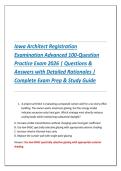
Iowa Architect Registration
Examination Advanced 100-Question
Practice Exam 2026 | Questions &
Answers with Detailed Rationales |
Complete Exam Prep & Study Guide
1. A project architect is evaluating a proposed curtain wall for a six-story office
building. The owner wants maximum glazing, but the energy model
indicates excessive solar heat gain. Which strategy most directly reduces
cooling loads while maintaining substantial daylight?
A. Increase visible transmittance without changing solar heat gain coefficient
B. Use low-SHGC spectrally selective glazing with appropriate exterior shading
C. Increase interior thermal mass only
D. Replace the curtain wall with single-pane glazing
Answer: Use low-SHGC spectrally selective glazing with appropriate exterior
shading.
,Rationale: Spectrally selective glazing can admit useful daylight while limiting
solar heat gain, and exterior shading blocks radiation before it enters the
building. This combination is generally more effective than relying solely on
interior thermal mass.
2. A reinforced concrete column in a multistory building is subjected to
significant axial compression and bending from wind. Which design
consideration is most important when determining its required longitudinal
reinforcement?
A. Slab finish thickness
B. Combined axial load and moment interaction
C. Interior partition layout
D. Floor covering coefficient
Answer: Combined axial load and moment interaction.
Rationale: Reinforced concrete columns subjected to compression and bending
must be designed using the interaction between axial force and moment.
Ignoring either component can result in inadequate capacity.
3. A historic masonry building has recurring moisture damage at the base of
exterior walls. The site has poor drainage and the adjacent grade slopes
toward the building. What is the most appropriate first intervention?
A. Apply interior waterproofing paint
B. Install additional interior insulation
C. Correct site drainage and direct water away from the foundation
D. Seal all interior masonry joints with epoxy
Answer: Correct site drainage and direct water away from the foundation.
Rationale: Moisture management should begin by addressing the source.
Improving grading and drainage reduces hydrostatic and capillary moisture
exposure before secondary waterproofing measures are considered.
, 4. During schematic design, an architect wants to compare alternatives using
life-cycle cost rather than initial construction cost. Which approach is most
appropriate?
A. Compare only first costs
B. Compare construction cost and anticipated operating, maintenance,
replacement, and disposal costs
C. Compare only energy consumption
D. Compare only contractor bids
Answer: Compare construction cost and anticipated operating, maintenance,
replacement, and disposal costs.
Rationale: Life-cycle cost analysis evaluates costs over the useful life of an asset
rather than focusing exclusively on initial construction expenditure.
5. A client requests a large open office with extensive west-facing glazing in
Iowa. Which orientation-related strategy is generally most effective for
controlling late-afternoon solar gain?
A. Increase west-facing glazing
B. Use exterior vertical shading and solar-control glazing
C. Eliminate all north-facing windows
D. Use dark interior paint
Answer: Use exterior vertical shading and solar-control glazing.
Rationale: West-facing glazing receives low-angle afternoon sun that is difficult
to control with horizontal overhangs alone. Exterior vertical shading combined
with appropriate glazing is effective.
6. Which structural system generally provides the greatest flexibility for
creating large column-free spaces in a convention center?
A. Closely spaced load-bearing masonry walls
B. Long-span steel framing
, C. Conventional wood joists
D. Short-span concrete beams
Answer: Long-span steel framing.
Rationale: Steel's high strength-to-weight ratio and availability of deep beams,
trusses, and space-frame systems make it well suited to long-span column-free
spaces.
7. A building has a large difference in pressure between its interior and
exterior. Which phenomenon can significantly increase uncontrolled air
infiltration?
A. Vapor diffusion
B. Stack effect
C. Thermal bridging only
D. Solar reflectance
Answer: Stack effect.
Rationale: Stack effect results from differences in indoor and outdoor air density
caused by temperature differences, producing pressure gradients that drive air
movement through openings.
8. In an accessible restroom, which design principle is most important when
positioning fixtures?
A. Maximize decorative symmetry
B. Maintain required clear floor and maneuvering spaces
C. Place all fixtures against one wall regardless of clearances
D. Reduce turning space to increase fixture count
Answer: Maintain required clear floor and maneuvering spaces.
Rationale: Accessible design depends on adequate clearances, approach spaces,
and maneuvering areas so users with mobility devices can independently use
the facilities.
Examination Advanced 100-Question
Practice Exam 2026 | Questions &
Answers with Detailed Rationales |
Complete Exam Prep & Study Guide
1. A project architect is evaluating a proposed curtain wall for a six-story office
building. The owner wants maximum glazing, but the energy model
indicates excessive solar heat gain. Which strategy most directly reduces
cooling loads while maintaining substantial daylight?
A. Increase visible transmittance without changing solar heat gain coefficient
B. Use low-SHGC spectrally selective glazing with appropriate exterior shading
C. Increase interior thermal mass only
D. Replace the curtain wall with single-pane glazing
Answer: Use low-SHGC spectrally selective glazing with appropriate exterior
shading.
,Rationale: Spectrally selective glazing can admit useful daylight while limiting
solar heat gain, and exterior shading blocks radiation before it enters the
building. This combination is generally more effective than relying solely on
interior thermal mass.
2. A reinforced concrete column in a multistory building is subjected to
significant axial compression and bending from wind. Which design
consideration is most important when determining its required longitudinal
reinforcement?
A. Slab finish thickness
B. Combined axial load and moment interaction
C. Interior partition layout
D. Floor covering coefficient
Answer: Combined axial load and moment interaction.
Rationale: Reinforced concrete columns subjected to compression and bending
must be designed using the interaction between axial force and moment.
Ignoring either component can result in inadequate capacity.
3. A historic masonry building has recurring moisture damage at the base of
exterior walls. The site has poor drainage and the adjacent grade slopes
toward the building. What is the most appropriate first intervention?
A. Apply interior waterproofing paint
B. Install additional interior insulation
C. Correct site drainage and direct water away from the foundation
D. Seal all interior masonry joints with epoxy
Answer: Correct site drainage and direct water away from the foundation.
Rationale: Moisture management should begin by addressing the source.
Improving grading and drainage reduces hydrostatic and capillary moisture
exposure before secondary waterproofing measures are considered.
, 4. During schematic design, an architect wants to compare alternatives using
life-cycle cost rather than initial construction cost. Which approach is most
appropriate?
A. Compare only first costs
B. Compare construction cost and anticipated operating, maintenance,
replacement, and disposal costs
C. Compare only energy consumption
D. Compare only contractor bids
Answer: Compare construction cost and anticipated operating, maintenance,
replacement, and disposal costs.
Rationale: Life-cycle cost analysis evaluates costs over the useful life of an asset
rather than focusing exclusively on initial construction expenditure.
5. A client requests a large open office with extensive west-facing glazing in
Iowa. Which orientation-related strategy is generally most effective for
controlling late-afternoon solar gain?
A. Increase west-facing glazing
B. Use exterior vertical shading and solar-control glazing
C. Eliminate all north-facing windows
D. Use dark interior paint
Answer: Use exterior vertical shading and solar-control glazing.
Rationale: West-facing glazing receives low-angle afternoon sun that is difficult
to control with horizontal overhangs alone. Exterior vertical shading combined
with appropriate glazing is effective.
6. Which structural system generally provides the greatest flexibility for
creating large column-free spaces in a convention center?
A. Closely spaced load-bearing masonry walls
B. Long-span steel framing
, C. Conventional wood joists
D. Short-span concrete beams
Answer: Long-span steel framing.
Rationale: Steel's high strength-to-weight ratio and availability of deep beams,
trusses, and space-frame systems make it well suited to long-span column-free
spaces.
7. A building has a large difference in pressure between its interior and
exterior. Which phenomenon can significantly increase uncontrolled air
infiltration?
A. Vapor diffusion
B. Stack effect
C. Thermal bridging only
D. Solar reflectance
Answer: Stack effect.
Rationale: Stack effect results from differences in indoor and outdoor air density
caused by temperature differences, producing pressure gradients that drive air
movement through openings.
8. In an accessible restroom, which design principle is most important when
positioning fixtures?
A. Maximize decorative symmetry
B. Maintain required clear floor and maneuvering spaces
C. Place all fixtures against one wall regardless of clearances
D. Reduce turning space to increase fixture count
Answer: Maintain required clear floor and maneuvering spaces.
Rationale: Accessible design depends on adequate clearances, approach spaces,
and maneuvering areas so users with mobility devices can independently use
the facilities.


