
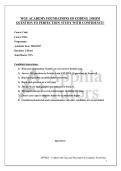
WGU ACADEMY FOUNDATIONS OF CODING | FROM
QUESTION TO PERFECTION| STUDY WITH CONFIDENCE!
Course Code:
Course Title:
Programme:
Academic Year: 2026/2027
Duration: 2 Hours
Total Marks: 70%
Candidate Instructions:
1) Write your Registration Number on every answer booklet used.
2) Answer ALL questions in Section A and ANY TWO (2) questions in Section B.
3) Read each question carefully before answering.
4) Begin each question on a new page.
5) The marks for each question are indicated in brackets.
6) This paper consists of several printed pages, including this page.
7) Ensure your copy is complete before the examination begins.
8) Unauthorized materials and communication with other candidates are not permitted.
Turn Over.
APPHIA – Crafted with Care and Precision for Academic Excellence.
1
, program Answer: A computer program consists of instructions executing one at a time.
Input Answer: A program gets data, perhaps from a file, keyboard, touchscreen, network, etc.
Process Answer: A program performs computations on that data, such as adding two values like
x + y.
Output Answer: A program puts that data somewhere, such as to a file, screen, network, etc.
variables Answer: Programs use variables to refer to data, like x.
computational thinking Answer: Creating a sequence of instructions to solve a problem.
algorithm Answer: A sequence of instructions that solves a problem.
computational problem Answer: A computational problem specifies an input, a question about
the input that can be answered using a computer, and the desired output.
NP-complete Answer: NP-complete problems are a set of problems for which no known
efficient algorithm exists.
algorithm time efficiency Answer: The number of calculations required to solve a problem.
problem solving Answer: Programming is largely about problem solving: Creating a methodical
solution to a given task.
pseudocode Answer: A high-level description of the actions of a program or algorithm, using a
mixture of English and informal programming language syntax.
statement Answer: A syntactical unit in a program. In Python a statement is either a simple
statement or a compound statement.
comment Answer: An explanation to help the human reader understand a section of a program;
ignored by the interpreter.
function Answer: A sequence of statements that can be invoked multiple times, with different
values for its parameter variables.
argument Answer: A value supplied in a function or method call, or one of the values combined
by an operator.
string Answer: A sequence of characters.
variable Answer: A symbol in a program that identifies a storage location that can hold different
values.
assignment Answer: Placing a new value into a variable.
type Answer: A named set of values and the operations that can be carried out with them.
primitive type Answer: A data type provided by the language itself.
APPHIA – Crafted with Care and Precision for Academic Excellence.
2
QUESTION TO PERFECTION| STUDY WITH CONFIDENCE!
Course Code:
Course Title:
Programme:
Academic Year: 2026/2027
Duration: 2 Hours
Total Marks: 70%
Candidate Instructions:
1) Write your Registration Number on every answer booklet used.
2) Answer ALL questions in Section A and ANY TWO (2) questions in Section B.
3) Read each question carefully before answering.
4) Begin each question on a new page.
5) The marks for each question are indicated in brackets.
6) This paper consists of several printed pages, including this page.
7) Ensure your copy is complete before the examination begins.
8) Unauthorized materials and communication with other candidates are not permitted.
Turn Over.
APPHIA – Crafted with Care and Precision for Academic Excellence.
1
, program Answer: A computer program consists of instructions executing one at a time.
Input Answer: A program gets data, perhaps from a file, keyboard, touchscreen, network, etc.
Process Answer: A program performs computations on that data, such as adding two values like
x + y.
Output Answer: A program puts that data somewhere, such as to a file, screen, network, etc.
variables Answer: Programs use variables to refer to data, like x.
computational thinking Answer: Creating a sequence of instructions to solve a problem.
algorithm Answer: A sequence of instructions that solves a problem.
computational problem Answer: A computational problem specifies an input, a question about
the input that can be answered using a computer, and the desired output.
NP-complete Answer: NP-complete problems are a set of problems for which no known
efficient algorithm exists.
algorithm time efficiency Answer: The number of calculations required to solve a problem.
problem solving Answer: Programming is largely about problem solving: Creating a methodical
solution to a given task.
pseudocode Answer: A high-level description of the actions of a program or algorithm, using a
mixture of English and informal programming language syntax.
statement Answer: A syntactical unit in a program. In Python a statement is either a simple
statement or a compound statement.
comment Answer: An explanation to help the human reader understand a section of a program;
ignored by the interpreter.
function Answer: A sequence of statements that can be invoked multiple times, with different
values for its parameter variables.
argument Answer: A value supplied in a function or method call, or one of the values combined
by an operator.
string Answer: A sequence of characters.
variable Answer: A symbol in a program that identifies a storage location that can hold different
values.
assignment Answer: Placing a new value into a variable.
type Answer: A named set of values and the operations that can be carried out with them.
primitive type Answer: A data type provided by the language itself.
APPHIA – Crafted with Care and Precision for Academic Excellence.
2


