

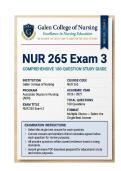
,NUR 265 Exam 3 – Advanced Concepts of Medical-
Surgical Nursing – Actual Q&A (GCN) (Updated PDF)
1. A client with a head injury has a heart rate decrease from 110 to 56 bpm and
blood pressure increase to 166/52 mm Hg. Which action should the nurse take
first?
A) Notify the healthcare provider immediately
B) Document the findings as expected
C) Administer a prescribed antihypertensive
D) Recheck vital signs in 1 hour
Correct Answer: A) Notify the healthcare provider immediately
Rationale: Bradycardia with a widened pulse pressure and hypertension
suggests Cushing's triad, a late sign of increased intracranial pressure and
impending herniation. The provider must be notified immediately. Documenting
or waiting delays emergency treatment.
2. A client with increased intracranial pressure is being turned. Which technique
is appropriate?
A) Keep the client flat
B) Flex the neck forward
C) Rotate the head side to side
D) Log roll the client while maintaining spinal alignment
Correct Answer: D) Log roll the client while maintaining spinal alignment
,Rationale: Log rolling prevents neck flexion and rotation, which can impede
venous drainage and increase ICP. Head of bed should be elevated 30-45
degrees, not flat.
3. A client with a T6 spinal cord injury develops severe headache, hypertension,
flushing, and bradycardia. Which condition is most likely?
A) Neurogenic shock
B) Hypovolemic shock
C) Autonomic dysreflexia
D) Septic shock
Correct Answer: C) Autonomic dysreflexia
Rationale: Autonomic dysreflexia occurs with spinal cord injuries at or above T6
and presents with severe hypertension, headache, flushing, and bradycardia. It
is a life-threatening emergency requiring immediate intervention.
4. A client with myasthenia gravis is experiencing respiratory distress and
difficulty swallowing. Which condition is the priority?
A) Cholinergic crisis
B) Myasthenic crisis
C) Exacerbation of multiple sclerosis
D) Guillain-Barré syndrome
Correct Answer: B) Myasthenic crisis
, Rationale: Myasthenic crisis is an exacerbation causing severe muscle weakness,
respiratory distress, and dysphagia. Airway and breathing are priorities;
intubation may be required.
5. A client with Parkinson's disease is prescribed carbidopa-levodopa. Which
instruction is correct?
A) Take with a high-protein meal
B) Take at bedtime only
C) Stop if symptoms improve
D) Avoid high-protein meals around the time of the medication
Correct Answer: D) Avoid high-protein meals around the time of the medication
Rationale: High-protein meals interfere with levodopa absorption. Carbidopa-
levodopa is the gold standard treatment but does not cure Parkinson's disease
and should not be stopped abruptly.
6. Which assessment finding is the priority in a client with Guillain-Barré
syndrome?
A) Ascending muscle weakness
B) Loss of bladder control
C) Decreased deep tendon reflexes
D) Respiratory distress
Correct Answer: D) Respiratory distress
Surgical Nursing – Actual Q&A (GCN) (Updated PDF)
1. A client with a head injury has a heart rate decrease from 110 to 56 bpm and
blood pressure increase to 166/52 mm Hg. Which action should the nurse take
first?
A) Notify the healthcare provider immediately
B) Document the findings as expected
C) Administer a prescribed antihypertensive
D) Recheck vital signs in 1 hour
Correct Answer: A) Notify the healthcare provider immediately
Rationale: Bradycardia with a widened pulse pressure and hypertension
suggests Cushing's triad, a late sign of increased intracranial pressure and
impending herniation. The provider must be notified immediately. Documenting
or waiting delays emergency treatment.
2. A client with increased intracranial pressure is being turned. Which technique
is appropriate?
A) Keep the client flat
B) Flex the neck forward
C) Rotate the head side to side
D) Log roll the client while maintaining spinal alignment
Correct Answer: D) Log roll the client while maintaining spinal alignment
,Rationale: Log rolling prevents neck flexion and rotation, which can impede
venous drainage and increase ICP. Head of bed should be elevated 30-45
degrees, not flat.
3. A client with a T6 spinal cord injury develops severe headache, hypertension,
flushing, and bradycardia. Which condition is most likely?
A) Neurogenic shock
B) Hypovolemic shock
C) Autonomic dysreflexia
D) Septic shock
Correct Answer: C) Autonomic dysreflexia
Rationale: Autonomic dysreflexia occurs with spinal cord injuries at or above T6
and presents with severe hypertension, headache, flushing, and bradycardia. It
is a life-threatening emergency requiring immediate intervention.
4. A client with myasthenia gravis is experiencing respiratory distress and
difficulty swallowing. Which condition is the priority?
A) Cholinergic crisis
B) Myasthenic crisis
C) Exacerbation of multiple sclerosis
D) Guillain-Barré syndrome
Correct Answer: B) Myasthenic crisis
, Rationale: Myasthenic crisis is an exacerbation causing severe muscle weakness,
respiratory distress, and dysphagia. Airway and breathing are priorities;
intubation may be required.
5. A client with Parkinson's disease is prescribed carbidopa-levodopa. Which
instruction is correct?
A) Take with a high-protein meal
B) Take at bedtime only
C) Stop if symptoms improve
D) Avoid high-protein meals around the time of the medication
Correct Answer: D) Avoid high-protein meals around the time of the medication
Rationale: High-protein meals interfere with levodopa absorption. Carbidopa-
levodopa is the gold standard treatment but does not cure Parkinson's disease
and should not be stopped abruptly.
6. Which assessment finding is the priority in a client with Guillain-Barré
syndrome?
A) Ascending muscle weakness
B) Loss of bladder control
C) Decreased deep tendon reflexes
D) Respiratory distress
Correct Answer: D) Respiratory distress


