
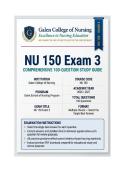
,NU 150/NU150 Exam 3 – Pharmacology – Actual
Q&A (GCN) (Updated PDF)
1. A nurse is administering morphine to a client for severe pain. Which
assessment is most critical before administration?
A) Respiratory rate
B) Capillary refill
C) Temperature
D) Blood pressure
Correct Answer: A) Respiratory rate
Rationale: Morphine can cause respiratory depression, the most serious adverse
effect. The nurse must assess respiratory rate before and after administration. If
respirations are below 12 breaths/min, the dose may be withheld.
2. A client prescribed omeprazole asks how to know the medication is working.
Which response is correct?
A) Decreased appetite
B) Weight gain
C) No gastric reflux or heartburn
D) Increased bowel sounds
Correct Answer: C) No gastric reflux or heartburn
,Rationale: Omeprazole is a proton pump inhibitor that reduces gastric acid
secretion. Symptom relief—absence of heartburn and reflux—is the best
indicator of effectiveness.
3. Which mechanism leads to superinfection during prolonged antibiotic
therapy?
A) The infection becomes viral
B) The dose is too low
C) Poor patient nutrition
D) Overgrowth of resistant organisms
Correct Answer: D) Overgrowth of resistant organisms
Rationale: Broad-spectrum or prolonged antibiotics disrupt normal flora,
allowing resistant organisms such as Clostridium difficile or Candida to
overgrow and cause superinfection.
4. Which condition is a contraindication for aspirin use?
A) Hypertension
B) Peptic ulcer disease
C) Diabetes mellitus
D) Asthma
Correct Answer: B) Peptic ulcer disease
, Rationale: Aspirin inhibits prostaglandins and platelet aggregation, increasing
the risk of GI bleeding. It is contraindicated in clients with peptic ulcer disease
and bleeding disorders.
5. Which adverse reaction is commonly associated with NSAIDs such as
ibuprofen?
A) Bradycardia
B) GI bleed and peptic ulcers
C) Hyperglycemia
D) Hypokalemia
Correct Answer: B) GI bleed and peptic ulcers
Rationale: NSAIDs can cause gastrointestinal bleeding, peptic ulcers, nausea,
and renal dysfunction. They should be used cautiously in older adults and clients
with renal impairment.
6. A client taking meperidine should avoid which substance?
A) Dairy products
B) Leafy green vegetables
C) Grapefruit juice
D) Alcohol and other CNS depressants
Correct Answer: D) Alcohol and other CNS depressants
Q&A (GCN) (Updated PDF)
1. A nurse is administering morphine to a client for severe pain. Which
assessment is most critical before administration?
A) Respiratory rate
B) Capillary refill
C) Temperature
D) Blood pressure
Correct Answer: A) Respiratory rate
Rationale: Morphine can cause respiratory depression, the most serious adverse
effect. The nurse must assess respiratory rate before and after administration. If
respirations are below 12 breaths/min, the dose may be withheld.
2. A client prescribed omeprazole asks how to know the medication is working.
Which response is correct?
A) Decreased appetite
B) Weight gain
C) No gastric reflux or heartburn
D) Increased bowel sounds
Correct Answer: C) No gastric reflux or heartburn
,Rationale: Omeprazole is a proton pump inhibitor that reduces gastric acid
secretion. Symptom relief—absence of heartburn and reflux—is the best
indicator of effectiveness.
3. Which mechanism leads to superinfection during prolonged antibiotic
therapy?
A) The infection becomes viral
B) The dose is too low
C) Poor patient nutrition
D) Overgrowth of resistant organisms
Correct Answer: D) Overgrowth of resistant organisms
Rationale: Broad-spectrum or prolonged antibiotics disrupt normal flora,
allowing resistant organisms such as Clostridium difficile or Candida to
overgrow and cause superinfection.
4. Which condition is a contraindication for aspirin use?
A) Hypertension
B) Peptic ulcer disease
C) Diabetes mellitus
D) Asthma
Correct Answer: B) Peptic ulcer disease
, Rationale: Aspirin inhibits prostaglandins and platelet aggregation, increasing
the risk of GI bleeding. It is contraindicated in clients with peptic ulcer disease
and bleeding disorders.
5. Which adverse reaction is commonly associated with NSAIDs such as
ibuprofen?
A) Bradycardia
B) GI bleed and peptic ulcers
C) Hyperglycemia
D) Hypokalemia
Correct Answer: B) GI bleed and peptic ulcers
Rationale: NSAIDs can cause gastrointestinal bleeding, peptic ulcers, nausea,
and renal dysfunction. They should be used cautiously in older adults and clients
with renal impairment.
6. A client taking meperidine should avoid which substance?
A) Dairy products
B) Leafy green vegetables
C) Grapefruit juice
D) Alcohol and other CNS depressants
Correct Answer: D) Alcohol and other CNS depressants


