

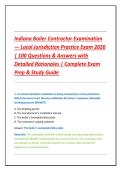
Indiana Boiler Contractor Examination
— Local Jurisdiction Practice Exam 2026
| 100 Questions & Answers with
Detailed Rationales | Complete Exam
Prep & Study Guide
1. A commercial boiler installation is being reviewed by a local jurisdiction.
Which document most directly establishes the boiler's maximum allowable
working pressure (MAWP)?
A. The building permit
B. The manufacturer's installation manual
C. The boiler's nameplate/data plate
D. The contractor's piping schedule
Answer: The boiler's nameplate/data plate
Rationale: The nameplate identifies critical design and operating information,
including the MAWP established for the pressure vessel. The contractor must
not operate or design connected systems in a manner that exceeds the
equipment's rated limitations.
,2. A steam boiler has a normal operating pressure of 80 psi. Which device is
specifically intended to prevent the boiler from exceeding its permitted
pressure?
A. Pressure-reducing valve
B. Safety valve
C. Check valve
D. Vacuum breaker
Answer: Safety valve
Rationale: The safety valve provides overpressure protection by relieving steam
when pressure reaches the valve's set point. It is a primary pressure-vessel
safety device and must not be isolated from the protected boiler.
3. During installation, a contractor proposes placing a shutoff valve between a
steam boiler and its safety valve. What is the principal concern?
A. Increased fuel consumption
B. Reduced condensate return
C. The safety valve could be isolated from the boiler
D. Increased stack temperature
Answer: The safety valve could be isolated from the boiler
Rationale: A safety valve must remain capable of protecting the pressure vessel.
An isolation valve installed so that the safety valve can be shut off can defeat
the required overpressure protection and create a serious safety hazard.
4. A hydronic boiler system repeatedly loses pressure after operating normally
for several hours. Which condition should be investigated first?
A. Boiler jacket color
B. Expansion tank operation and system leakage
,C. Burner flame color only
D. Flue termination height only
Answer: Expansion tank operation and system leakage
Rationale: Loss of system pressure can result from leakage, inadequate fill
pressure, or an improperly charged or failed expansion tank. These conditions
should be evaluated before replacing major boiler components.
5. What is the primary purpose of an expansion tank in a closed hot-water
heating system?
A. To increase burner capacity
B. To absorb thermal expansion of the water
C. To remove combustion products
D. To increase pump horsepower
Answer: To absorb thermal expansion of the water
Rationale: Water expands as it is heated. The expansion tank provides a
compressible volume that accommodates this increase and limits excessive
pressure rise in the closed hydronic system.
6. A contractor installs a boiler pump directly adjacent to an elbow with no
straight pipe between them. Why can this arrangement be problematic?
A. It changes the fuel type
B. It can create turbulent flow and poor pump performance
C. It increases boiler MAWP
D. It eliminates the need for an expansion tank
Answer: It can create turbulent flow and poor pump performance
, Rationale: Poor piping geometry immediately upstream of a pump can produce
turbulence and uneven velocity distribution at the pump inlet. Proper hydraulic
design improves pump performance and reliability.
7. Which condition is most likely to cause cavitation in a hydronic circulation
pump?
A. Excessive net positive suction head
B. Insufficient pressure at the pump inlet
C. Oversized expansion tank
D. Low return-water temperature alone
Answer: Insufficient pressure at the pump inlet
Rationale: Cavitation occurs when local fluid pressure falls sufficiently for vapor
bubbles to form. Maintaining adequate suction pressure and appropriate
system conditions helps prevent pump damage and noise.
8. What is the principal purpose of a low-water cutoff on a steam boiler?
A. Increase steam pressure
B. Prevent firing when insufficient water is present
C. Reduce combustion air
D. Control building humidity
Answer: Prevent firing when insufficient water is present
Rationale: A low-water cutoff protects the boiler from firing under low-water
conditions, which can expose heat-transfer surfaces to excessive temperatures
and potentially damage the boiler.
— Local Jurisdiction Practice Exam 2026
| 100 Questions & Answers with
Detailed Rationales | Complete Exam
Prep & Study Guide
1. A commercial boiler installation is being reviewed by a local jurisdiction.
Which document most directly establishes the boiler's maximum allowable
working pressure (MAWP)?
A. The building permit
B. The manufacturer's installation manual
C. The boiler's nameplate/data plate
D. The contractor's piping schedule
Answer: The boiler's nameplate/data plate
Rationale: The nameplate identifies critical design and operating information,
including the MAWP established for the pressure vessel. The contractor must
not operate or design connected systems in a manner that exceeds the
equipment's rated limitations.
,2. A steam boiler has a normal operating pressure of 80 psi. Which device is
specifically intended to prevent the boiler from exceeding its permitted
pressure?
A. Pressure-reducing valve
B. Safety valve
C. Check valve
D. Vacuum breaker
Answer: Safety valve
Rationale: The safety valve provides overpressure protection by relieving steam
when pressure reaches the valve's set point. It is a primary pressure-vessel
safety device and must not be isolated from the protected boiler.
3. During installation, a contractor proposes placing a shutoff valve between a
steam boiler and its safety valve. What is the principal concern?
A. Increased fuel consumption
B. Reduced condensate return
C. The safety valve could be isolated from the boiler
D. Increased stack temperature
Answer: The safety valve could be isolated from the boiler
Rationale: A safety valve must remain capable of protecting the pressure vessel.
An isolation valve installed so that the safety valve can be shut off can defeat
the required overpressure protection and create a serious safety hazard.
4. A hydronic boiler system repeatedly loses pressure after operating normally
for several hours. Which condition should be investigated first?
A. Boiler jacket color
B. Expansion tank operation and system leakage
,C. Burner flame color only
D. Flue termination height only
Answer: Expansion tank operation and system leakage
Rationale: Loss of system pressure can result from leakage, inadequate fill
pressure, or an improperly charged or failed expansion tank. These conditions
should be evaluated before replacing major boiler components.
5. What is the primary purpose of an expansion tank in a closed hot-water
heating system?
A. To increase burner capacity
B. To absorb thermal expansion of the water
C. To remove combustion products
D. To increase pump horsepower
Answer: To absorb thermal expansion of the water
Rationale: Water expands as it is heated. The expansion tank provides a
compressible volume that accommodates this increase and limits excessive
pressure rise in the closed hydronic system.
6. A contractor installs a boiler pump directly adjacent to an elbow with no
straight pipe between them. Why can this arrangement be problematic?
A. It changes the fuel type
B. It can create turbulent flow and poor pump performance
C. It increases boiler MAWP
D. It eliminates the need for an expansion tank
Answer: It can create turbulent flow and poor pump performance
, Rationale: Poor piping geometry immediately upstream of a pump can produce
turbulence and uneven velocity distribution at the pump inlet. Proper hydraulic
design improves pump performance and reliability.
7. Which condition is most likely to cause cavitation in a hydronic circulation
pump?
A. Excessive net positive suction head
B. Insufficient pressure at the pump inlet
C. Oversized expansion tank
D. Low return-water temperature alone
Answer: Insufficient pressure at the pump inlet
Rationale: Cavitation occurs when local fluid pressure falls sufficiently for vapor
bubbles to form. Maintaining adequate suction pressure and appropriate
system conditions helps prevent pump damage and noise.
8. What is the principal purpose of a low-water cutoff on a steam boiler?
A. Increase steam pressure
B. Prevent firing when insufficient water is present
C. Reduce combustion air
D. Control building humidity
Answer: Prevent firing when insufficient water is present
Rationale: A low-water cutoff protects the boiler from firing under low-water
conditions, which can expose heat-transfer surfaces to excessive temperatures
and potentially damage the boiler.


