

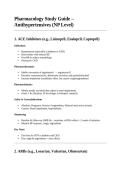
Pharmacology Study Guide –
Antihypertensives (NP Level)
1. ACE Inhibitors (e.g., Lisinopril, Enalapril, Captopril)
Indications
Hypertension (especially in diabetes or CKD)
Heart failure with reduced EF
Post-MI (to reduce remodeling)
Proteinuric CKD
Pharmacodynamics
Inhibit conversion of angiotensin I → angiotensin II
Decrease vasoconstriction, aldosterone secretion, and preload/afterload
Increase bradykinin (vasodilator effect, but causes cough/angioedema)
Pharmacokinetics
Mostly renally excreted (dose adjust in renal impairment)
Onset: 1 hr; Duration: 24 hrs (longer in lisinopril, ramipril)
Safety & Contraindications
Absolute: Pregnancy, history of angioedema, bilateral renal artery stenosis
Caution: Renal impairment, hyperkalemia
Monitoring
Baseline & follow-up: BMP (K+, creatinine, eGFR) within 1–2 weeks of initiation
Monitor BP response, cough, angioedema
Key Notes
First-line for HTN in diabetes and CKD
Dry cough & angioedema = class effects
2. ARBs (e.g., Losartan, Valsartan, Olmesartan)
,Indications
Hypertension (alternative to ACE if cough/angioedema)
Heart failure
Diabetic nephropathy
Pharmacodynamics
Block angiotensin II receptor (AT1) → vasodilation, ↓ aldosterone
Do not affect bradykinin (less cough/angioedema than ACEs)
Pharmacokinetics
Hepatic metabolism (CYP2C9, CYP3A4)
Mostly once daily dosing
Safety & Contraindications
Absolute: Pregnancy, bilateral renal artery stenosis
Caution: Renal impairment, hyperkalemia
Monitoring
Same as ACEs (BMP: K+, creatinine, eGFR)
BP response
Key Notes
Better tolerated than ACEs; useful if ACE-induced cough
Still risk of hyperkalemia & renal dysfunction
3. Calcium Channel Blockers (CCBs)
Dihydropyridines (Amlodipine, Nifedipine)
Indications: HTN, angina, Raynaud’s
MOA: Inhibit Ca2+ influx into vascular smooth muscle → vasodilation
PK: Oral, hepatic metabolism (CYP3A4)
Contraindications: Severe hypotension, caution in HF with reduced EF
Safety: Peripheral edema, headache, flushing, gingival hyperplasia
Monitoring: BP, HR, edema
Key Notes: Amlodipine safe in HFrEF, others not preferred
Non-dihydropyridines (Verapamil, Diltiazem)
, Indications: HTN, angina, rate control in atrial fibrillation
MOA: Decrease AV node conduction → ↓ HR & contractility
Contraindications: Severe LV dysfunction, AV block, bradycardia
Safety: Bradycardia, constipation (esp. verapamil)
Monitoring: HR, BP, ECG
Key Notes: Avoid with beta-blockers (risk of brady/heart block)
4. Thiazide Diuretics (Hydrochlorothiazide, Chlorthalidone)
Indications
First-line for uncomplicated HTN
Synergistic with ACE/ARB
Pharmacodynamics
Inhibit Na+/Cl– reabsorption in distal convoluted tubule → mild diuresis, ↓ BP
Pharmacokinetics
Onset: 2 hrs, Duration: 6–12 hrs (longer for chlorthalidone)
Safety & Contraindications
Absolute: Sulfa allergy (relative), anuria
Safety: Hypokalemia, hyponatremia, hypercalcemia, ↑ uric acid (avoid in gout),
hyperglycemia
Monitoring
BMP (Na+, K+, Ca2+, creatinine, glucose, uric acid)
BP response
Key Notes
More effective in Black and elderly patients
Chlorthalidone stronger, longer acting than HCTZ
5. Beta Blockers (Metoprolol, Atenolol, Carvedilol,
Propranolol)
, Indications
HTN (not first-line unless compelling indication: CAD, MI, HFrEF, arrhythmias)
Angina, rate control, heart failure (carvedilol, metoprolol succinate, bisoprolol)
Pharmacodynamics
Block beta-adrenergic receptors → ↓ HR, ↓ contractility, ↓ renin release
Pharmacokinetics
Lipophilic (propranolol) vs hydrophilic (atenolol) → affects CNS penetration
Hepatic metabolism (metoprolol, carvedilol) vs renal (atenolol)
Safety & Contraindications
Absolute: Severe bradycardia, AV block, decompensated HF, asthma (nonselective)
Safety: Fatigue, depression, sexual dysfunction, bronchospasm (nonselective)
Monitoring
HR, BP
Caution in diabetics (mask hypoglycemia symptoms)
Key Notes
Not first-line for HTN unless compelling cardiac indication
6. Aldosterone Antagonists (Spironolactone, Eplerenone)
Indications
Resistant HTN
HFrEF (mortality benefit)
Hyperaldosteronism
Pharmacodynamics
Block aldosterone receptor in distal tubule → Na+ excretion, K+ retention
Pharmacokinetics
Oral, hepatic metabolism
Antihypertensives (NP Level)
1. ACE Inhibitors (e.g., Lisinopril, Enalapril, Captopril)
Indications
Hypertension (especially in diabetes or CKD)
Heart failure with reduced EF
Post-MI (to reduce remodeling)
Proteinuric CKD
Pharmacodynamics
Inhibit conversion of angiotensin I → angiotensin II
Decrease vasoconstriction, aldosterone secretion, and preload/afterload
Increase bradykinin (vasodilator effect, but causes cough/angioedema)
Pharmacokinetics
Mostly renally excreted (dose adjust in renal impairment)
Onset: 1 hr; Duration: 24 hrs (longer in lisinopril, ramipril)
Safety & Contraindications
Absolute: Pregnancy, history of angioedema, bilateral renal artery stenosis
Caution: Renal impairment, hyperkalemia
Monitoring
Baseline & follow-up: BMP (K+, creatinine, eGFR) within 1–2 weeks of initiation
Monitor BP response, cough, angioedema
Key Notes
First-line for HTN in diabetes and CKD
Dry cough & angioedema = class effects
2. ARBs (e.g., Losartan, Valsartan, Olmesartan)
,Indications
Hypertension (alternative to ACE if cough/angioedema)
Heart failure
Diabetic nephropathy
Pharmacodynamics
Block angiotensin II receptor (AT1) → vasodilation, ↓ aldosterone
Do not affect bradykinin (less cough/angioedema than ACEs)
Pharmacokinetics
Hepatic metabolism (CYP2C9, CYP3A4)
Mostly once daily dosing
Safety & Contraindications
Absolute: Pregnancy, bilateral renal artery stenosis
Caution: Renal impairment, hyperkalemia
Monitoring
Same as ACEs (BMP: K+, creatinine, eGFR)
BP response
Key Notes
Better tolerated than ACEs; useful if ACE-induced cough
Still risk of hyperkalemia & renal dysfunction
3. Calcium Channel Blockers (CCBs)
Dihydropyridines (Amlodipine, Nifedipine)
Indications: HTN, angina, Raynaud’s
MOA: Inhibit Ca2+ influx into vascular smooth muscle → vasodilation
PK: Oral, hepatic metabolism (CYP3A4)
Contraindications: Severe hypotension, caution in HF with reduced EF
Safety: Peripheral edema, headache, flushing, gingival hyperplasia
Monitoring: BP, HR, edema
Key Notes: Amlodipine safe in HFrEF, others not preferred
Non-dihydropyridines (Verapamil, Diltiazem)
, Indications: HTN, angina, rate control in atrial fibrillation
MOA: Decrease AV node conduction → ↓ HR & contractility
Contraindications: Severe LV dysfunction, AV block, bradycardia
Safety: Bradycardia, constipation (esp. verapamil)
Monitoring: HR, BP, ECG
Key Notes: Avoid with beta-blockers (risk of brady/heart block)
4. Thiazide Diuretics (Hydrochlorothiazide, Chlorthalidone)
Indications
First-line for uncomplicated HTN
Synergistic with ACE/ARB
Pharmacodynamics
Inhibit Na+/Cl– reabsorption in distal convoluted tubule → mild diuresis, ↓ BP
Pharmacokinetics
Onset: 2 hrs, Duration: 6–12 hrs (longer for chlorthalidone)
Safety & Contraindications
Absolute: Sulfa allergy (relative), anuria
Safety: Hypokalemia, hyponatremia, hypercalcemia, ↑ uric acid (avoid in gout),
hyperglycemia
Monitoring
BMP (Na+, K+, Ca2+, creatinine, glucose, uric acid)
BP response
Key Notes
More effective in Black and elderly patients
Chlorthalidone stronger, longer acting than HCTZ
5. Beta Blockers (Metoprolol, Atenolol, Carvedilol,
Propranolol)
, Indications
HTN (not first-line unless compelling indication: CAD, MI, HFrEF, arrhythmias)
Angina, rate control, heart failure (carvedilol, metoprolol succinate, bisoprolol)
Pharmacodynamics
Block beta-adrenergic receptors → ↓ HR, ↓ contractility, ↓ renin release
Pharmacokinetics
Lipophilic (propranolol) vs hydrophilic (atenolol) → affects CNS penetration
Hepatic metabolism (metoprolol, carvedilol) vs renal (atenolol)
Safety & Contraindications
Absolute: Severe bradycardia, AV block, decompensated HF, asthma (nonselective)
Safety: Fatigue, depression, sexual dysfunction, bronchospasm (nonselective)
Monitoring
HR, BP
Caution in diabetics (mask hypoglycemia symptoms)
Key Notes
Not first-line for HTN unless compelling cardiac indication
6. Aldosterone Antagonists (Spironolactone, Eplerenone)
Indications
Resistant HTN
HFrEF (mortality benefit)
Hyperaldosteronism
Pharmacodynamics
Block aldosterone receptor in distal tubule → Na+ excretion, K+ retention
Pharmacokinetics
Oral, hepatic metabolism


