

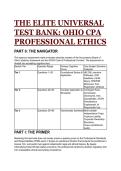
THE ELITE UNIVERSAL
TEST BANK: OHIO CPA
PROFESSIONAL ETHICS
PART 0: THE NAVIGATOR
This rigorous assessment matrix evaluates absolute mastery of the Accountancy Board of
Ohio's statutory framework and the AICPA Code of Professional Conduct. The assessment is
divided into escalating cognitive tiers:
Section Tier Question Range Primary Cognitive Core Subject Domains
Focus Analyzed
Tier 1 Questions 1–28 Foundational Syntax & HB 238 Licensure
Application Pathways, OAC
Deadlines (15/45
Days), CPE/PSR
Minimums, Firm
Registration Defaults.
Tier 2 Questions 29–58 Complex Application & Contingent Fees,
Simulation Commission
Disclosures, Acts
Discreditable, AICPA
Simultaneous
Employment, AI
Responsible Use.
Tier 3 Questions 59–88 Grandmaster Synthesis Multi-variable
Independence Traps,
Vicarious Liability,
Corporate Ownership
Structures,
Cross-Jurisdictional
Audits.
PART I: THE PRIMER
Mastering this test bank does not merely ensure a passing score on the Professional Standards
and Responsibilities (PSR) exam; it forges an operational intuition that protects the practitioner’s
license, firm, and public trust against catastrophic legal and ethical failures. By deeply
internalizing these 88 high-stakes scenarios, the professional transforms abstract regulatory text
into unassailable clinical accounting competence.
,The "Critical Axioms" Cheat Sheet
Axiom Domain 2026/2027 Regulatory Hard Professional Implication
Deck
HB 238 Licensure 120 credits requires 2 years Experience scales inversely
(4,000 hrs) experience; 150 with academic credit
credits requires 1 year (2,000 accumulation.
hrs).
Communication Licensees MUST respond to Silence during an investigation
Accountancy Board instantly compounds the ethical
communications within exactly violation.
15 business days.
Client Records Client-provided records MUST The CPA license cannot be
be returned within 45 days of a weaponized as a
written request, regardless of debt-collection tool against
unpaid fees. native property.
Firm Ownership CPAs must hold >50% Passive capital cannot control
equity/voting control. Non-CPA the execution of the public
owners must be active accounting monopoly.
participants, not passive
investors.
Contingent Fees Strictly prohibited for attest If a third party relies on the
engagements, compilations report, the fee cannot rely on
(without disclosure), and the third party's decision.
amended tax returns.
PART II: THE ELITE TEST BANK
Tier 1 - Foundational Syntax & Application
Q1: An Ohio CPA candidate plans to sit for the Uniform CPA Examination in February 2026. The
candidate holds a bachelor's degree with 120 total credits, including 30 accounting credits and
24 business credits. Based on the principles of Ohio HB 238, which experience threshold is
MOST ACCURATE for licensure? A) One year (2,000 hours) of verified accounting experience
B) Three years of verified accounting experience C) Two years (4,000 hours) of verified
accounting experience D) Zero years, provided they pass all four sections of the CPA exam on
the first attempt
● The Answer: C (Two years (4,000 hours) of verified accounting experience)
● Distractor Analysis:
○ A is incorrect: One year of experience is reserved for candidates holding 150
credits or a Master's degree under the new pathways.
○ B is incorrect: Three years is not a recognized statutory timeline under HB 238.
○ D is incorrect: Field experience is a mandatory statutory prerequisite regardless of
examination velocity.
The Mentor's Analysis: Ohio's 2026 legislative update fundamentally alters the
education-experience ratio. When sitting for the exam after January 1, 2026, with only a
120-credit bachelor's degree, the immediate priority is verifying two full years of professional
,experience. By utilizing the Bachelor's + 2 Years pathway, candidates bypass the trap of the
legacy 150-credit mandate. Professional/Academic Intuition: Under HB 238, fewer academic
credits strictly necessitate more field experience.
Q2: An Ohio permit holder receives an official letter of inquiry from the Accountancy Board of
Ohio regarding a potential peer review deficiency. Based on the principles of OAC 4701-11-07,
what is the maximum time allowed for the required response? A) 10 calendar days B) 30
calendar days C) 15 business days D) 45 business days
● The Answer: C (15 business days)
● Distractor Analysis:
○ A is incorrect: 10 calendar days is an arbitrary deadline not supported by the
Administrative Code.
○ B is incorrect: 30 days applies to notifying the board of an external agency
suspension, not responding to official inquiries.
○ D is incorrect: 45 days relates strictly to the return of client records under OAC
4701-11-06.
The Mentor's Analysis: The Accountancy Board demands absolute responsiveness to maintain
self-regulation. When receiving official correspondence, the immediate priority is drafting a
compliant response within 15 business days. By utilizing a rapid response protocol, the
practitioner bypasses the trap of compounding disciplinary charges for insubordination.
Professional/Academic Intuition: Silence is a secondary violation; always answer the Board
within 15 business days.
Q3: A former client formally requests the return of their original ledger books from their Ohio
CPA. The client currently owes the CPA $8,500 for past tax preparation. Based on the principles
of OAC 4701-11-06, which action MUST the CPA take? A) The CPA may withhold the ledgers
utilizing a mechanic's lien until the balance is paid. B) The CPA must submit the dispute to
binding arbitration within 15 business days before returning any documents. C) The CPA must
return the client-provided ledgers within 45 days, regardless of the unpaid fee balance. D) The
CPA must return the records within 10 business days but may withhold specific tax carryforward
schedules permanently.
● The Answer: C (The CPA must return the client-provided ledgers within 45 days,
regardless of the unpaid fee balance.)
● Distractor Analysis:
○ A is incorrect: Withholding client-provided records as leverage for unpaid fees
constitutes an act discreditable.
○ B is incorrect: Mediation exists for disputes over specific firm workpapers, not native
client records.
○ D is incorrect: The statutory timeframe is 45 days, not 10 days.
The Mentor's Analysis: Client records always belong to the client. When a client demands their
native documents, the immediate priority is absolute compliance within 45 days. By utilizing
immediate return protocols, the practitioner bypasses the trap of weaponizing client data for
debt collection. Professional/Academic Intuition: A CPA license is not a collection agency;
never hold client-native records hostage.
Q4: An Ohio CPA permit holder renews their license on December 31. They completed 110
hours of acceptable CPE, missing the requirement by 10 hours. Based on the principles of OAC
4701-15-12, what is the MOST LIKELY immediate consequence? A) Immediate revocation of
the CPA certificate without a hearing. B) Assessment of a noncompliance fine of $100 for each
month until the requirement is met. C) A mandatory peer review engagement at the permit
holder's expense. D) A noncompliance fine of exactly $10 per credit hour deficient.
, ● The Answer: B (Assessment of a noncompliance fine of $100 for each month until the
requirement is met.)
● Distractor Analysis:
○ A is incorrect: Revocation requires a hearing and is reserved for severe character
or fraud violations.
○ C is incorrect: Peer reviews are required for public accounting firms performing
attest services, not as penalties for individual CPE shortages.
○ D is incorrect: OAC 4701-15-12 explicitly assesses $100 for each full or partial
month of noncompliance.
The Mentor's Analysis: The Accountancy Board strictly enforces continuous education. When
maintaining an active Ohio permit, the immediate priority is hitting the rigid 120-hour triennial
total. By utilizing structured CPE tracking, the practitioner bypasses the trap of compounding
monthly fines. Professional/Academic Intuition: CPE deficiencies in Ohio trigger time-based,
compounding financial penalties.
Q5: An Ohio public accounting firm transitions away from all attest work to focus exclusively on
taxation. To avoid the triennial peer review mandate under ORC 4701.04, which action MUST
the firm execute FIRST? A) Surrender their firm registration and operate as unregistered
consultants. B) Wait three years from the date of the last attest engagement before dropping the
peer review. C) Submit a notarized Peer Review Exemption Form confirming no peer review
services were performed since the last review. D) Submit all future tax returns to the AICPA for a
specialized consulting review.
● The Answer: C (Submit a notarized Peer Review Exemption Form confirming no peer
review services were performed since the last review.)
● Distractor Analysis:
○ A is incorrect: Firms using the CPA designation for tax work must still register;
surrendering registration is unauthorized practice.
○ B is incorrect: The firm must proactively notify the board and submit evidence that
their most recent peer review occurred after their final attest engagement.
○ D is incorrect: The AICPA does not conduct substituting tax reviews for state peer
review exemptions.
The Mentor's Analysis: Exemption is a proactive, documented status, not an assumed right.
When shifting away from attest services, the immediate priority is formalizing the exemption via
a notarized affidavit. By utilizing the Peer Review Exemption Form, the firm bypasses the trap of
failing an audit for an uncompleted peer review. Professional/Academic Intuition: You are an
attest firm until the Accountancy Board explicitly approves your exemption in writing.
Q6: A corporate entity in Ohio is structured as a corporation-for-profit and wishes to register as a
public accounting firm. An IT specialist who is not a CPA wishes to purchase 40% of the firm's
equity. Under ORC 4701.04, which condition is an absolute PREREQUISITE for this non-CPA
ownership? A) The non-CPA must eventually pass the Uniform CPA Exam within 5 years. B)
The non-CPA's participation in the firm must be their principal occupation; they cannot act solely
as a passive investor. C) The non-CPA may hold up to 60% of the firm's total equity if they serve
as the Chief Executive Officer. D) The non-CPA is exempt from all continuing professional
education (CPE) requirements.
● The Answer: B (The non-CPA's participation in the firm must be their principal occupation;
they cannot act solely as a passive investor.)
● Distractor Analysis:
○ A is incorrect: There is no statutory requirement for a minority non-CPA owner to
eventually become a CPA.
TEST BANK: OHIO CPA
PROFESSIONAL ETHICS
PART 0: THE NAVIGATOR
This rigorous assessment matrix evaluates absolute mastery of the Accountancy Board of
Ohio's statutory framework and the AICPA Code of Professional Conduct. The assessment is
divided into escalating cognitive tiers:
Section Tier Question Range Primary Cognitive Core Subject Domains
Focus Analyzed
Tier 1 Questions 1–28 Foundational Syntax & HB 238 Licensure
Application Pathways, OAC
Deadlines (15/45
Days), CPE/PSR
Minimums, Firm
Registration Defaults.
Tier 2 Questions 29–58 Complex Application & Contingent Fees,
Simulation Commission
Disclosures, Acts
Discreditable, AICPA
Simultaneous
Employment, AI
Responsible Use.
Tier 3 Questions 59–88 Grandmaster Synthesis Multi-variable
Independence Traps,
Vicarious Liability,
Corporate Ownership
Structures,
Cross-Jurisdictional
Audits.
PART I: THE PRIMER
Mastering this test bank does not merely ensure a passing score on the Professional Standards
and Responsibilities (PSR) exam; it forges an operational intuition that protects the practitioner’s
license, firm, and public trust against catastrophic legal and ethical failures. By deeply
internalizing these 88 high-stakes scenarios, the professional transforms abstract regulatory text
into unassailable clinical accounting competence.
,The "Critical Axioms" Cheat Sheet
Axiom Domain 2026/2027 Regulatory Hard Professional Implication
Deck
HB 238 Licensure 120 credits requires 2 years Experience scales inversely
(4,000 hrs) experience; 150 with academic credit
credits requires 1 year (2,000 accumulation.
hrs).
Communication Licensees MUST respond to Silence during an investigation
Accountancy Board instantly compounds the ethical
communications within exactly violation.
15 business days.
Client Records Client-provided records MUST The CPA license cannot be
be returned within 45 days of a weaponized as a
written request, regardless of debt-collection tool against
unpaid fees. native property.
Firm Ownership CPAs must hold >50% Passive capital cannot control
equity/voting control. Non-CPA the execution of the public
owners must be active accounting monopoly.
participants, not passive
investors.
Contingent Fees Strictly prohibited for attest If a third party relies on the
engagements, compilations report, the fee cannot rely on
(without disclosure), and the third party's decision.
amended tax returns.
PART II: THE ELITE TEST BANK
Tier 1 - Foundational Syntax & Application
Q1: An Ohio CPA candidate plans to sit for the Uniform CPA Examination in February 2026. The
candidate holds a bachelor's degree with 120 total credits, including 30 accounting credits and
24 business credits. Based on the principles of Ohio HB 238, which experience threshold is
MOST ACCURATE for licensure? A) One year (2,000 hours) of verified accounting experience
B) Three years of verified accounting experience C) Two years (4,000 hours) of verified
accounting experience D) Zero years, provided they pass all four sections of the CPA exam on
the first attempt
● The Answer: C (Two years (4,000 hours) of verified accounting experience)
● Distractor Analysis:
○ A is incorrect: One year of experience is reserved for candidates holding 150
credits or a Master's degree under the new pathways.
○ B is incorrect: Three years is not a recognized statutory timeline under HB 238.
○ D is incorrect: Field experience is a mandatory statutory prerequisite regardless of
examination velocity.
The Mentor's Analysis: Ohio's 2026 legislative update fundamentally alters the
education-experience ratio. When sitting for the exam after January 1, 2026, with only a
120-credit bachelor's degree, the immediate priority is verifying two full years of professional
,experience. By utilizing the Bachelor's + 2 Years pathway, candidates bypass the trap of the
legacy 150-credit mandate. Professional/Academic Intuition: Under HB 238, fewer academic
credits strictly necessitate more field experience.
Q2: An Ohio permit holder receives an official letter of inquiry from the Accountancy Board of
Ohio regarding a potential peer review deficiency. Based on the principles of OAC 4701-11-07,
what is the maximum time allowed for the required response? A) 10 calendar days B) 30
calendar days C) 15 business days D) 45 business days
● The Answer: C (15 business days)
● Distractor Analysis:
○ A is incorrect: 10 calendar days is an arbitrary deadline not supported by the
Administrative Code.
○ B is incorrect: 30 days applies to notifying the board of an external agency
suspension, not responding to official inquiries.
○ D is incorrect: 45 days relates strictly to the return of client records under OAC
4701-11-06.
The Mentor's Analysis: The Accountancy Board demands absolute responsiveness to maintain
self-regulation. When receiving official correspondence, the immediate priority is drafting a
compliant response within 15 business days. By utilizing a rapid response protocol, the
practitioner bypasses the trap of compounding disciplinary charges for insubordination.
Professional/Academic Intuition: Silence is a secondary violation; always answer the Board
within 15 business days.
Q3: A former client formally requests the return of their original ledger books from their Ohio
CPA. The client currently owes the CPA $8,500 for past tax preparation. Based on the principles
of OAC 4701-11-06, which action MUST the CPA take? A) The CPA may withhold the ledgers
utilizing a mechanic's lien until the balance is paid. B) The CPA must submit the dispute to
binding arbitration within 15 business days before returning any documents. C) The CPA must
return the client-provided ledgers within 45 days, regardless of the unpaid fee balance. D) The
CPA must return the records within 10 business days but may withhold specific tax carryforward
schedules permanently.
● The Answer: C (The CPA must return the client-provided ledgers within 45 days,
regardless of the unpaid fee balance.)
● Distractor Analysis:
○ A is incorrect: Withholding client-provided records as leverage for unpaid fees
constitutes an act discreditable.
○ B is incorrect: Mediation exists for disputes over specific firm workpapers, not native
client records.
○ D is incorrect: The statutory timeframe is 45 days, not 10 days.
The Mentor's Analysis: Client records always belong to the client. When a client demands their
native documents, the immediate priority is absolute compliance within 45 days. By utilizing
immediate return protocols, the practitioner bypasses the trap of weaponizing client data for
debt collection. Professional/Academic Intuition: A CPA license is not a collection agency;
never hold client-native records hostage.
Q4: An Ohio CPA permit holder renews their license on December 31. They completed 110
hours of acceptable CPE, missing the requirement by 10 hours. Based on the principles of OAC
4701-15-12, what is the MOST LIKELY immediate consequence? A) Immediate revocation of
the CPA certificate without a hearing. B) Assessment of a noncompliance fine of $100 for each
month until the requirement is met. C) A mandatory peer review engagement at the permit
holder's expense. D) A noncompliance fine of exactly $10 per credit hour deficient.
, ● The Answer: B (Assessment of a noncompliance fine of $100 for each month until the
requirement is met.)
● Distractor Analysis:
○ A is incorrect: Revocation requires a hearing and is reserved for severe character
or fraud violations.
○ C is incorrect: Peer reviews are required for public accounting firms performing
attest services, not as penalties for individual CPE shortages.
○ D is incorrect: OAC 4701-15-12 explicitly assesses $100 for each full or partial
month of noncompliance.
The Mentor's Analysis: The Accountancy Board strictly enforces continuous education. When
maintaining an active Ohio permit, the immediate priority is hitting the rigid 120-hour triennial
total. By utilizing structured CPE tracking, the practitioner bypasses the trap of compounding
monthly fines. Professional/Academic Intuition: CPE deficiencies in Ohio trigger time-based,
compounding financial penalties.
Q5: An Ohio public accounting firm transitions away from all attest work to focus exclusively on
taxation. To avoid the triennial peer review mandate under ORC 4701.04, which action MUST
the firm execute FIRST? A) Surrender their firm registration and operate as unregistered
consultants. B) Wait three years from the date of the last attest engagement before dropping the
peer review. C) Submit a notarized Peer Review Exemption Form confirming no peer review
services were performed since the last review. D) Submit all future tax returns to the AICPA for a
specialized consulting review.
● The Answer: C (Submit a notarized Peer Review Exemption Form confirming no peer
review services were performed since the last review.)
● Distractor Analysis:
○ A is incorrect: Firms using the CPA designation for tax work must still register;
surrendering registration is unauthorized practice.
○ B is incorrect: The firm must proactively notify the board and submit evidence that
their most recent peer review occurred after their final attest engagement.
○ D is incorrect: The AICPA does not conduct substituting tax reviews for state peer
review exemptions.
The Mentor's Analysis: Exemption is a proactive, documented status, not an assumed right.
When shifting away from attest services, the immediate priority is formalizing the exemption via
a notarized affidavit. By utilizing the Peer Review Exemption Form, the firm bypasses the trap of
failing an audit for an uncompleted peer review. Professional/Academic Intuition: You are an
attest firm until the Accountancy Board explicitly approves your exemption in writing.
Q6: A corporate entity in Ohio is structured as a corporation-for-profit and wishes to register as a
public accounting firm. An IT specialist who is not a CPA wishes to purchase 40% of the firm's
equity. Under ORC 4701.04, which condition is an absolute PREREQUISITE for this non-CPA
ownership? A) The non-CPA must eventually pass the Uniform CPA Exam within 5 years. B)
The non-CPA's participation in the firm must be their principal occupation; they cannot act solely
as a passive investor. C) The non-CPA may hold up to 60% of the firm's total equity if they serve
as the Chief Executive Officer. D) The non-CPA is exempt from all continuing professional
education (CPE) requirements.
● The Answer: B (The non-CPA's participation in the firm must be their principal occupation;
they cannot act solely as a passive investor.)
● Distractor Analysis:
○ A is incorrect: There is no statutory requirement for a minority non-CPA owner to
eventually become a CPA.


