

The Ultimate Leadership HESI Exam
Prep: Practice Questions with
Rationales
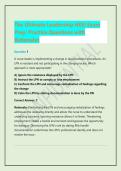
Question 1
A nurse leader is implementing a change in documentation procedures. An
LPN is resistant and not participating in the change process. Which
approach is most appropriate?
A) Ignore the resistance displayed by the LPN
B) Instruct the LPN to comply or lose employment
C) Confront the LPN and encourage verbalization of feelings regarding
the change
D) Calm the LPN by stating documentation is done by the RN
Correct Answer: C
Rationale: Confronting the LPN and encouraging verbalization of feelings
addresses the resistance directly and allows the nurse to understand the
underlying concerns. Ignoring resistance allows it to fester. Threatening
employment creates a hostile environment and bypasses the opportunity
for dialogue. Dismissing the LPN's role by stating RNs handle
documentation undermines the LPN's professional identity and does not
resolve the issue .
,Question 2
A discussion between team members results in serious conflict. The nurse
leader accepts the challenge and uses an adaptive style. Which leadership
theory is being applied?
A) Trait theory
B) Two-factor theory
C) Hierarchy of needs
D) Situational-contingency theory
Correct Answer: D
Rationale: Situational-contingency theory takes into account the challenge
of a situation and encourages an adaptive leadership style. Trait theory
focuses on self-awareness of traits to inspire others. Two-factor theory
addresses hygiene and motivator factors for work performance. Hierarchy
of needs theory holds that motivation is achieved by providing individuals
with a hierarchy of needs .
Question 3
The nurse leader has implemented a change in documentation. Which
action demonstrates effective change implementation?
A) Avoiding managerial skills
B) Using personal and professional skills
C) Avoiding giving timely feedback
D) Removing ineffective team members
Correct Answer: B
,Rationale: A nurse leader should use both personal and professional skills
to ensure effective implementation of change. Managerial skills should be
used, not avoided. Regular and timely feedback should be given to team
members. Motivation is more effective than removing team members .
Question 4
Calculate the productive hours for a staff nurse who took a 19-day vacation.
Assume an 8-hour workday and a standard 2080-hour work year.
A) 1848 hours
B) 1928 hours
C) 1984 hours
D) 2016 hours
Correct Answer: B
Rationale: Productive hours = Total working hours per year -
Nonproductive hours. Nonproductive hours = 19 vacation days × 8 hours =
152 hours. 2080 - 152 = 1,928 productive hours .
Question 5
Which model of nursing care includes working "within the walls" as well as
"beyond the walls" of the hospital?
A) Primary nursing method
B) Practice partnership model
, C) Patient-focused care model
D) Nursing case-management model
Correct Answer: D
Rationale: In the nursing case-management model, the nurse provides care
in nurse-managed centers, home health agencies, urgent care centers,
schools, and rural settings. Primary nursing involves a single nurse caring
for a client while hospitalized. Practice partnership pairs an RN with a
technical assistant. Patient-focused care pairs an RN with a cross-trained
technician .
Question 6
A nurse is caring for a client post-operative day 1 following abdominal
hysterectomy. The client reports pain and nausea. The nurse administers
prescribed medication. This action represents which level of care?
A) Primary care
B) Secondary care
C) Tertiary care
D) Essential care
Correct Answer: B
Rationale: Secondary care involves acute care services provided in a
hospital setting following surgery or for acute conditions. Primary care
focuses on health promotion and prevention. Tertiary care involves
specialized, highly technical services .
Prep: Practice Questions with
Rationales
Question 1
A nurse leader is implementing a change in documentation procedures. An
LPN is resistant and not participating in the change process. Which
approach is most appropriate?
A) Ignore the resistance displayed by the LPN
B) Instruct the LPN to comply or lose employment
C) Confront the LPN and encourage verbalization of feelings regarding
the change
D) Calm the LPN by stating documentation is done by the RN
Correct Answer: C
Rationale: Confronting the LPN and encouraging verbalization of feelings
addresses the resistance directly and allows the nurse to understand the
underlying concerns. Ignoring resistance allows it to fester. Threatening
employment creates a hostile environment and bypasses the opportunity
for dialogue. Dismissing the LPN's role by stating RNs handle
documentation undermines the LPN's professional identity and does not
resolve the issue .
,Question 2
A discussion between team members results in serious conflict. The nurse
leader accepts the challenge and uses an adaptive style. Which leadership
theory is being applied?
A) Trait theory
B) Two-factor theory
C) Hierarchy of needs
D) Situational-contingency theory
Correct Answer: D
Rationale: Situational-contingency theory takes into account the challenge
of a situation and encourages an adaptive leadership style. Trait theory
focuses on self-awareness of traits to inspire others. Two-factor theory
addresses hygiene and motivator factors for work performance. Hierarchy
of needs theory holds that motivation is achieved by providing individuals
with a hierarchy of needs .
Question 3
The nurse leader has implemented a change in documentation. Which
action demonstrates effective change implementation?
A) Avoiding managerial skills
B) Using personal and professional skills
C) Avoiding giving timely feedback
D) Removing ineffective team members
Correct Answer: B
,Rationale: A nurse leader should use both personal and professional skills
to ensure effective implementation of change. Managerial skills should be
used, not avoided. Regular and timely feedback should be given to team
members. Motivation is more effective than removing team members .
Question 4
Calculate the productive hours for a staff nurse who took a 19-day vacation.
Assume an 8-hour workday and a standard 2080-hour work year.
A) 1848 hours
B) 1928 hours
C) 1984 hours
D) 2016 hours
Correct Answer: B
Rationale: Productive hours = Total working hours per year -
Nonproductive hours. Nonproductive hours = 19 vacation days × 8 hours =
152 hours. 2080 - 152 = 1,928 productive hours .
Question 5
Which model of nursing care includes working "within the walls" as well as
"beyond the walls" of the hospital?
A) Primary nursing method
B) Practice partnership model
, C) Patient-focused care model
D) Nursing case-management model
Correct Answer: D
Rationale: In the nursing case-management model, the nurse provides care
in nurse-managed centers, home health agencies, urgent care centers,
schools, and rural settings. Primary nursing involves a single nurse caring
for a client while hospitalized. Practice partnership pairs an RN with a
technical assistant. Patient-focused care pairs an RN with a cross-trained
technician .
Question 6
A nurse is caring for a client post-operative day 1 following abdominal
hysterectomy. The client reports pain and nausea. The nurse administers
prescribed medication. This action represents which level of care?
A) Primary care
B) Secondary care
C) Tertiary care
D) Essential care
Correct Answer: B
Rationale: Secondary care involves acute care services provided in a
hospital setting following surgery or for acute conditions. Primary care
focuses on health promotion and prevention. Tertiary care involves
specialized, highly technical services .


