

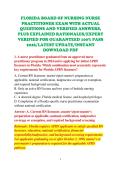
FLORIDA BOARD OF NURSING NURSE
PRACTITIONER EXAM WITH ACTUAL
QUESTIONS AND VERIFIED ANSWERS,
PLUS EXPLAINED RATIONALES/EXPERT
VERIFIED FOR GUARANTEED 100% PASS
2026/LATEST UPDATE/INSTANT
DOWNLOAD PDF
1. A nurse practitioner graduated from an approved nurse
practitioner program in 2024 and is applying for initial APRN
licensure in Florida. Which combination most accurately represents
key requirements for Florida APRN licensure?
A. Current RN licensure, master's/post-master's preparation as
applicable, national certification, malpractice coverage or exemption,
and required background screening
B. Only an active RN license and two years of bedside nursing
experience
C. A doctoral degree, Florida medical license, and hospital privileges
D. Completion of a Florida-specific nurse practitioner examination
without national certification
Answer: A. Current RN licensure, master's/post-master's
preparation as applicable, national certification, malpractice
coverage or exemption, and required background screening
Rationale: Florida requires APRN applicants to satisfy specified RN
licensure, education, national certification, financial-
responsibility/malpractice, and background-screening requirements.
For applicants graduating on or after October 1, 1998, master's or
post-master's preparation is required for the applicable APRN
pathway.
1
,2. A Florida nurse practitioner wants to practice autonomously
rather than under a physician supervisory protocol. Which
requirement is essential for autonomous APRN registration?
A. 500 hours of clinical experience as an RN
B. 1,000 hours of physician-supervised APRN practice
C. At least 3,000 qualifying clinical practice hours under physician
supervision during the preceding five years
D. Ten years of continuous Florida APRN licensure
Answer: C. At least 3,000 qualifying clinical practice hours under
physician supervision during the preceding five years
Rationale: Florida's autonomous APRN registration statute requires
at least 3,000 clinical practice hours within the five years preceding
the request, while practicing as an APRN under the supervision of an
appropriately licensed allopathic or osteopathic physician.
3. Which additional educational requirement applies to an APRN
seeking autonomous practice registration in Florida?
A. Three graduate-level semester hours of anatomy only
B. Three graduate-level semester hours in differential diagnosis and
three in pharmacology, completed within the preceding five years
C. Six undergraduate hours in microbiology
D. Three graduate-level hours in nursing leadership
Answer: B. Three graduate-level semester hours in differential
diagnosis and three in pharmacology, completed within the
preceding five years
Rationale: Florida requires applicants for autonomous APRN
registration to document three graduate-level semester hours, or
2
,equivalent, in differential diagnosis and three in pharmacology
completed within the previous five years.
4. A nurse practitioner applies for autonomous APRN registration
but received qualifying disciplinary action four years ago. What is
the most appropriate interpretation?
A. The disciplinary history is irrelevant if the NP has 3,000 hours
B. The NP automatically qualifies after paying an additional fee
C. The disciplinary history may prevent autonomous registration
because the statute addresses specified disciplinary actions during the
preceding five years
D. Only criminal convictions matter
Answer: C. The disciplinary history may prevent autonomous
registration because the statute addresses specified disciplinary
actions during the preceding five years
Rationale: Florida's autonomous-practice requirements include an
absence of specified disciplinary action under applicable Florida law,
or similar disciplinary action in another jurisdiction, during the five
years immediately preceding the registration request.
5. A Florida APRN practices under a supervisory protocol rather
than autonomous registration. What must the APRN generally
maintain at the practice location?
A. The physician's medical-school transcript
B. The established protocol
C. The patient's entire medical record
D. The physician's DEA application
Answer: B. The established protocol
3
, Rationale: Florida law provides that APRNs perform authorized
functions within an established protocol unless they are registered and
practicing under the autonomous-practice provisions. The protocol
must be maintained at the applicable practice location.
6. A patient presents with crushing substernal chest pain radiating
to the left arm, diaphoresis, and nausea. ECG demonstrates ST-
segment elevation in leads II, III, and aVF. What is the priority?
A. Schedule an outpatient stress test
B. Diagnose gastroesophageal reflux disease
C. Initiate an acute STEMI management pathway and arrange emergent
reperfusion evaluation
D. Prescribe a proton-pump inhibitor
Answer: C. Initiate an acute STEMI management pathway and
arrange emergent reperfusion evaluation
Rationale: ST elevation in contiguous inferior leads with a compatible
ischemic presentation is highly concerning for acute STEMI. The
priority is rapid stabilization, appropriate antiplatelet/anticoagulant
therapy when indicated, monitoring, and emergent reperfusion
evaluation rather than outpatient testing.
7. A 68-year-old patient has dyspnea, orthopnea, bilateral crackles,
elevated jugular venous pressure, and an S3 gallop. Which diagnosis
best explains the findings?
A. Acute decompensated heart failure
B. Stable angina
C. COPD exacerbation
D. Nephrolithiasis
Answer: A. Acute decompensated heart failure
4
PRACTITIONER EXAM WITH ACTUAL
QUESTIONS AND VERIFIED ANSWERS,
PLUS EXPLAINED RATIONALES/EXPERT
VERIFIED FOR GUARANTEED 100% PASS
2026/LATEST UPDATE/INSTANT
DOWNLOAD PDF
1. A nurse practitioner graduated from an approved nurse
practitioner program in 2024 and is applying for initial APRN
licensure in Florida. Which combination most accurately represents
key requirements for Florida APRN licensure?
A. Current RN licensure, master's/post-master's preparation as
applicable, national certification, malpractice coverage or exemption,
and required background screening
B. Only an active RN license and two years of bedside nursing
experience
C. A doctoral degree, Florida medical license, and hospital privileges
D. Completion of a Florida-specific nurse practitioner examination
without national certification
Answer: A. Current RN licensure, master's/post-master's
preparation as applicable, national certification, malpractice
coverage or exemption, and required background screening
Rationale: Florida requires APRN applicants to satisfy specified RN
licensure, education, national certification, financial-
responsibility/malpractice, and background-screening requirements.
For applicants graduating on or after October 1, 1998, master's or
post-master's preparation is required for the applicable APRN
pathway.
1
,2. A Florida nurse practitioner wants to practice autonomously
rather than under a physician supervisory protocol. Which
requirement is essential for autonomous APRN registration?
A. 500 hours of clinical experience as an RN
B. 1,000 hours of physician-supervised APRN practice
C. At least 3,000 qualifying clinical practice hours under physician
supervision during the preceding five years
D. Ten years of continuous Florida APRN licensure
Answer: C. At least 3,000 qualifying clinical practice hours under
physician supervision during the preceding five years
Rationale: Florida's autonomous APRN registration statute requires
at least 3,000 clinical practice hours within the five years preceding
the request, while practicing as an APRN under the supervision of an
appropriately licensed allopathic or osteopathic physician.
3. Which additional educational requirement applies to an APRN
seeking autonomous practice registration in Florida?
A. Three graduate-level semester hours of anatomy only
B. Three graduate-level semester hours in differential diagnosis and
three in pharmacology, completed within the preceding five years
C. Six undergraduate hours in microbiology
D. Three graduate-level hours in nursing leadership
Answer: B. Three graduate-level semester hours in differential
diagnosis and three in pharmacology, completed within the
preceding five years
Rationale: Florida requires applicants for autonomous APRN
registration to document three graduate-level semester hours, or
2
,equivalent, in differential diagnosis and three in pharmacology
completed within the previous five years.
4. A nurse practitioner applies for autonomous APRN registration
but received qualifying disciplinary action four years ago. What is
the most appropriate interpretation?
A. The disciplinary history is irrelevant if the NP has 3,000 hours
B. The NP automatically qualifies after paying an additional fee
C. The disciplinary history may prevent autonomous registration
because the statute addresses specified disciplinary actions during the
preceding five years
D. Only criminal convictions matter
Answer: C. The disciplinary history may prevent autonomous
registration because the statute addresses specified disciplinary
actions during the preceding five years
Rationale: Florida's autonomous-practice requirements include an
absence of specified disciplinary action under applicable Florida law,
or similar disciplinary action in another jurisdiction, during the five
years immediately preceding the registration request.
5. A Florida APRN practices under a supervisory protocol rather
than autonomous registration. What must the APRN generally
maintain at the practice location?
A. The physician's medical-school transcript
B. The established protocol
C. The patient's entire medical record
D. The physician's DEA application
Answer: B. The established protocol
3
, Rationale: Florida law provides that APRNs perform authorized
functions within an established protocol unless they are registered and
practicing under the autonomous-practice provisions. The protocol
must be maintained at the applicable practice location.
6. A patient presents with crushing substernal chest pain radiating
to the left arm, diaphoresis, and nausea. ECG demonstrates ST-
segment elevation in leads II, III, and aVF. What is the priority?
A. Schedule an outpatient stress test
B. Diagnose gastroesophageal reflux disease
C. Initiate an acute STEMI management pathway and arrange emergent
reperfusion evaluation
D. Prescribe a proton-pump inhibitor
Answer: C. Initiate an acute STEMI management pathway and
arrange emergent reperfusion evaluation
Rationale: ST elevation in contiguous inferior leads with a compatible
ischemic presentation is highly concerning for acute STEMI. The
priority is rapid stabilization, appropriate antiplatelet/anticoagulant
therapy when indicated, monitoring, and emergent reperfusion
evaluation rather than outpatient testing.
7. A 68-year-old patient has dyspnea, orthopnea, bilateral crackles,
elevated jugular venous pressure, and an S3 gallop. Which diagnosis
best explains the findings?
A. Acute decompensated heart failure
B. Stable angina
C. COPD exacerbation
D. Nephrolithiasis
Answer: A. Acute decompensated heart failure
4


