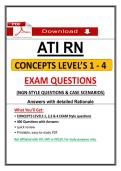
ATI RN
CONCEPTS LEVEL’S 1 - 4
EXAM QUESTIONS
(NGN-STYLE QUESTIONS & CASE SCENARIOS)
Answers with detailed Rationale
What You’ll Get:
• CONCEPTS LEVELS 1, 2,3 & 4 EXAM Style questions
• 400 Questions with Answers
• quick review
• Printable, easy-to-study PDF
Not affiliated with ATI, VATI or NCLEX. For study purposes only.
,PREVIEW QUESTIONS BELOW
GET THE COMPLETE PDF
AFTER PURCHASE
“ If you require further clarification
or in need of any study resources,
feel free to Message me.
”
,Table of Contents
ATI RN CONCEPTS LEVEL 1 EXAM ......................................... 2
ATI RN CONCEPTS LEVEL 2 EXAM ....................................... 52
ATI RN CONCEPTS LEVEL 3 EXAM ..................................... 121
ATI RN CONCEPTS LEVEL 4 EXAM ..................................... 192
ATI RN CONCEPTS LEVEL 1 EXAM
QUESTION 1 (Pharmacology/Pain Management)
A nurse is caring for a client who is 2 days postoperative following an above-the-
knee amputation. The client states he is experiencing a dull, burning pain in the
leg that was amputated. Which of the following actions should the nurse take to
treat the client's neuropathic pain?
A. Administer a beta-blocking medication to the client
B. Administer an opioid analgesic PRN
C. Apply ice packs to the residual limb
D. Elevate the residual limb on pillows
Correct Answer: A
Rationale: The nurse should administer a beta-blocking medication to the client. This
classification of medication has been shown to relieve phantom limb pain manifestations
of constant dull and burning type pain. Beta-blockers such as propranolol can help
manage the neuropathic component of phantom limb pain by affecting sympathetic
nervous system activity. Opioids are less effective for neuropathic pain, and
ice/elevation address physical comfort but not the neuropathic mechanism.
QUESTION 2 (Legal/Ethical)
,A newly licensed nurse asks a charge nurse where to find information about
scope of practice for registered nurses. Which of the following responses should
the charge nurse make?
A. "The state board of nursing can provide this information"
B. "Check with the hospital's legal department"
C. "Review the ANA Code of Ethics for Nurses"
D. "Consult the facility's policy and procedure manual"
Correct Answer: A
Rationale: Each state develops a Nurse Practice Act, which defines scope of practice
for nurses in that state. This practice act is available on the board of nursing website for
each state and is the legal authority governing nursing practice. While the ANA Code of
Ethics and facility policies provide guidance, only the state board of nursing defines
legal scope of practice.
QUESTION 3 (Infection Control)
A nurse is planning care to prevent a catheter-related bloodstream infection
(CLABSI) for a client who is receiving IV fluid therapy. Which of the following
interventions should the nurse include in the plan? (Select All That Apply)
A. Perform hand hygiene before touching the IV tubing
B. Change the IV tubing every 24 hours
C. Use chlorhexidine skin preparation before insertion
D. Apply a transparent dressing over the insertion site
E. Replace the catheter every 72 hours routinely
Correct Answers: A, C, D
Rationale:
• A: The nurse should perform thorough hand hygiene before touching any part of
the infusion system or the client to reduce the risk of catheter-related
bloodstream infections.
• C: Chlorhexidine is the preferred antiseptic for skin preparation before central
line insertion.
• D: Transparent dressings allow visualization of the insertion site while
maintaining a sterile barrier.
• B is incorrect: Tubing changes depend on solution type (every 72-96 hours for
continuous infusions, not daily).
, • E is incorrect: Catheters should not be routinely replaced; they are changed
based on clinical indication or complication.
QUESTION 4 (Skin Integrity)
A nurse is creating a plan of care for a client who is non-ambulatory and has
bladder and bowel incontinence. Which of the following interventions should the
nurse include to prevent skin breakdown?
A. Apply moisture barrier cream every 4 hours
B. Offer the client a glass of water every two hours
C. Use an incontinence pad and change every 8 hours
D. Position the client in supine position continuously
Correct Answer: B
Rationale: The nurse should offer the client a glass of water every two hours on the
client's repositioning schedule. This helps prevent dehydration, which increases the risk
of skin breakdown. Proper hydration maintains skin turgor and elasticity. While moisture
barriers are important, they should be applied with each incontinence episode, not on a
timed schedule. Incontinence pads must be changed immediately when soiled, not
every 8 hours.
QUESTION 5 (Health Promotion)
A nurse is teaching a young adult female client about health screening for breast
cancer. Which of the following statements by the client indicates an
understanding of breast self-examination (BSE)?
A. "I should expect to feel a firm ridge along the bottom curve of each breast"
B. "I should perform BSE only if I notice a lump"
C. "BSE should be performed during my menstrual period"
D. "I should press firmly to detect any deep tissue abnormalities"
Correct Answer: A
Rationale: The nurse should instruct the client that a firm ridge is expected along the
bottom curve of each breast (the inframammary ridge). The client should be able to feel
this area during BSE. Performing BSE promotes breast self-awareness so that the client
knows how her breasts normally feel. This awareness increases the client's ability to
identify changes that require further evaluation. BSE should be performed monthly, 3-5
,days after menstruation ends, using light, medium, and firm pressure in a systematic
pattern.
QUESTION 6 (Psychosocial/Grief and Loss)
A nurse is caring for an adolescent who is in critical condition following a motor
vehicle crash in which he was the passenger. The client's parent shouts at the
nurse, asking why her son is dying instead of the driver. Which of the following
actions should the nurse take to provide emotional support to the parent?
A. Inform the parent that anger is a natural response when dealing with loss
B. Tell the parent that the driver was also injured
C. Suggest the parent speak with the hospital chaplain
D. Remain silent until the parent calms down
Correct Answer: A
Rationale: The nurse should identify that the parent is in the anger stage of grief. The
nurse should assist the parent to understand that anger is a natural response to loss
and encourage her to talk about her feelings. This therapeutic communication validates
the parent's emotions and establishes trust. Kübler-Ross's stages of grief include denial,
anger, bargaining, depression, and acceptance.
QUESTION 7 (Informatics/Health Literacy)
A nurse is teaching an older adult client about accessing electronic resources for
healthcare information on the internet. Which of the following statements should
the nurse include in the teaching?
A. "Websites ending in '.gov' are reliable sites for obtaining health information from
government sources"
B. "Social media health groups provide the most current information"
C. "Any website that appears professional is trustworthy"
D. "Wikipedia is a good starting point for medical research"
Correct Answer: A
Rationale: The nurse should teach the client how to select reliable internet websites
when researching health care information. The nurse should identify that websites
ending in '.gov' (government) and '.edu' (educational institutions) are considered reliable
and credible sources for health information. Websites ending in '.com' should be
,evaluated carefully, and '.org' sites vary in credibility. Social media and Wikipedia are
not reliable sources for medical information.
QUESTION 8 (Safety/Prioritization)
A nurse enters a client's room and finds the client lying on the floor. The client
states that on the way to the bathroom her "knee locked," causing her to fall.
Which of the following actions should the nurse take first?
A. Check the client for injuries
B. Call for a provider's order for X-rays
C. Document the fall in the medical record
D. Assist the client back to bed
Correct Answer: A
Rationale: The first action the nurse should take when using the nursing process is to
assess the client. The nurse should first check the client for injuries and measure vital
signs to help determine physiologic stability. The nurse should also inform the provider
of the client's fall and assessment findings. Never move a client after a fall until injuries
are assessed, as this could worsen potential fractures or spinal injuries.
QUESTION 9 (Comfort/Alternative Therapies)
A nurse is teaching a client who has rheumatoid arthritis about chronic pain
management. Which of the following statements by the client indicates an
understanding of the teaching?
A. "I should use a warm paraffin dip for my hands and feet"
B. "I should apply ice packs to my joints for 30 minutes daily"
C. "I should avoid exercise to prevent joint damage"
D. "I should take my pain medication only when pain is severe"
Correct Answer: A
Rationale: The nurse should instruct the client to dip her hands and feet in warm
paraffin to alleviate pain and stiffness. The client can more easily perform hand and
finger exercises following the treatment. Heat therapy increases blood flow and reduces
stiffness in rheumatoid arthritis. Ice is contraindicated for chronic RA pain, regular
exercise preserves joint function, and pain medication should be taken as prescribed for
chronic management, not PRN only.
,QUESTION 10 (Community Health/Epidemiology)
A community health nurse is planning prevention strategies for hypertension
among members of her community. The nurse should identify that which of the
following ethnic groups in the community is at greatest risk of developing
hypertension?
A. African American
B. Hispanic/Latino
C. Asian American
D. Caucasian
Correct Answer: A
Rationale: Evidence-based practice indicates that individuals of African American
ethnicity have the highest prevalence of hypertension. They tend to develop
hypertension earlier in life, with higher average blood pressures and greater target-
organ damage. Therefore, the nurse should identify community members of this
ethnicity as being at greatest risk and prioritize prevention strategies accordingly.
QUESTION 11 (Safety/Emergency Response)
A nurse is preparing to extinguish a small fire in a client's room. Which of the
following actions should the nurse take when using the fire extinguisher?
A. Slide the pin on top of the fire extinguisher straight out
B. Aim at the top of the flames
C. Shake the extinguisher vigorously before use
D. Hold the extinguisher upside down
Correct Answer: A
Rationale: The nurse should pull the pin on top of the fire extinguisher to allow for use
to extinguish the fire. The PASS acronym guides proper use: Pull the pin, Aim at the
base of the fire, Squeeze the handle, and Sweep from side to side. Aiming at the base
of the fire, not the top, is essential for effective extinguishing.
QUESTION 12 (Nutrition/Enteral Feeding - Prioritization/Ordered Response)
A nurse is preparing to administer intermittent enteral nutrition via a client's NG
tube. In which order should the nurse take the following actions? (Ordered
Response)
, 1. Assist the client to an upright position
2. Aspirate 5mL of gastric contents
3. Test the pH of gastric aspirate
4. Measure gastric residual volume
5. Flush the NG tube with 30mL of water
Correct Order: 1 → 2 → 3 → 4 → 5
Rationale:
• First: The nurse should assist the client into high Fowler's position or raise the
HOB at least 30 degrees to help prevent aspiration.
• Second: The nurse should verify the tube's placement by aspirating 5mL of
gastric contents.
• Third: Test the pH of gastric aspirate (should be ≤5.5 for gastric placement).
• Fourth: Check for gastric residual volume. Excessive GRV (>500mL) is an
indication of delayed gastric emptying, which places the client at risk of
aspiration.
• Finally: Flush the tubing with 30mL of water to ensure the tube is clear and
patent.
QUESTION 13 (Assessment/Urinary Elimination)
A nurse is caring for a 47-year-old female client who has urinary incontinence.
Which of the following actions should the nurse take first?
A. Obtain a specimen from the client for urinalysis
B. Teach the client pelvic floor exercises
C. Implement a scheduled toileting program
D. Apply absorbent incontinence products
Correct Answer: A
Rationale: The first action the nurse should take when using the nursing process is
assessment. The nurse should obtain a urine specimen from the client to rule out a
UTI. If it is determined the client has RBCs and WBCs in the urine, the specimen will
require a culture. If it is determined that the client has a UTI, this will require treatment
before any further assessment of incontinence would be appropriate. Treating the
underlying cause takes priority over symptom management.
, QUESTION 14 (Psychosocial/Therapeutic Communication)
A nurse is talking with a client who has a major depressive disorder. The client
states, "Nobody cares if I'm around or not." Which of the following responses
should the nurse make?
A. "It sounds as though you're feeling isolated and alone"
B. "Your family visits you every day, so they obviously care"
C. "You should focus on the positive things in your life"
D. "Have you been thinking about hurting yourself?"
Correct Answer: A
Rationale: This statement by the nurse is an example of restatement, which is a
therapeutic response. This technique restates the main idea the client has expressed
and allows the client to clarify any misperceptions. It validates the client's feelings
without being judgmental. While D (assessing for suicidal ideation) is important,
establishing rapport through therapeutic communication comes first in this context.
QUESTION 15 (Safety/Blood Administration)
A charge nurse is teaching a group of newly licensed nurses how to prevent
errors during administration of blood transfusions. Which of the following actions
should the nurse include? (Select All That Apply)
A. Use a new blood administration tubing set for each blood bag
B. Prime the tubing with D5W solution
C. Remain with the client during the first 15 minutes of the transfusion
D. Verify client identity using two identifiers
E. Check blood product with another qualified healthcare provider
Correct Answers: A, C, D, E
Rationale:
• A: The nurse should use a new blood infusion tubing set for each component of
blood. A blood infusion set should not be reused, even for the same client.
• C: The first 15 minutes are critical as acute hemolytic reactions typically manifest
during this period.
• D: Two identifiers (name, DOB, medical record number) must be used per TJC
standards.
CONCEPTS LEVEL’S 1 - 4
EXAM QUESTIONS
(NGN-STYLE QUESTIONS & CASE SCENARIOS)
Answers with detailed Rationale
What You’ll Get:
• CONCEPTS LEVELS 1, 2,3 & 4 EXAM Style questions
• 400 Questions with Answers
• quick review
• Printable, easy-to-study PDF
Not affiliated with ATI, VATI or NCLEX. For study purposes only.
,PREVIEW QUESTIONS BELOW
GET THE COMPLETE PDF
AFTER PURCHASE
“ If you require further clarification
or in need of any study resources,
feel free to Message me.
”
,Table of Contents
ATI RN CONCEPTS LEVEL 1 EXAM ......................................... 2
ATI RN CONCEPTS LEVEL 2 EXAM ....................................... 52
ATI RN CONCEPTS LEVEL 3 EXAM ..................................... 121
ATI RN CONCEPTS LEVEL 4 EXAM ..................................... 192
ATI RN CONCEPTS LEVEL 1 EXAM
QUESTION 1 (Pharmacology/Pain Management)
A nurse is caring for a client who is 2 days postoperative following an above-the-
knee amputation. The client states he is experiencing a dull, burning pain in the
leg that was amputated. Which of the following actions should the nurse take to
treat the client's neuropathic pain?
A. Administer a beta-blocking medication to the client
B. Administer an opioid analgesic PRN
C. Apply ice packs to the residual limb
D. Elevate the residual limb on pillows
Correct Answer: A
Rationale: The nurse should administer a beta-blocking medication to the client. This
classification of medication has been shown to relieve phantom limb pain manifestations
of constant dull and burning type pain. Beta-blockers such as propranolol can help
manage the neuropathic component of phantom limb pain by affecting sympathetic
nervous system activity. Opioids are less effective for neuropathic pain, and
ice/elevation address physical comfort but not the neuropathic mechanism.
QUESTION 2 (Legal/Ethical)
,A newly licensed nurse asks a charge nurse where to find information about
scope of practice for registered nurses. Which of the following responses should
the charge nurse make?
A. "The state board of nursing can provide this information"
B. "Check with the hospital's legal department"
C. "Review the ANA Code of Ethics for Nurses"
D. "Consult the facility's policy and procedure manual"
Correct Answer: A
Rationale: Each state develops a Nurse Practice Act, which defines scope of practice
for nurses in that state. This practice act is available on the board of nursing website for
each state and is the legal authority governing nursing practice. While the ANA Code of
Ethics and facility policies provide guidance, only the state board of nursing defines
legal scope of practice.
QUESTION 3 (Infection Control)
A nurse is planning care to prevent a catheter-related bloodstream infection
(CLABSI) for a client who is receiving IV fluid therapy. Which of the following
interventions should the nurse include in the plan? (Select All That Apply)
A. Perform hand hygiene before touching the IV tubing
B. Change the IV tubing every 24 hours
C. Use chlorhexidine skin preparation before insertion
D. Apply a transparent dressing over the insertion site
E. Replace the catheter every 72 hours routinely
Correct Answers: A, C, D
Rationale:
• A: The nurse should perform thorough hand hygiene before touching any part of
the infusion system or the client to reduce the risk of catheter-related
bloodstream infections.
• C: Chlorhexidine is the preferred antiseptic for skin preparation before central
line insertion.
• D: Transparent dressings allow visualization of the insertion site while
maintaining a sterile barrier.
• B is incorrect: Tubing changes depend on solution type (every 72-96 hours for
continuous infusions, not daily).
, • E is incorrect: Catheters should not be routinely replaced; they are changed
based on clinical indication or complication.
QUESTION 4 (Skin Integrity)
A nurse is creating a plan of care for a client who is non-ambulatory and has
bladder and bowel incontinence. Which of the following interventions should the
nurse include to prevent skin breakdown?
A. Apply moisture barrier cream every 4 hours
B. Offer the client a glass of water every two hours
C. Use an incontinence pad and change every 8 hours
D. Position the client in supine position continuously
Correct Answer: B
Rationale: The nurse should offer the client a glass of water every two hours on the
client's repositioning schedule. This helps prevent dehydration, which increases the risk
of skin breakdown. Proper hydration maintains skin turgor and elasticity. While moisture
barriers are important, they should be applied with each incontinence episode, not on a
timed schedule. Incontinence pads must be changed immediately when soiled, not
every 8 hours.
QUESTION 5 (Health Promotion)
A nurse is teaching a young adult female client about health screening for breast
cancer. Which of the following statements by the client indicates an
understanding of breast self-examination (BSE)?
A. "I should expect to feel a firm ridge along the bottom curve of each breast"
B. "I should perform BSE only if I notice a lump"
C. "BSE should be performed during my menstrual period"
D. "I should press firmly to detect any deep tissue abnormalities"
Correct Answer: A
Rationale: The nurse should instruct the client that a firm ridge is expected along the
bottom curve of each breast (the inframammary ridge). The client should be able to feel
this area during BSE. Performing BSE promotes breast self-awareness so that the client
knows how her breasts normally feel. This awareness increases the client's ability to
identify changes that require further evaluation. BSE should be performed monthly, 3-5
,days after menstruation ends, using light, medium, and firm pressure in a systematic
pattern.
QUESTION 6 (Psychosocial/Grief and Loss)
A nurse is caring for an adolescent who is in critical condition following a motor
vehicle crash in which he was the passenger. The client's parent shouts at the
nurse, asking why her son is dying instead of the driver. Which of the following
actions should the nurse take to provide emotional support to the parent?
A. Inform the parent that anger is a natural response when dealing with loss
B. Tell the parent that the driver was also injured
C. Suggest the parent speak with the hospital chaplain
D. Remain silent until the parent calms down
Correct Answer: A
Rationale: The nurse should identify that the parent is in the anger stage of grief. The
nurse should assist the parent to understand that anger is a natural response to loss
and encourage her to talk about her feelings. This therapeutic communication validates
the parent's emotions and establishes trust. Kübler-Ross's stages of grief include denial,
anger, bargaining, depression, and acceptance.
QUESTION 7 (Informatics/Health Literacy)
A nurse is teaching an older adult client about accessing electronic resources for
healthcare information on the internet. Which of the following statements should
the nurse include in the teaching?
A. "Websites ending in '.gov' are reliable sites for obtaining health information from
government sources"
B. "Social media health groups provide the most current information"
C. "Any website that appears professional is trustworthy"
D. "Wikipedia is a good starting point for medical research"
Correct Answer: A
Rationale: The nurse should teach the client how to select reliable internet websites
when researching health care information. The nurse should identify that websites
ending in '.gov' (government) and '.edu' (educational institutions) are considered reliable
and credible sources for health information. Websites ending in '.com' should be
,evaluated carefully, and '.org' sites vary in credibility. Social media and Wikipedia are
not reliable sources for medical information.
QUESTION 8 (Safety/Prioritization)
A nurse enters a client's room and finds the client lying on the floor. The client
states that on the way to the bathroom her "knee locked," causing her to fall.
Which of the following actions should the nurse take first?
A. Check the client for injuries
B. Call for a provider's order for X-rays
C. Document the fall in the medical record
D. Assist the client back to bed
Correct Answer: A
Rationale: The first action the nurse should take when using the nursing process is to
assess the client. The nurse should first check the client for injuries and measure vital
signs to help determine physiologic stability. The nurse should also inform the provider
of the client's fall and assessment findings. Never move a client after a fall until injuries
are assessed, as this could worsen potential fractures or spinal injuries.
QUESTION 9 (Comfort/Alternative Therapies)
A nurse is teaching a client who has rheumatoid arthritis about chronic pain
management. Which of the following statements by the client indicates an
understanding of the teaching?
A. "I should use a warm paraffin dip for my hands and feet"
B. "I should apply ice packs to my joints for 30 minutes daily"
C. "I should avoid exercise to prevent joint damage"
D. "I should take my pain medication only when pain is severe"
Correct Answer: A
Rationale: The nurse should instruct the client to dip her hands and feet in warm
paraffin to alleviate pain and stiffness. The client can more easily perform hand and
finger exercises following the treatment. Heat therapy increases blood flow and reduces
stiffness in rheumatoid arthritis. Ice is contraindicated for chronic RA pain, regular
exercise preserves joint function, and pain medication should be taken as prescribed for
chronic management, not PRN only.
,QUESTION 10 (Community Health/Epidemiology)
A community health nurse is planning prevention strategies for hypertension
among members of her community. The nurse should identify that which of the
following ethnic groups in the community is at greatest risk of developing
hypertension?
A. African American
B. Hispanic/Latino
C. Asian American
D. Caucasian
Correct Answer: A
Rationale: Evidence-based practice indicates that individuals of African American
ethnicity have the highest prevalence of hypertension. They tend to develop
hypertension earlier in life, with higher average blood pressures and greater target-
organ damage. Therefore, the nurse should identify community members of this
ethnicity as being at greatest risk and prioritize prevention strategies accordingly.
QUESTION 11 (Safety/Emergency Response)
A nurse is preparing to extinguish a small fire in a client's room. Which of the
following actions should the nurse take when using the fire extinguisher?
A. Slide the pin on top of the fire extinguisher straight out
B. Aim at the top of the flames
C. Shake the extinguisher vigorously before use
D. Hold the extinguisher upside down
Correct Answer: A
Rationale: The nurse should pull the pin on top of the fire extinguisher to allow for use
to extinguish the fire. The PASS acronym guides proper use: Pull the pin, Aim at the
base of the fire, Squeeze the handle, and Sweep from side to side. Aiming at the base
of the fire, not the top, is essential for effective extinguishing.
QUESTION 12 (Nutrition/Enteral Feeding - Prioritization/Ordered Response)
A nurse is preparing to administer intermittent enteral nutrition via a client's NG
tube. In which order should the nurse take the following actions? (Ordered
Response)
, 1. Assist the client to an upright position
2. Aspirate 5mL of gastric contents
3. Test the pH of gastric aspirate
4. Measure gastric residual volume
5. Flush the NG tube with 30mL of water
Correct Order: 1 → 2 → 3 → 4 → 5
Rationale:
• First: The nurse should assist the client into high Fowler's position or raise the
HOB at least 30 degrees to help prevent aspiration.
• Second: The nurse should verify the tube's placement by aspirating 5mL of
gastric contents.
• Third: Test the pH of gastric aspirate (should be ≤5.5 for gastric placement).
• Fourth: Check for gastric residual volume. Excessive GRV (>500mL) is an
indication of delayed gastric emptying, which places the client at risk of
aspiration.
• Finally: Flush the tubing with 30mL of water to ensure the tube is clear and
patent.
QUESTION 13 (Assessment/Urinary Elimination)
A nurse is caring for a 47-year-old female client who has urinary incontinence.
Which of the following actions should the nurse take first?
A. Obtain a specimen from the client for urinalysis
B. Teach the client pelvic floor exercises
C. Implement a scheduled toileting program
D. Apply absorbent incontinence products
Correct Answer: A
Rationale: The first action the nurse should take when using the nursing process is
assessment. The nurse should obtain a urine specimen from the client to rule out a
UTI. If it is determined the client has RBCs and WBCs in the urine, the specimen will
require a culture. If it is determined that the client has a UTI, this will require treatment
before any further assessment of incontinence would be appropriate. Treating the
underlying cause takes priority over symptom management.
, QUESTION 14 (Psychosocial/Therapeutic Communication)
A nurse is talking with a client who has a major depressive disorder. The client
states, "Nobody cares if I'm around or not." Which of the following responses
should the nurse make?
A. "It sounds as though you're feeling isolated and alone"
B. "Your family visits you every day, so they obviously care"
C. "You should focus on the positive things in your life"
D. "Have you been thinking about hurting yourself?"
Correct Answer: A
Rationale: This statement by the nurse is an example of restatement, which is a
therapeutic response. This technique restates the main idea the client has expressed
and allows the client to clarify any misperceptions. It validates the client's feelings
without being judgmental. While D (assessing for suicidal ideation) is important,
establishing rapport through therapeutic communication comes first in this context.
QUESTION 15 (Safety/Blood Administration)
A charge nurse is teaching a group of newly licensed nurses how to prevent
errors during administration of blood transfusions. Which of the following actions
should the nurse include? (Select All That Apply)
A. Use a new blood administration tubing set for each blood bag
B. Prime the tubing with D5W solution
C. Remain with the client during the first 15 minutes of the transfusion
D. Verify client identity using two identifiers
E. Check blood product with another qualified healthcare provider
Correct Answers: A, C, D, E
Rationale:
• A: The nurse should use a new blood infusion tubing set for each component of
blood. A blood infusion set should not be reused, even for the same client.
• C: The first 15 minutes are critical as acute hemolytic reactions typically manifest
during this period.
• D: Two identifiers (name, DOB, medical record number) must be used per TJC
standards.