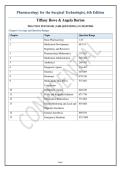
Pharmacology for the Surgical Technologist, 6th Edition
Tiffany Howe & Angela Burton
PRACTICE TEST BANK | 1,000 QUESTIONS | 15 CHAPTERS
Chapter Coverage and Question Ranges
Chapter Topic Question Range
1 Basic Pharmacology 1-67
2 Medication Development, 68-134
Regulation, and Resources
3 Pharmacology Mathematics 135-201
4 Medication Administration 202-268
5 Antibiotics 269-335
6 Diagnostic Agents 336-402
7 Diuretics 403-469
8 Hormones 470-536
9 Medications That Affect 537-603
Coagulation
10 Ophthalmic Agents 604-670
11 Fluids and Irrigation Solutions 671-736
12 Preoperative Medications 737-802
13 Patient Monitoring and Local and 803-868
Regional Anesthesia
14 General Anesthesia 869-934
15 Emergency Situations 935-1000
Page 1
,Chapter 1: Basic Pharmacology | Questions 1-67
1. In the context of this chapter, which statement best describes a drug's therapeutic effect?
A. Any unexpected harmful response
B. The rate of renal excretion
C. The trade name assigned by a manufacturer
D. The intended beneficial response
Correct Answer: D | Rationale: A therapeutic effect is the intended beneficial clinical response to a
medication. Option D is the best answer because “The intended beneficial response” directly applies the
concept, priority, or action tested in the stem. The other choices either address a different concept or are less
appropriate for this specific situation. This distinction supports safe medication practice and patient
protection in the perioperative setting.
2. A medication with a narrow therapeutic index generally requires which approach?
A. Administration only by the intravenous route
B. Closer monitoring of response and, when indicated, serum levels
C. Automatic doubling of the first dose
D. Less monitoring because toxicity is unlikely
Correct Answer: B | Rationale: A narrow therapeutic index means the effective and toxic concentrations
are relatively close, so careful monitoring is important. Option B is the best answer because “Closer
monitoring of response and, when indicated, serum levels” directly applies the concept, priority, or action
tested in the stem. The other choices either address a different concept or are less appropriate for this specific
situation. This distinction supports safe medication practice and patient protection in the perioperative
setting.
3. Which action most directly reduces preventable medication harm?
A. Using abbreviations whenever possible
B. Relying on memory rather than current references
C. Verifying the patient, drug, dose, route, time, and relevant clinical data
D. Administering all medications before assessment
Correct Answer: C | Rationale: Systematic verification and patient assessment are core safeguards against
medication errors. Option C is the best answer because “Verifying the patient, drug, dose, route, time, and
relevant clinical data” directly applies the concept, priority, or action tested in the stem. The other choices
either address a different concept or are less appropriate for this specific situation. This distinction supports
safe medication practice and patient protection in the perioperative setting.
Page 2
,4. In a clinical conference covering Basic Pharmacology, the operating-room technologist is asked to
choose the best answer. Select the best-supported response. In the context of this chapter, which
statement best describes a drug's therapeutic effect?
A. Any unexpected harmful response
B. The intended beneficial response
C. The rate of renal excretion
D. The trade name assigned by a manufacturer
Correct Answer: B | Rationale: A therapeutic effect is the intended beneficial clinical response to a
medication. Option B is the best answer because “The intended beneficial response” directly applies the
concept, priority, or action tested in the stem. The other choices either address a different concept or are less
appropriate for this specific situation. This distinction supports safe medication practice and patient
protection in the perioperative setting.
5. During an applied-learning exercise on Basic Pharmacology, the surgical technologist selects the
best response to this item. Identify the most appropriate answer. A medication with a narrow
therapeutic index generally requires which approach?
A. Administration only by the intravenous route
B. Automatic doubling of the first dose
C. Less monitoring because toxicity is unlikely
D. Closer monitoring of response and, when indicated, serum levels
Correct Answer: D | Rationale: A narrow therapeutic index means the effective and toxic concentrations
are relatively close, so careful monitoring is important. Option D is the best answer because “Closer
monitoring of response and, when indicated, serum levels” directly applies the concept, priority, or action
tested in the stem. The other choices either address a different concept or are less appropriate for this specific
situation. This distinction supports safe medication practice and patient protection in the perioperative
setting.
6. During a teaching session on Basic Pharmacology, the surgical technology student is asked to select
the best answer. Choose the single best response. Which action most directly reduces preventable
medication harm?
A. Administering all medications before assessment
B. Using abbreviations whenever possible
C. Relying on memory rather than current references
D. Verifying the patient, drug, dose, route, time, and relevant clinical data
Correct Answer: D | Rationale: Systematic verification and patient assessment are core safeguards against
medication errors. Option D is the best answer because “Verifying the patient, drug, dose, route, time, and
Page 3
, relevant clinical data” directly applies the concept, priority, or action tested in the stem. The other choices
either address a different concept or are less appropriate for this specific situation. This distinction supports
safe medication practice and patient protection in the perioperative setting.
7. While preparing for a case involving Basic Pharmacology, the perioperative team member reviews
this question. Focus on the safest and most clinically appropriate response. In the context of this
chapter, which statement best describes a drug's therapeutic effect?
A. The intended beneficial response
B. The trade name assigned by a manufacturer
C. The rate of renal excretion
D. Any unexpected harmful response
Correct Answer: A | Rationale: A therapeutic effect is the intended beneficial clinical response to a
medication. Option A is the best answer because “The intended beneficial response” directly applies the
concept, priority, or action tested in the stem. The other choices either address a different concept or are less
appropriate for this specific situation. This distinction supports safe medication practice and patient
protection in the perioperative setting.
8. In preparation for clinical decision-making involving Basic Pharmacology, the operating-room
technologist reviews this question. Select the response that best fits the situation. A medication with a
narrow therapeutic index generally requires which approach?
A. Less monitoring because toxicity is unlikely
B. Administration only by the intravenous route
C. Closer monitoring of response and, when indicated, serum levels
D. Automatic doubling of the first dose
Correct Answer: C | Rationale: A narrow therapeutic index means the effective and toxic concentrations
are relatively close, so careful monitoring is important. Option C is the best answer because “Closer
monitoring of response and, when indicated, serum levels” directly applies the concept, priority, or action
tested in the stem. The other choices either address a different concept or are less appropriate for this specific
situation. This distinction supports safe medication practice and patient protection in the perioperative
setting.
9. While preparing for practice involving Basic Pharmacology, the surgical technologist reviews the
following item. Apply the chapter concepts carefully. Which action most directly reduces preventable
medication harm?
A. Using abbreviations whenever possible
B. Administering all medications before assessment
C. Relying on memory rather than current references
Page 4
Tiffany Howe & Angela Burton
PRACTICE TEST BANK | 1,000 QUESTIONS | 15 CHAPTERS
Chapter Coverage and Question Ranges
Chapter Topic Question Range
1 Basic Pharmacology 1-67
2 Medication Development, 68-134
Regulation, and Resources
3 Pharmacology Mathematics 135-201
4 Medication Administration 202-268
5 Antibiotics 269-335
6 Diagnostic Agents 336-402
7 Diuretics 403-469
8 Hormones 470-536
9 Medications That Affect 537-603
Coagulation
10 Ophthalmic Agents 604-670
11 Fluids and Irrigation Solutions 671-736
12 Preoperative Medications 737-802
13 Patient Monitoring and Local and 803-868
Regional Anesthesia
14 General Anesthesia 869-934
15 Emergency Situations 935-1000
Page 1
,Chapter 1: Basic Pharmacology | Questions 1-67
1. In the context of this chapter, which statement best describes a drug's therapeutic effect?
A. Any unexpected harmful response
B. The rate of renal excretion
C. The trade name assigned by a manufacturer
D. The intended beneficial response
Correct Answer: D | Rationale: A therapeutic effect is the intended beneficial clinical response to a
medication. Option D is the best answer because “The intended beneficial response” directly applies the
concept, priority, or action tested in the stem. The other choices either address a different concept or are less
appropriate for this specific situation. This distinction supports safe medication practice and patient
protection in the perioperative setting.
2. A medication with a narrow therapeutic index generally requires which approach?
A. Administration only by the intravenous route
B. Closer monitoring of response and, when indicated, serum levels
C. Automatic doubling of the first dose
D. Less monitoring because toxicity is unlikely
Correct Answer: B | Rationale: A narrow therapeutic index means the effective and toxic concentrations
are relatively close, so careful monitoring is important. Option B is the best answer because “Closer
monitoring of response and, when indicated, serum levels” directly applies the concept, priority, or action
tested in the stem. The other choices either address a different concept or are less appropriate for this specific
situation. This distinction supports safe medication practice and patient protection in the perioperative
setting.
3. Which action most directly reduces preventable medication harm?
A. Using abbreviations whenever possible
B. Relying on memory rather than current references
C. Verifying the patient, drug, dose, route, time, and relevant clinical data
D. Administering all medications before assessment
Correct Answer: C | Rationale: Systematic verification and patient assessment are core safeguards against
medication errors. Option C is the best answer because “Verifying the patient, drug, dose, route, time, and
relevant clinical data” directly applies the concept, priority, or action tested in the stem. The other choices
either address a different concept or are less appropriate for this specific situation. This distinction supports
safe medication practice and patient protection in the perioperative setting.
Page 2
,4. In a clinical conference covering Basic Pharmacology, the operating-room technologist is asked to
choose the best answer. Select the best-supported response. In the context of this chapter, which
statement best describes a drug's therapeutic effect?
A. Any unexpected harmful response
B. The intended beneficial response
C. The rate of renal excretion
D. The trade name assigned by a manufacturer
Correct Answer: B | Rationale: A therapeutic effect is the intended beneficial clinical response to a
medication. Option B is the best answer because “The intended beneficial response” directly applies the
concept, priority, or action tested in the stem. The other choices either address a different concept or are less
appropriate for this specific situation. This distinction supports safe medication practice and patient
protection in the perioperative setting.
5. During an applied-learning exercise on Basic Pharmacology, the surgical technologist selects the
best response to this item. Identify the most appropriate answer. A medication with a narrow
therapeutic index generally requires which approach?
A. Administration only by the intravenous route
B. Automatic doubling of the first dose
C. Less monitoring because toxicity is unlikely
D. Closer monitoring of response and, when indicated, serum levels
Correct Answer: D | Rationale: A narrow therapeutic index means the effective and toxic concentrations
are relatively close, so careful monitoring is important. Option D is the best answer because “Closer
monitoring of response and, when indicated, serum levels” directly applies the concept, priority, or action
tested in the stem. The other choices either address a different concept or are less appropriate for this specific
situation. This distinction supports safe medication practice and patient protection in the perioperative
setting.
6. During a teaching session on Basic Pharmacology, the surgical technology student is asked to select
the best answer. Choose the single best response. Which action most directly reduces preventable
medication harm?
A. Administering all medications before assessment
B. Using abbreviations whenever possible
C. Relying on memory rather than current references
D. Verifying the patient, drug, dose, route, time, and relevant clinical data
Correct Answer: D | Rationale: Systematic verification and patient assessment are core safeguards against
medication errors. Option D is the best answer because “Verifying the patient, drug, dose, route, time, and
Page 3
, relevant clinical data” directly applies the concept, priority, or action tested in the stem. The other choices
either address a different concept or are less appropriate for this specific situation. This distinction supports
safe medication practice and patient protection in the perioperative setting.
7. While preparing for a case involving Basic Pharmacology, the perioperative team member reviews
this question. Focus on the safest and most clinically appropriate response. In the context of this
chapter, which statement best describes a drug's therapeutic effect?
A. The intended beneficial response
B. The trade name assigned by a manufacturer
C. The rate of renal excretion
D. Any unexpected harmful response
Correct Answer: A | Rationale: A therapeutic effect is the intended beneficial clinical response to a
medication. Option A is the best answer because “The intended beneficial response” directly applies the
concept, priority, or action tested in the stem. The other choices either address a different concept or are less
appropriate for this specific situation. This distinction supports safe medication practice and patient
protection in the perioperative setting.
8. In preparation for clinical decision-making involving Basic Pharmacology, the operating-room
technologist reviews this question. Select the response that best fits the situation. A medication with a
narrow therapeutic index generally requires which approach?
A. Less monitoring because toxicity is unlikely
B. Administration only by the intravenous route
C. Closer monitoring of response and, when indicated, serum levels
D. Automatic doubling of the first dose
Correct Answer: C | Rationale: A narrow therapeutic index means the effective and toxic concentrations
are relatively close, so careful monitoring is important. Option C is the best answer because “Closer
monitoring of response and, when indicated, serum levels” directly applies the concept, priority, or action
tested in the stem. The other choices either address a different concept or are less appropriate for this specific
situation. This distinction supports safe medication practice and patient protection in the perioperative
setting.
9. While preparing for practice involving Basic Pharmacology, the surgical technologist reviews the
following item. Apply the chapter concepts carefully. Which action most directly reduces preventable
medication harm?
A. Using abbreviations whenever possible
B. Administering all medications before assessment
C. Relying on memory rather than current references
Page 4