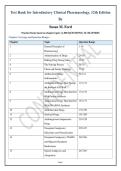
Test Bank for Introductory Clinical Pharmacology, 12th Edition
By
Susan M. Ford
Practice Items based on chapter topics | 1,000 QUESTIONS | 54 CHAPTERS
Chapter Coverage and Question Ranges
Chapter Topic Question Range
1 General Principles of 1-19
Pharmacology
2 Administration of Drugs 20-38
3 Making Drug Dosing Safer 39-57
4 The Nursing Process 58-76
5 Client and Family Teaching 77-95
6 Antibacterial Drugs: 96-114
Sulfonamides
7 Antibacterial Drugs That Disrupt 115-133
the Bacterial Cell Wall
8 Antibacterial Drugs That Interfere 134-152
With Protein Synthesis
9 Antibacterial Drugs That Interfere 153-171
With DNA/RNA Synthesis
10 Antitubercular Drugs 172-190
11 Antiviral Drugs 191-209
12 Antifungal and Antiparasitic 210-228
Drugs
13 Nonopioid Analgesics: 229-247
Salicylates and Nonsalicylates
14 Nonopioid Analgesics: NSAIDs 248-266
and Migraine Headache
Medications
15 Opioid Analgesics and 267-285
Antagonists
Page 1
,Chapter Topic Question Range
16 Anesthetic Drugs 286-304
17 Central Nervous System 305-323
Stimulants
18 Antidementia Drugs 324-342
19 Antianxiety Drugs 343-361
20 Sedatives and Hypnotics 362-380
21 Antidepressant Drugs 381-399
22 Antipsychotic Drugs 400-418
23 Adrenergic Drugs 419-437
24 Adrenergic Blocking Drugs 438-456
25 Cholinergic Drugs 457-475
26 Cholinergic Blocking Drugs 476-494
27 Antiparkinson Drugs 495-513
28 Antiepileptics 514-532
29 Skeletal Muscle, Bone, and Joint 533-550
Disorder Drugs
30 Upper Respiratory System Drugs 551-568
31 Lower Respiratory System Drugs 569-586
32 Diuretics 587-604
33 Antihyperlipidemic Drugs 605-622
34 Antihypertensive Drugs 623-640
35 Antianginal and Vasodilating 641-658
Drugs
36 Anticoagulant and Thrombolytic 659-676
Drugs
37 Cardiotonic and Antiarrhythmic 677-694
Drugs
38 Upper Gastrointestinal System 695-712
Drugs
39 Lower Gastrointestinal System 713-730
Drugs
40 Antidiabetic Drugs 731-748
Page 2
,Chapter Topic Question Range
41 Pituitary and Adrenocortical 749-766
Hormones
42 Thyroid and Antithyroid Drugs 767-784
43 Male and Female Hormones 785-802
44 Uterine Drugs 803-820
45 Menopause and Andropause 821-838
Drugs
46 Urinary Tract Anti-Infectives and 839-856
Other Urinary Drugs
47 Vaccines 857-874
48 Immunostimulants and 875-892
Modulators
49 Immune Blockers 893-910
50 Traditional Chemotherapy 911-928
51 Immune Modulating Therapies 929-946
52 Skin Disorder Topical Drugs 947-964
53 Otic and Ophthalmic Preparations 965-982
54 Fluids, Electrolytes, and 983-1000
Parenteral Therapy
Page 3
, Chapter 1: General Principles of Pharmacology | Questions 1-19
1. In the context of this chapter, which statement best describes a drug's therapeutic effect?
A. The rate of renal excretion
B. Any unexpected harmful response
C. The trade name assigned by a manufacturer
D. The intended beneficial response
Correct Answer: D | Rationale: A therapeutic effect is the intended beneficial clinical response to a
medication. Option D is the best answer because “The intended beneficial response” directly applies the
concept, priority, or action tested in the stem. The other choices either address a different concept or are less
appropriate for this specific situation. Applying this distinction helps connect pharmacologic knowledge with
safe medication administration, monitoring, and patient education.
2. A medication with a narrow therapeutic index generally requires which approach?
A. Less monitoring because toxicity is unlikely
B. Automatic doubling of the first dose
C. Administration only by the intravenous route
D. Closer monitoring of response and, when indicated, serum levels
Correct Answer: D | Rationale: A narrow therapeutic index means the effective and toxic concentrations
are relatively close, so careful monitoring is important. Option D is the best answer because “Closer
monitoring of response and, when indicated, serum levels” directly applies the concept, priority, or action
tested in the stem. The other choices either address a different concept or are less appropriate for this specific
situation. Applying this distinction helps connect pharmacologic knowledge with safe medication
administration, monitoring, and patient education.
3. Which action most directly reduces preventable medication harm?
A. Relying on memory rather than current references
B. Administering all medications before assessment
C. Using abbreviations whenever possible
D. Verifying the patient, drug, dose, route, time, and relevant clinical data
Correct Answer: D | Rationale: Systematic verification and patient assessment are core safeguards against
medication errors. Option D is the best answer because “Verifying the patient, drug, dose, route, time, and
relevant clinical data” directly applies the concept, priority, or action tested in the stem. The other choices
either address a different concept or are less appropriate for this specific situation. Applying this distinction
helps connect pharmacologic knowledge with safe medication administration, monitoring, and patient
education.
Page 4
By
Susan M. Ford
Practice Items based on chapter topics | 1,000 QUESTIONS | 54 CHAPTERS
Chapter Coverage and Question Ranges
Chapter Topic Question Range
1 General Principles of 1-19
Pharmacology
2 Administration of Drugs 20-38
3 Making Drug Dosing Safer 39-57
4 The Nursing Process 58-76
5 Client and Family Teaching 77-95
6 Antibacterial Drugs: 96-114
Sulfonamides
7 Antibacterial Drugs That Disrupt 115-133
the Bacterial Cell Wall
8 Antibacterial Drugs That Interfere 134-152
With Protein Synthesis
9 Antibacterial Drugs That Interfere 153-171
With DNA/RNA Synthesis
10 Antitubercular Drugs 172-190
11 Antiviral Drugs 191-209
12 Antifungal and Antiparasitic 210-228
Drugs
13 Nonopioid Analgesics: 229-247
Salicylates and Nonsalicylates
14 Nonopioid Analgesics: NSAIDs 248-266
and Migraine Headache
Medications
15 Opioid Analgesics and 267-285
Antagonists
Page 1
,Chapter Topic Question Range
16 Anesthetic Drugs 286-304
17 Central Nervous System 305-323
Stimulants
18 Antidementia Drugs 324-342
19 Antianxiety Drugs 343-361
20 Sedatives and Hypnotics 362-380
21 Antidepressant Drugs 381-399
22 Antipsychotic Drugs 400-418
23 Adrenergic Drugs 419-437
24 Adrenergic Blocking Drugs 438-456
25 Cholinergic Drugs 457-475
26 Cholinergic Blocking Drugs 476-494
27 Antiparkinson Drugs 495-513
28 Antiepileptics 514-532
29 Skeletal Muscle, Bone, and Joint 533-550
Disorder Drugs
30 Upper Respiratory System Drugs 551-568
31 Lower Respiratory System Drugs 569-586
32 Diuretics 587-604
33 Antihyperlipidemic Drugs 605-622
34 Antihypertensive Drugs 623-640
35 Antianginal and Vasodilating 641-658
Drugs
36 Anticoagulant and Thrombolytic 659-676
Drugs
37 Cardiotonic and Antiarrhythmic 677-694
Drugs
38 Upper Gastrointestinal System 695-712
Drugs
39 Lower Gastrointestinal System 713-730
Drugs
40 Antidiabetic Drugs 731-748
Page 2
,Chapter Topic Question Range
41 Pituitary and Adrenocortical 749-766
Hormones
42 Thyroid and Antithyroid Drugs 767-784
43 Male and Female Hormones 785-802
44 Uterine Drugs 803-820
45 Menopause and Andropause 821-838
Drugs
46 Urinary Tract Anti-Infectives and 839-856
Other Urinary Drugs
47 Vaccines 857-874
48 Immunostimulants and 875-892
Modulators
49 Immune Blockers 893-910
50 Traditional Chemotherapy 911-928
51 Immune Modulating Therapies 929-946
52 Skin Disorder Topical Drugs 947-964
53 Otic and Ophthalmic Preparations 965-982
54 Fluids, Electrolytes, and 983-1000
Parenteral Therapy
Page 3
, Chapter 1: General Principles of Pharmacology | Questions 1-19
1. In the context of this chapter, which statement best describes a drug's therapeutic effect?
A. The rate of renal excretion
B. Any unexpected harmful response
C. The trade name assigned by a manufacturer
D. The intended beneficial response
Correct Answer: D | Rationale: A therapeutic effect is the intended beneficial clinical response to a
medication. Option D is the best answer because “The intended beneficial response” directly applies the
concept, priority, or action tested in the stem. The other choices either address a different concept or are less
appropriate for this specific situation. Applying this distinction helps connect pharmacologic knowledge with
safe medication administration, monitoring, and patient education.
2. A medication with a narrow therapeutic index generally requires which approach?
A. Less monitoring because toxicity is unlikely
B. Automatic doubling of the first dose
C. Administration only by the intravenous route
D. Closer monitoring of response and, when indicated, serum levels
Correct Answer: D | Rationale: A narrow therapeutic index means the effective and toxic concentrations
are relatively close, so careful monitoring is important. Option D is the best answer because “Closer
monitoring of response and, when indicated, serum levels” directly applies the concept, priority, or action
tested in the stem. The other choices either address a different concept or are less appropriate for this specific
situation. Applying this distinction helps connect pharmacologic knowledge with safe medication
administration, monitoring, and patient education.
3. Which action most directly reduces preventable medication harm?
A. Relying on memory rather than current references
B. Administering all medications before assessment
C. Using abbreviations whenever possible
D. Verifying the patient, drug, dose, route, time, and relevant clinical data
Correct Answer: D | Rationale: Systematic verification and patient assessment are core safeguards against
medication errors. Option D is the best answer because “Verifying the patient, drug, dose, route, time, and
relevant clinical data” directly applies the concept, priority, or action tested in the stem. The other choices
either address a different concept or are less appropriate for this specific situation. Applying this distinction
helps connect pharmacologic knowledge with safe medication administration, monitoring, and patient
education.
Page 4