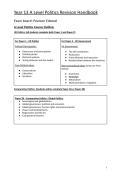
Year 13 A Level Politics Revision Handbook
Exam board: Pearson Edexcel
A Level Politics Course Outline:
UK Politics: (all students complete both Paper 1 and Paper 2)
For Paper 1 - UK Politics For Paper 2 - UK Government
Political Participation: UK Government:
● Democracy and participation ● The UK constitution
● Political parties ● Parliament
● Electoral systems. ● Prime Minister and executive
● Voting behavior and the media. ● Relationships between the branches.
Core Political Ideas: Non-core political ideas: (only one from
below)
● Conservatism
● Liberalism ● Anarchism
● Socialism ● Feminism
● Nationalism
● Multiculturalism or Egotism
Comparative Politics: (students either complete Paper 3A or Paper 3B)
Paper 3B - Comparative Politics - Global Politics.
● Sovereignty and globalization
● Global governance: political and economic
● Global governance: human rights and environmental
● Power and developments
● Regionalism and the EU
● Comparative theories
1
,Assessment - How will A Level Politics be examined?
All assessment is by external exams at the end of Year 13 (there is no coursework)
Paper 1: UK Politics and Core Ideology
• The assessment is 2 hours.
• The assessment is out of 84 marks.
The assessment consists of two sections:
Section A – Political Participation: Section B – Core Political Ideas:
This section is worth 60 marks. This section is worth 24 marks
Students answer: Students answer:
● One source question from a ● One question from a choice of two.
choice of two. (30 marks) ● AO1, AO2 and AO3 are assessed.
● One essay question from a
choice of two. (30 marks)
● AO1, AO2 and AO3 are assessed.
Paper 2: UK Government and Non-Core Ideology
• The assessment is 2 hours.
• The assessment is out of 84 marks.
The assessment consists of two sections:
Section A – UK Government: Section B – Non-Core Political Ideas:
This section is worth 60 marks. This section is worth 24 marks
Students answer: Students answer:
● One source question from a ● One question from a choice of
choice of two. (30 marks) two.
● One essay question from a ● AO1, AO2 and AO3 are assessed.
choice of two. (30 marks)
● AO1, AO2 and AO3 are assessed.
Paper 3: Comparative Politics: Global Politics
• The assessment is 2 hours.
• The assessment is out of 84 marks.
The assessment consists of two sections:
Section A – Comparing the Section B – Comparative Section C - Global Politics:
UK and Global: theories:
This section is worth 60
This section is worth This section is worth 12 marks.
12 marks. marks.
Students answer:
Students answer: Students answer: ● Two essay questions
● One question from ● One question from a from a choice of
a choice of two. choice of two. three.
● AO1 and AO2 are ● AO1 and AO2 are ● AO1, AO2 and AO3
assessed. assessed. are tested.
2
, Assessment Objectives - what do they mean?
The exam board is looking for you to show:
AO1: ‘Demonstrate knowledge and Knowledge =
understanding of political institutions, ● Facts
● Examples
processes, concepts, theories and
● Keywords
issues.’ Understanding = being able to use all this
knowledge correctly.
AO2: ‘Analyze aspects of politics and Analyze = being able to EXPLAIN what you
political information, including in know.
Showing the different sides/ viewpoints on a
relation to parallels, connections,
particular issue/ debate.
similarities and differences’.
A simple way to test AO1 and AO2:‘5 bare-bums on a bench’
Example of using this technique:
● Who said it? (AO1)
● What does this mean? (AO2)
● Why does it work that way?
(AO2)
● Where has this been seen?
(AO1)
● When did this happen? (AO1)
● How does that answer the
question and How does this
link to what else I know?
(AO2)
AO3: ‘Evaluate aspects of politics and Evaluation =
political information, including to Having an opinion on a particular viewpoint.
Showing why that viewpoint is strong and why
construct arguments, make
the opposing viewpoint is weak.
substantiated judgements and draw Showing throughout your work that you have
conclusions’. the same opinion.
Synopticity (only in Paper 2 & Paper 3) = making links between the different topics
you have studied.
3
Exam board: Pearson Edexcel
A Level Politics Course Outline:
UK Politics: (all students complete both Paper 1 and Paper 2)
For Paper 1 - UK Politics For Paper 2 - UK Government
Political Participation: UK Government:
● Democracy and participation ● The UK constitution
● Political parties ● Parliament
● Electoral systems. ● Prime Minister and executive
● Voting behavior and the media. ● Relationships between the branches.
Core Political Ideas: Non-core political ideas: (only one from
below)
● Conservatism
● Liberalism ● Anarchism
● Socialism ● Feminism
● Nationalism
● Multiculturalism or Egotism
Comparative Politics: (students either complete Paper 3A or Paper 3B)
Paper 3B - Comparative Politics - Global Politics.
● Sovereignty and globalization
● Global governance: political and economic
● Global governance: human rights and environmental
● Power and developments
● Regionalism and the EU
● Comparative theories
1
,Assessment - How will A Level Politics be examined?
All assessment is by external exams at the end of Year 13 (there is no coursework)
Paper 1: UK Politics and Core Ideology
• The assessment is 2 hours.
• The assessment is out of 84 marks.
The assessment consists of two sections:
Section A – Political Participation: Section B – Core Political Ideas:
This section is worth 60 marks. This section is worth 24 marks
Students answer: Students answer:
● One source question from a ● One question from a choice of two.
choice of two. (30 marks) ● AO1, AO2 and AO3 are assessed.
● One essay question from a
choice of two. (30 marks)
● AO1, AO2 and AO3 are assessed.
Paper 2: UK Government and Non-Core Ideology
• The assessment is 2 hours.
• The assessment is out of 84 marks.
The assessment consists of two sections:
Section A – UK Government: Section B – Non-Core Political Ideas:
This section is worth 60 marks. This section is worth 24 marks
Students answer: Students answer:
● One source question from a ● One question from a choice of
choice of two. (30 marks) two.
● One essay question from a ● AO1, AO2 and AO3 are assessed.
choice of two. (30 marks)
● AO1, AO2 and AO3 are assessed.
Paper 3: Comparative Politics: Global Politics
• The assessment is 2 hours.
• The assessment is out of 84 marks.
The assessment consists of two sections:
Section A – Comparing the Section B – Comparative Section C - Global Politics:
UK and Global: theories:
This section is worth 60
This section is worth This section is worth 12 marks.
12 marks. marks.
Students answer:
Students answer: Students answer: ● Two essay questions
● One question from ● One question from a from a choice of
a choice of two. choice of two. three.
● AO1 and AO2 are ● AO1 and AO2 are ● AO1, AO2 and AO3
assessed. assessed. are tested.
2
, Assessment Objectives - what do they mean?
The exam board is looking for you to show:
AO1: ‘Demonstrate knowledge and Knowledge =
understanding of political institutions, ● Facts
● Examples
processes, concepts, theories and
● Keywords
issues.’ Understanding = being able to use all this
knowledge correctly.
AO2: ‘Analyze aspects of politics and Analyze = being able to EXPLAIN what you
political information, including in know.
Showing the different sides/ viewpoints on a
relation to parallels, connections,
particular issue/ debate.
similarities and differences’.
A simple way to test AO1 and AO2:‘5 bare-bums on a bench’
Example of using this technique:
● Who said it? (AO1)
● What does this mean? (AO2)
● Why does it work that way?
(AO2)
● Where has this been seen?
(AO1)
● When did this happen? (AO1)
● How does that answer the
question and How does this
link to what else I know?
(AO2)
AO3: ‘Evaluate aspects of politics and Evaluation =
political information, including to Having an opinion on a particular viewpoint.
Showing why that viewpoint is strong and why
construct arguments, make
the opposing viewpoint is weak.
substantiated judgements and draw Showing throughout your work that you have
conclusions’. the same opinion.
Synopticity (only in Paper 2 & Paper 3) = making links between the different topics
you have studied.
3