William Blake: The Garden of Love (Poetry Revision)
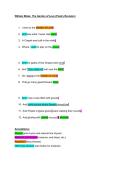
1. I went to the Garden of Love,
2. And saw what I never had seen:
3. A Chapel was built in the midst,
4. Where I used to play on the green.
5. And the gates of this Chapel were shut,
6. And 'Thou shalt not' writ over the door;
7. So I turn'd to the Garden of Love,
8. That so many sweet flowers bore.
9. And I saw it was filled with graves,
10. And tomb-stones where flowers should be:
11. And Priests in black gowns, were walking their rounds,
12. And binding with briars, my joys & desires.
Annotations:
Rhyme (end rhyme and internal line rhyme)
Relevant punctuation (caesura, end-stops, etc.)
Repetition (key phrases)
Other key devices (see below for analysis)
, Structure
● Three quatrains (three stanzas of four lines)
● Simple rhyme (like a cross between a hymn and a nursery rhyme, tying
together the themes of religion and childhood). This musical rhythm is
unsettling because of how it contrasts the poem’s more cynical subject matter.
○ May be labelled as a lyrical poem or a narrative poem
● Use of a personal voice, emphasised by the use of the first person narrative.
The criticism seems personal and powerful.
● Makes use of recurring symbols
○ Garden
■ Childhood, innocence
○ Chapel
■ Organised religion, repression
○ Gates
■ Exclusion, restriction, hostility
○ Flowers
■ Natural feeling, life, beauty, nature
○ Graves
■ Death and emotional repression (particularly in relation to the
priests, who symbolise institutional control and power)
○ Briars
■ Suffering, punishment, religious penance
Context
● Late 18th Century
● Romantic era (focus on emotion over strict logic)
○ Consider: imagination, emotion, and nature
○ Link this to a focus on individual emotion rather than institutional order
or societal expectation. In the poem, we see a tragic love story left
1. I went to the Garden of Love,
2. And saw what I never had seen:
3. A Chapel was built in the midst,
4. Where I used to play on the green.
5. And the gates of this Chapel were shut,
6. And 'Thou shalt not' writ over the door;
7. So I turn'd to the Garden of Love,
8. That so many sweet flowers bore.
9. And I saw it was filled with graves,
10. And tomb-stones where flowers should be:
11. And Priests in black gowns, were walking their rounds,
12. And binding with briars, my joys & desires.
Annotations:
Rhyme (end rhyme and internal line rhyme)
Relevant punctuation (caesura, end-stops, etc.)
Repetition (key phrases)
Other key devices (see below for analysis)
, Structure
● Three quatrains (three stanzas of four lines)
● Simple rhyme (like a cross between a hymn and a nursery rhyme, tying
together the themes of religion and childhood). This musical rhythm is
unsettling because of how it contrasts the poem’s more cynical subject matter.
○ May be labelled as a lyrical poem or a narrative poem
● Use of a personal voice, emphasised by the use of the first person narrative.
The criticism seems personal and powerful.
● Makes use of recurring symbols
○ Garden
■ Childhood, innocence
○ Chapel
■ Organised religion, repression
○ Gates
■ Exclusion, restriction, hostility
○ Flowers
■ Natural feeling, life, beauty, nature
○ Graves
■ Death and emotional repression (particularly in relation to the
priests, who symbolise institutional control and power)
○ Briars
■ Suffering, punishment, religious penance
Context
● Late 18th Century
● Romantic era (focus on emotion over strict logic)
○ Consider: imagination, emotion, and nature
○ Link this to a focus on individual emotion rather than institutional order
or societal expectation. In the poem, we see a tragic love story left