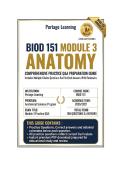
,BIOD 151 Module 3 | Practice Q&A | 2026/2027 | Anatomy | Portage
Learning
# BIOD 151 Module 3 Exam – Practice Question Bank
## Course Blueprint Summary
**Course:** BIOD 151 – Essential Human Anatomy & Physiology I with Lab
**University:** Portage Learning
**Module 3 Topics (based on course evidence):**
**Digestive System:**
- Anatomy and histology of the alimentary canal (mouth, pharynx,
esophagus, stomach, small intestine, large intestine)
- Accessory organs (liver, gallbladder, pancreas, salivary glands)
- Mechanical and chemical digestion processes
- Enzymes and their functions (salivary amylase, pepsin, pancreatic
enzymes)
- Hormonal regulation of digestion (gastrin, secretin, CCK, ghrelin, leptin)
- Absorption of nutrients (carbohydrates, proteins, lipids, vitamins)
- Liver functions (bile production, glycogen storage, urea synthesis)
- Stomach physiology (parietal cells, chief cells, HCl, pepsinogen)
- Small intestine structure (villi, microvilli, circular folds)
- Large intestine functions (water reabsorption, vitamin absorption,
defecation)
- Cellular respiration (glycolysis, TCA cycle, electron transport chain)
**Nervous System:**
- Neurons (structure: dendrites, cell body, axon)
,- Neuron types (sensory, motor, interneurons)
- Nervous system organization (CNS, PNS)
- Basic neurophysiology (action potentials, synapses)
---
1. Which of the following is NOT one of the four main functions performed by
the digestive system?
A) Ingestion
B) Digestion
C) Filtration
D) Defecation
Correct Answer: Filtration
Rationale: The four main functions of the digestive system are ingestion
(eating), digestion (breaking down food), absorption (moving nutrients into
bloodstream), and defecation (eliminating wastes). Filtration is a function of
the urinary system, not the digestive system.
2. The digestive work of salivary amylase is an example of which type of
digestion?
A) Mechanical digestion
B) Chemical digestion
C) Absorption
D) Ingestion
Correct Answer: Chemical digestion
, Rationale: Salivary amylase chemically breaks down starches into smaller
molecules, making this chemical digestion. Mechanical digestion involves
physical breakdown (chewing, churning). This distinction is essential for
understanding the two phases of digestion.
3. Which of the following statements is true concerning glycolysis?
A) Pyruvic acid is broken down into glucose
B) Two ATP molecules are formed in the first breakdown of glucose
C) Glucose is broken down into three pyruvate molecules
D) Glucose is broken down into two sucrose molecules
Correct Answer: Two ATP molecules are formed in the first breakdown of
glucose
Rationale: During glycolysis, glucose is broken down into two pyruvate
molecules with a net gain of 2 ATP. Glucose is not converted to sucrose, and
it yields two pyruvates, not three. This ATP production is foundational to
cellular respiration.
4. Which of the following statements is false concerning the second stage of
glucose breakdown?
A) This second stage is also known as the TCA cycle
B) Pyruvic acid is converted to carbon dioxide
C) Additional ATP is formed
D) This is also known as the electron transport system
Correct Answer: This is also known as the electron transport system
Learning
# BIOD 151 Module 3 Exam – Practice Question Bank
## Course Blueprint Summary
**Course:** BIOD 151 – Essential Human Anatomy & Physiology I with Lab
**University:** Portage Learning
**Module 3 Topics (based on course evidence):**
**Digestive System:**
- Anatomy and histology of the alimentary canal (mouth, pharynx,
esophagus, stomach, small intestine, large intestine)
- Accessory organs (liver, gallbladder, pancreas, salivary glands)
- Mechanical and chemical digestion processes
- Enzymes and their functions (salivary amylase, pepsin, pancreatic
enzymes)
- Hormonal regulation of digestion (gastrin, secretin, CCK, ghrelin, leptin)
- Absorption of nutrients (carbohydrates, proteins, lipids, vitamins)
- Liver functions (bile production, glycogen storage, urea synthesis)
- Stomach physiology (parietal cells, chief cells, HCl, pepsinogen)
- Small intestine structure (villi, microvilli, circular folds)
- Large intestine functions (water reabsorption, vitamin absorption,
defecation)
- Cellular respiration (glycolysis, TCA cycle, electron transport chain)
**Nervous System:**
- Neurons (structure: dendrites, cell body, axon)
,- Neuron types (sensory, motor, interneurons)
- Nervous system organization (CNS, PNS)
- Basic neurophysiology (action potentials, synapses)
---
1. Which of the following is NOT one of the four main functions performed by
the digestive system?
A) Ingestion
B) Digestion
C) Filtration
D) Defecation
Correct Answer: Filtration
Rationale: The four main functions of the digestive system are ingestion
(eating), digestion (breaking down food), absorption (moving nutrients into
bloodstream), and defecation (eliminating wastes). Filtration is a function of
the urinary system, not the digestive system.
2. The digestive work of salivary amylase is an example of which type of
digestion?
A) Mechanical digestion
B) Chemical digestion
C) Absorption
D) Ingestion
Correct Answer: Chemical digestion
, Rationale: Salivary amylase chemically breaks down starches into smaller
molecules, making this chemical digestion. Mechanical digestion involves
physical breakdown (chewing, churning). This distinction is essential for
understanding the two phases of digestion.
3. Which of the following statements is true concerning glycolysis?
A) Pyruvic acid is broken down into glucose
B) Two ATP molecules are formed in the first breakdown of glucose
C) Glucose is broken down into three pyruvate molecules
D) Glucose is broken down into two sucrose molecules
Correct Answer: Two ATP molecules are formed in the first breakdown of
glucose
Rationale: During glycolysis, glucose is broken down into two pyruvate
molecules with a net gain of 2 ATP. Glucose is not converted to sucrose, and
it yields two pyruvates, not three. This ATP production is foundational to
cellular respiration.
4. Which of the following statements is false concerning the second stage of
glucose breakdown?
A) This second stage is also known as the TCA cycle
B) Pyruvic acid is converted to carbon dioxide
C) Additional ATP is formed
D) This is also known as the electron transport system
Correct Answer: This is also known as the electron transport system