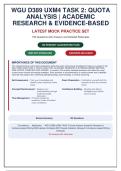
WGU D389 UXM4 TASK 2: QUOTA
ANALYSIS | ACADEMIC
RESEARCH & EVIDENCE-BASED
LATEST MOCK PRACTICE SET
150 Questions with Answers and Detailed Rationales
100 PERCENT GUARANTEED PASS
INSTANT DOWNLOAD ANSWERS INCLUDED
IMPORTANCE OF THIS DOCUMENT
This comprehensive examination preparation guide has been meticulously developed to help you succeed in the
WGU D389 UXM4 TASK 2: QUOTA ANALYSIS | ACADEMIC RESEARCH & EVIDENCE-BASED WRITING |
2026 UPDATE COMPLETE AND PASSED.. It contains 150 carefully selected questions that reflect the most
current exam content and testing strategies. Each question is accompanied by a correct answer and a detailed
rationale that explains the underlying pathophysiology, pharmacology, or clinical reasoning.
Self-Assessment – Test your knowledge and Exam Preparation – Familiarize yourself with the
identify areas requiring further question format and content
study areas
Concept Reinforcement – Deepen your Confidence Building – Develop test-taking
understanding through strategies and reduce
evidence-based exam anxiety
rationales
Time Management – Practice answering
questions under simulated
exam conditions
Review Summary 150 Questions
Foundations - Application - WGU D389 UXM4 TASK 2 Quota Analysis Academic Research &
Evidence-based Writing 2026 Update Complete AND Passed Academic Research & Evidence-based Writing
Graduate
All answers with rationales
,Table of Contents
Content Area Questions Key Topics
Quota Analysis Framework 1-25 Quota, Framework, Evidence, Component, Source
Academic Research Methods 26-50 Quota, Analysis, Chi-square, Evidence, Quality
Evidence-based Writing 51-75 Quota, Framework, Component, Review, Directly
Critical Thinking AND 76-100 Quota, Review, Analysis, Systematic, Evidence
Analysis
Source Evaluation AND 101-125 Quota, Evidence, Framework, Writing, Review
Citation
Argumentation AND 126-150 Quota, Analysis, Framework, Study, Appropriate
Persuasion
TOTAL 150 All questions include answers and detailed rationales
,Section A - Quota Analysis Framework
Q1.
In the QUOTA framework, which scenario best exemplifies the 'Q' (Question) component
when evaluating a source for a literature review on the efficacy of cognitive behavioral
therapy for insomnia?
A. Checking if the author has a PhD in B. Formulating a focused research question
clinical psychology. to guide the search for evidence.
C. Determining whether the journal is D. Assessing the sample size of the study.
peer-reviewed.
Correct: B - Formulating a focused research question to guide the search for evidence.
Rationale:The 'Q' in QUOTA stands for Question, which emphasizes formulating a clear,
focused research question to guide the entire research process. While checking author
credentials (A), journal status (C), and sample size (D) are important for evaluating sources,
they belong to other components like Authority, Transparency, and Accuracy. The correct
answer is B because it directly addresses the initial framing of the inquiry.
Q2.
When synthesizing evidence from multiple studies, which approach best avoids the pitfall
of 'cherry-picking' data that supports a predetermined conclusion?
A. Including only studies that have B. Conducting a systematic search and
statistically significant results. documenting all included studies, regardless
of outcome.
C. Prioritizing studies from high-impact D. Excluding studies that contradict the main
journals over others. hypothesis to maintain clarity.
Correct: B - Conducting a systematic search and documenting all included studies,
regardless of outcome.
Rationale:Systematic searching with transparent documentation of all studies, regardless of
outcome, is the cornerstone of unbiased evidence synthesis. Option A and D are forms of
selection bias, while C introduces a bias based on journal prestige. The correct approach is B,
which ensures a comprehensive and objective synthesis.
Q3.
A researcher uses an AI tool to paraphrase a complex argument from a source. According
to 2026 academic integrity standards, what is the most appropriate action?
A. Cite the AI tool as the author of the B. Use the paraphrase without citation, as it
paraphrase. is now in the researcher's own words.
Page 3
, Section A - Quota Analysis Framework
C. Cite the original source and disclose the D. Avoid using AI tools altogether in
use of AI in the methodology. academic writing.
Correct: C - Cite the original source and disclose the use of AI in the methodology.
Rationale:Even when paraphrased, the underlying idea originates from the original source,
so citation is required. Additionally, transparency about AI assistance is now mandated by
most journals and universities. Option A incorrectly credits the AI, B violates citation rules,
and D is overly restrictive. Option C aligns with both citation ethics and evolving AI disclosure
norms.
Q4.
In the QUOTA framework, which component directly addresses the potential for bias in a
source's funding or affiliations?
A. Question B. Authority
C. Transparency D. Accuracy
Correct: C - Transparency
Rationale:Transparency in QUOTA covers the disclosure of conflicts of interest, funding
sources, and affiliations that could bias the research. Authority (B) focuses on credentials,
Accuracy (D) on factual correctness, and Question (A) on the research question. Thus, C is
the correct answer.
Q5.
When constructing a PICO(T) question for a clinical evidence-based practice project,
which element is correctly formatted?
A. Population: 'adults with insomnia' B. Intervention: 'cognitive behavioral
therapy'
C. Comparison: 'no treatment' D. All of the above are correctly formatted.
Correct: D - All of the above are correctly formatted.
Rationale:A PICO(T) question includes Population, Intervention, Comparison, Outcome, and
Time. Each element should be clearly defined. Options A, B, and C correctly identify these
components. Thus, D is correct, as all are appropriately formatted.
Q6.
In the context of evidence-based writing, which statement best describes the 'hierarchy of
evidence'?
Page 4
ANALYSIS | ACADEMIC
RESEARCH & EVIDENCE-BASED
LATEST MOCK PRACTICE SET
150 Questions with Answers and Detailed Rationales
100 PERCENT GUARANTEED PASS
INSTANT DOWNLOAD ANSWERS INCLUDED
IMPORTANCE OF THIS DOCUMENT
This comprehensive examination preparation guide has been meticulously developed to help you succeed in the
WGU D389 UXM4 TASK 2: QUOTA ANALYSIS | ACADEMIC RESEARCH & EVIDENCE-BASED WRITING |
2026 UPDATE COMPLETE AND PASSED.. It contains 150 carefully selected questions that reflect the most
current exam content and testing strategies. Each question is accompanied by a correct answer and a detailed
rationale that explains the underlying pathophysiology, pharmacology, or clinical reasoning.
Self-Assessment – Test your knowledge and Exam Preparation – Familiarize yourself with the
identify areas requiring further question format and content
study areas
Concept Reinforcement – Deepen your Confidence Building – Develop test-taking
understanding through strategies and reduce
evidence-based exam anxiety
rationales
Time Management – Practice answering
questions under simulated
exam conditions
Review Summary 150 Questions
Foundations - Application - WGU D389 UXM4 TASK 2 Quota Analysis Academic Research &
Evidence-based Writing 2026 Update Complete AND Passed Academic Research & Evidence-based Writing
Graduate
All answers with rationales
,Table of Contents
Content Area Questions Key Topics
Quota Analysis Framework 1-25 Quota, Framework, Evidence, Component, Source
Academic Research Methods 26-50 Quota, Analysis, Chi-square, Evidence, Quality
Evidence-based Writing 51-75 Quota, Framework, Component, Review, Directly
Critical Thinking AND 76-100 Quota, Review, Analysis, Systematic, Evidence
Analysis
Source Evaluation AND 101-125 Quota, Evidence, Framework, Writing, Review
Citation
Argumentation AND 126-150 Quota, Analysis, Framework, Study, Appropriate
Persuasion
TOTAL 150 All questions include answers and detailed rationales
,Section A - Quota Analysis Framework
Q1.
In the QUOTA framework, which scenario best exemplifies the 'Q' (Question) component
when evaluating a source for a literature review on the efficacy of cognitive behavioral
therapy for insomnia?
A. Checking if the author has a PhD in B. Formulating a focused research question
clinical psychology. to guide the search for evidence.
C. Determining whether the journal is D. Assessing the sample size of the study.
peer-reviewed.
Correct: B - Formulating a focused research question to guide the search for evidence.
Rationale:The 'Q' in QUOTA stands for Question, which emphasizes formulating a clear,
focused research question to guide the entire research process. While checking author
credentials (A), journal status (C), and sample size (D) are important for evaluating sources,
they belong to other components like Authority, Transparency, and Accuracy. The correct
answer is B because it directly addresses the initial framing of the inquiry.
Q2.
When synthesizing evidence from multiple studies, which approach best avoids the pitfall
of 'cherry-picking' data that supports a predetermined conclusion?
A. Including only studies that have B. Conducting a systematic search and
statistically significant results. documenting all included studies, regardless
of outcome.
C. Prioritizing studies from high-impact D. Excluding studies that contradict the main
journals over others. hypothesis to maintain clarity.
Correct: B - Conducting a systematic search and documenting all included studies,
regardless of outcome.
Rationale:Systematic searching with transparent documentation of all studies, regardless of
outcome, is the cornerstone of unbiased evidence synthesis. Option A and D are forms of
selection bias, while C introduces a bias based on journal prestige. The correct approach is B,
which ensures a comprehensive and objective synthesis.
Q3.
A researcher uses an AI tool to paraphrase a complex argument from a source. According
to 2026 academic integrity standards, what is the most appropriate action?
A. Cite the AI tool as the author of the B. Use the paraphrase without citation, as it
paraphrase. is now in the researcher's own words.
Page 3
, Section A - Quota Analysis Framework
C. Cite the original source and disclose the D. Avoid using AI tools altogether in
use of AI in the methodology. academic writing.
Correct: C - Cite the original source and disclose the use of AI in the methodology.
Rationale:Even when paraphrased, the underlying idea originates from the original source,
so citation is required. Additionally, transparency about AI assistance is now mandated by
most journals and universities. Option A incorrectly credits the AI, B violates citation rules,
and D is overly restrictive. Option C aligns with both citation ethics and evolving AI disclosure
norms.
Q4.
In the QUOTA framework, which component directly addresses the potential for bias in a
source's funding or affiliations?
A. Question B. Authority
C. Transparency D. Accuracy
Correct: C - Transparency
Rationale:Transparency in QUOTA covers the disclosure of conflicts of interest, funding
sources, and affiliations that could bias the research. Authority (B) focuses on credentials,
Accuracy (D) on factual correctness, and Question (A) on the research question. Thus, C is
the correct answer.
Q5.
When constructing a PICO(T) question for a clinical evidence-based practice project,
which element is correctly formatted?
A. Population: 'adults with insomnia' B. Intervention: 'cognitive behavioral
therapy'
C. Comparison: 'no treatment' D. All of the above are correctly formatted.
Correct: D - All of the above are correctly formatted.
Rationale:A PICO(T) question includes Population, Intervention, Comparison, Outcome, and
Time. Each element should be clearly defined. Options A, B, and C correctly identify these
components. Thus, D is correct, as all are appropriately formatted.
Q6.
In the context of evidence-based writing, which statement best describes the 'hierarchy of
evidence'?
Page 4