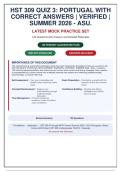
HST 309 QUIZ 3: PORTUGAL WITH
CORRECT ANSWERS | VERIFIED |
SUMMER 2026 - ASU.
LATEST MOCK PRACTICE SET
120 Questions with Answers and Detailed Rationales
100 PERCENT GUARANTEED PASS
INSTANT DOWNLOAD ANSWERS INCLUDED
IMPORTANCE OF THIS DOCUMENT
This comprehensive examination preparation guide has been meticulously developed to help you succeed in the
HST 309 QUIZ 3: PORTUGAL WITH CORRECT ANSWERS | VERIFIED | SUMMER 2026 - ASU.. It contains
120 carefully selected questions that reflect the most current exam content and testing strategies. Each question
is accompanied by a correct answer and a detailed rationale that explains the underlying pathophysiology,
pharmacology, or clinical reasoning.
Self-Assessment – Test your knowledge and Exam Preparation – Familiarize yourself with the
identify areas requiring further question format and content
study areas
Concept Reinforcement – Deepen your Confidence Building – Develop test-taking
understanding through strategies and reduce
evidence-based exam anxiety
rationales
Time Management – Practice answering
questions under simulated
exam conditions
Review Summary 120 Questions
Foundations - Application - HST 309 3 Portugal WITH Correct Summer 2026 - ASU Portuguese History
Culture AND Empire HST 309 Undergraduate YEAR 3 / Graduate
All answers with rationales
,Table of Contents
Content Area Questions Key Topics
Portuguese Maritime 1-20 Portuguese, Context, Explains, Portugal, Economic
Expansion
AGE OF Discoveries 21-40 Portuguese, Portugal S, Context, Estado, Affect
Vasco DA GAMA AND THE 41-60 Portuguese, Century, Context, Explains, Trade
Route TO India
Portuguese Empire IN Africa 61-80 Portuguese, Century, Trade, Context, Explains
Portuguese Empire IN ASIA 81-100 Portuguese, Estado, Explains, Century, Context
Portuguese Empire IN Brazil 101-120 Portuguese, Context, Colonial, Economic, Primary
TOTAL 120 All questions include answers and detailed rationales
,Section A - Portuguese Maritime Expansion
Q1.
In the context of the Portuguese maritime expansion, which of the following best explains
the strategic rationale behind the conquest of Ceuta in 1415?
A. To control the Strait of Gibraltar and thus B. To gain access to the trans-Saharan gold
dominate Mediterranean trade routes trade and weaken Muslim power in North
Africa
C. To establish a naval base for future D. To secure a foothold for Christian
expeditions to the Indian Ocean crusading against the Kingdom of Granada
Correct: B - To gain access to the trans-Saharan gold trade and weaken Muslim power in
North Africa
Rationale:The conquest of Ceuta was motivated by the desire to tap into the trans-Saharan
gold trade and to extend the Reconquista into North Africa. It also provided a base for further
exploration, but the primary immediate goal was economic and religious, not control of
Gibraltar or a stepping stone to India.
Q2.
Which of the following best characterizes the economic and political relationship between
Portugal and the Hanseatic League during the late medieval period?
A. Portugal was a major supplier of salted B. The Hanseatic League held a monopoly
fish to the Hanseatic ports, receiving Baltic on the distribution of Portuguese cork and
timber in return wine in Northern Europe
C. Trade was minimal due to the League's D. The League financed Portuguese
focus on the Baltic and Portugal's orientation voyages of exploration in exchange for
toward the Atlantic exclusive trading rights in West Africa
Correct: C - Trade was minimal due to the League's focus on the Baltic and Portugal's
orientation toward the Atlantic
Rationale:During the late medieval period, Portugal's trade was primarily oriented toward the
Mediterranean and Northern Europe via Flemish and English intermediaries, not directly with
the Hanseatic League. The League's activities were concentrated in the Baltic and North Sea,
and direct trade with Portugal was limited. Salted fish was a staple of the Hanseatic trade, but
Portugal was not a major supplier to the League.
Q3.
Analyzing the political dynamics of the Iberian Union (1580-1640), which factor most
critically undermined the legitimacy of the Habsburg monarchy in Portugal?
Page 3
, Section A - Portuguese Maritime Expansion
A. The imposition of Castilian law and the B. The diversion of Portuguese colonial
abolition of the Cortes revenues to fund Spanish wars in Europe
C. The introduction of the Inquisition into D. The forced conscription of Portuguese
Portugal, which was previously absent nobles into the Spanish army
Correct: B - The diversion of Portuguese colonial revenues to fund Spanish wars in
Europe
Rationale:The Habsburg kings, particularly Philip II and his successors, increasingly taxed
Portuguese trade and diverted colonial profits to support Spanish military campaigns. This
economic exploitation, coupled with the perception of neglect of Portuguese interests, fueled
resentment and ultimately led to the restoration of independence in 1640. The Cortes was not
abolished, the Inquisition already existed, and conscription was not a primary grievance.
Q4.
Which of the following best explains the significance of the Treaty of Tordesillas (1494) for
the Portuguese Empire's expansion in the Atlantic?
A. It granted Portugal exclusive rights to the B. It established a line of demarcation that
coast of Africa and the route to India, but allowed Portugal to claim Brazil, even
excluded Brazil though it was not yet discovered
C. It recognized Portuguese claims to the D. It ended the Portuguese monopoly on the
Azores and Madeira, but not the Cape Verde slave trade, opening it to Spanish
islands participation
Correct: B - It established a line of demarcation that allowed Portugal to claim Brazil, even
though it was not yet discovered
Rationale:The Treaty of Tordesillas divided newly discovered lands along a meridian 370
leagues west of the Cape Verde islands. This line placed the eastern tip of South America,
including Brazil, within the Portuguese sphere, even though Brazil was only officially claimed
in 1500. The treaty did not exclude Brazil; it actually secured Portugal's claim to it. The
Azores and Madeira were already Portuguese, and the treaty did not address the slave trade.
Q5.
During the Portuguese Restoration War (1640-1668), which of the following was a decisive
factor in Portugal's ability to maintain independence from Spain?
A. The alliance with England, which B. The internal rebellion of Catalonia, which
provided naval support and diplomatic diverted Spanish military resources
recognition
C. The superior military tactics of the D. The economic wealth from Brazilian gold,
Portuguese army, which outmatched the which funded the war effort
Spanish tercios
Page 4
CORRECT ANSWERS | VERIFIED |
SUMMER 2026 - ASU.
LATEST MOCK PRACTICE SET
120 Questions with Answers and Detailed Rationales
100 PERCENT GUARANTEED PASS
INSTANT DOWNLOAD ANSWERS INCLUDED
IMPORTANCE OF THIS DOCUMENT
This comprehensive examination preparation guide has been meticulously developed to help you succeed in the
HST 309 QUIZ 3: PORTUGAL WITH CORRECT ANSWERS | VERIFIED | SUMMER 2026 - ASU.. It contains
120 carefully selected questions that reflect the most current exam content and testing strategies. Each question
is accompanied by a correct answer and a detailed rationale that explains the underlying pathophysiology,
pharmacology, or clinical reasoning.
Self-Assessment – Test your knowledge and Exam Preparation – Familiarize yourself with the
identify areas requiring further question format and content
study areas
Concept Reinforcement – Deepen your Confidence Building – Develop test-taking
understanding through strategies and reduce
evidence-based exam anxiety
rationales
Time Management – Practice answering
questions under simulated
exam conditions
Review Summary 120 Questions
Foundations - Application - HST 309 3 Portugal WITH Correct Summer 2026 - ASU Portuguese History
Culture AND Empire HST 309 Undergraduate YEAR 3 / Graduate
All answers with rationales
,Table of Contents
Content Area Questions Key Topics
Portuguese Maritime 1-20 Portuguese, Context, Explains, Portugal, Economic
Expansion
AGE OF Discoveries 21-40 Portuguese, Portugal S, Context, Estado, Affect
Vasco DA GAMA AND THE 41-60 Portuguese, Century, Context, Explains, Trade
Route TO India
Portuguese Empire IN Africa 61-80 Portuguese, Century, Trade, Context, Explains
Portuguese Empire IN ASIA 81-100 Portuguese, Estado, Explains, Century, Context
Portuguese Empire IN Brazil 101-120 Portuguese, Context, Colonial, Economic, Primary
TOTAL 120 All questions include answers and detailed rationales
,Section A - Portuguese Maritime Expansion
Q1.
In the context of the Portuguese maritime expansion, which of the following best explains
the strategic rationale behind the conquest of Ceuta in 1415?
A. To control the Strait of Gibraltar and thus B. To gain access to the trans-Saharan gold
dominate Mediterranean trade routes trade and weaken Muslim power in North
Africa
C. To establish a naval base for future D. To secure a foothold for Christian
expeditions to the Indian Ocean crusading against the Kingdom of Granada
Correct: B - To gain access to the trans-Saharan gold trade and weaken Muslim power in
North Africa
Rationale:The conquest of Ceuta was motivated by the desire to tap into the trans-Saharan
gold trade and to extend the Reconquista into North Africa. It also provided a base for further
exploration, but the primary immediate goal was economic and religious, not control of
Gibraltar or a stepping stone to India.
Q2.
Which of the following best characterizes the economic and political relationship between
Portugal and the Hanseatic League during the late medieval period?
A. Portugal was a major supplier of salted B. The Hanseatic League held a monopoly
fish to the Hanseatic ports, receiving Baltic on the distribution of Portuguese cork and
timber in return wine in Northern Europe
C. Trade was minimal due to the League's D. The League financed Portuguese
focus on the Baltic and Portugal's orientation voyages of exploration in exchange for
toward the Atlantic exclusive trading rights in West Africa
Correct: C - Trade was minimal due to the League's focus on the Baltic and Portugal's
orientation toward the Atlantic
Rationale:During the late medieval period, Portugal's trade was primarily oriented toward the
Mediterranean and Northern Europe via Flemish and English intermediaries, not directly with
the Hanseatic League. The League's activities were concentrated in the Baltic and North Sea,
and direct trade with Portugal was limited. Salted fish was a staple of the Hanseatic trade, but
Portugal was not a major supplier to the League.
Q3.
Analyzing the political dynamics of the Iberian Union (1580-1640), which factor most
critically undermined the legitimacy of the Habsburg monarchy in Portugal?
Page 3
, Section A - Portuguese Maritime Expansion
A. The imposition of Castilian law and the B. The diversion of Portuguese colonial
abolition of the Cortes revenues to fund Spanish wars in Europe
C. The introduction of the Inquisition into D. The forced conscription of Portuguese
Portugal, which was previously absent nobles into the Spanish army
Correct: B - The diversion of Portuguese colonial revenues to fund Spanish wars in
Europe
Rationale:The Habsburg kings, particularly Philip II and his successors, increasingly taxed
Portuguese trade and diverted colonial profits to support Spanish military campaigns. This
economic exploitation, coupled with the perception of neglect of Portuguese interests, fueled
resentment and ultimately led to the restoration of independence in 1640. The Cortes was not
abolished, the Inquisition already existed, and conscription was not a primary grievance.
Q4.
Which of the following best explains the significance of the Treaty of Tordesillas (1494) for
the Portuguese Empire's expansion in the Atlantic?
A. It granted Portugal exclusive rights to the B. It established a line of demarcation that
coast of Africa and the route to India, but allowed Portugal to claim Brazil, even
excluded Brazil though it was not yet discovered
C. It recognized Portuguese claims to the D. It ended the Portuguese monopoly on the
Azores and Madeira, but not the Cape Verde slave trade, opening it to Spanish
islands participation
Correct: B - It established a line of demarcation that allowed Portugal to claim Brazil, even
though it was not yet discovered
Rationale:The Treaty of Tordesillas divided newly discovered lands along a meridian 370
leagues west of the Cape Verde islands. This line placed the eastern tip of South America,
including Brazil, within the Portuguese sphere, even though Brazil was only officially claimed
in 1500. The treaty did not exclude Brazil; it actually secured Portugal's claim to it. The
Azores and Madeira were already Portuguese, and the treaty did not address the slave trade.
Q5.
During the Portuguese Restoration War (1640-1668), which of the following was a decisive
factor in Portugal's ability to maintain independence from Spain?
A. The alliance with England, which B. The internal rebellion of Catalonia, which
provided naval support and diplomatic diverted Spanish military resources
recognition
C. The superior military tactics of the D. The economic wealth from Brazilian gold,
Portuguese army, which outmatched the which funded the war effort
Spanish tercios
Page 4