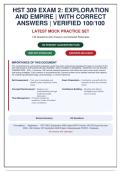
HST 309 EXAM 2: EXPLORATION
AND EMPIRE | WITH CORRECT
ANSWERS | VERIFIED 100/100
LATEST MOCK PRACTICE SET
140 Questions with Answers and Detailed Rationales
100 PERCENT GUARANTEED PASS
INSTANT DOWNLOAD ANSWERS INCLUDED
IMPORTANCE OF THIS DOCUMENT
This comprehensive examination preparation guide has been meticulously developed to help you succeed in the
HST 309 EXAM 2: EXPLORATION AND EMPIRE | WITH CORRECT ANSWERS | VERIFIED 100/100 SCORE |
SUMMER 2026 - ASU.. It contains 140 carefully selected questions that reflect the most current exam content
and testing strategies. Each question is accompanied by a correct answer and a detailed rationale that explains
the underlying pathophysiology, pharmacology, or clinical reasoning.
Self-Assessment – Test your knowledge and Exam Preparation – Familiarize yourself with the
identify areas requiring further question format and content
study areas
Concept Reinforcement – Deepen your Confidence Building – Develop test-taking
understanding through strategies and reduce
evidence-based exam anxiety
rationales
Time Management – Practice answering
questions under simulated
exam conditions
Review Summary 140 Questions
Foundations - Application - HST 309 2 Exploration AND Empire WITH Correct 100/100 Score Summer
2026 - ASU History OF Exploration AND Empire Undergraduate YEAR 3 / Graduate
All answers with rationales
,Table of Contents
Content Area Questions Key Topics
Motivations FOR Exploration 1-24 Context, Imperial, Argues, British, Historian
Technological Advances IN 25-48 Spanish, Colonial, Trade, Describes, India
Navigation AND Shipbuilding
Portuguese AND Spanish 49-72 Spanish, Century, Colonial, Atlantic, World
Exploration
THE Atlantic World AND 73-96 British, Colonial, Context, Policy, System
Columbian Exchange
Conquest OF THE Aztec AND 97-120 Context, Century, Colonial, Describes, Explains
INCA Empires
Spanish Colonial 121-140 Context, Colonial, Concept, Early, Factor
Administration AND Society
TOTAL 140 All questions include answers and detailed rationales
,Section A - Motivations FOR Exploration
Q1.
In the context of Iberian overseas expansion, which factor most critically differentiated the
Castilian model of colonization in the Americas from the Portuguese model in the Indian
Ocean?
A. The Castilian model emphasized coastal B. The Castilian model was characterized by
trading factories, while the Portuguese large-scale territorial conquest and
model focused on territorial conquest and settlement, while the Portuguese model
settlement. prioritized maritime trade networks and
fortified enclaves.
C. The Castilian model relied on private D. The Castilian model was primarily driven
commercial companies, while the by religious conversion, while the
Portuguese model was directly administered Portuguese model was purely economic.
by the crown.
Correct: B - The Castilian model was characterized by large-scale territorial conquest and
settlement, while the Portuguese model prioritized maritime trade networks and fortified
enclaves.
Rationale:The Castilian model in the Americas involved extensive territorial conquest,
encomiendas, and settlement, aiming at permanent colonization. In contrast, the Portuguese
established a seaborne empire of feitorias (trading posts) and fortresses like Goa and
Malacca, focusing on controlling trade routes rather than large-scale territorial control. The
other options misrepresent the scale and nature of both models.
Q2.
How did the cartographic revolution of the early modern period transform imperial
governance in ways beyond mere navigation?
A. It enabled the precise mapping of B. It allowed for the visualization of colonial
indigenous land claims, facilitating legal territories, enabling centralized
recognition of native sovereignty. administration, resource extraction, and the
assertion of sovereignty over abstract
spaces.
C. It primarily served decorative purposes in D. It replaced the need for on-the-ground
royal courts, with little practical impact on surveys, as maps were considered definitive
colonial administration. and unchanging.
Correct: B - It allowed for the visualization of colonial territories, enabling centralized
administration, resource extraction, and the assertion of sovereignty over abstract
spaces.
Page 3
, Section A - Motivations FOR Exploration
Rationale: Cartography was a tool of empire, allowing metropoles to 'see' and manage distant
territories. Maps enabled the imposition of boundaries, the planning of infrastructure, and the
rationalization of resource extraction, all critical for centralized control. They also encoded
imperial ideologies, but did not recognize indigenous sovereignty. Maps were not static; they
required constant updating and were not merely decorative.
Q3.
Which of the following best exemplifies the concept of 'informal empire' as applied to
nineteenth-century British expansion in Latin America?
A. Direct annexation of Argentina and Chile B. Establishment of protectorates over
as crown colonies. Mexico and Brazil.
C. Economic domination through trade, D. Military occupation of key ports and
loans, and diplomatic pressure without inland territories.
formal political control.
Correct: C - Economic domination through trade, loans, and diplomatic pressure without
formal political control.
Rationale:Informal empire refers to a situation where a powerful state exerts significant
influence over a nominally independent region through economic means-such as trade,
investment, and debt-and political pressure, without formal annexation. Britain's dominance in
Latin America in the 19th century, through its commercial and financial power, is a classic
example. The other options describe forms of formal empire.
Q4.
A historian argues that the 'scramble for Africa' was primarily a response to domestic
European crises rather than African realities. Which evidence would most directly support
this interpretation?
A. European powers partitioned Africa with B. The Berlin Conference of 1884-85
little regard for existing African political established rules for claiming African
boundaries or ethnic distributions. territory, prioritizing effective occupation.
C. European states used colonial expansion D. African resistance movements, such as
to deflect internal social tensions and to the Mahdist War, were decisive in shaping
secure popular support at home. the timing and extent of colonization.
Correct: C - European states used colonial expansion to deflect internal social tensions
and to secure popular support at home.
Page 4
AND EMPIRE | WITH CORRECT
ANSWERS | VERIFIED 100/100
LATEST MOCK PRACTICE SET
140 Questions with Answers and Detailed Rationales
100 PERCENT GUARANTEED PASS
INSTANT DOWNLOAD ANSWERS INCLUDED
IMPORTANCE OF THIS DOCUMENT
This comprehensive examination preparation guide has been meticulously developed to help you succeed in the
HST 309 EXAM 2: EXPLORATION AND EMPIRE | WITH CORRECT ANSWERS | VERIFIED 100/100 SCORE |
SUMMER 2026 - ASU.. It contains 140 carefully selected questions that reflect the most current exam content
and testing strategies. Each question is accompanied by a correct answer and a detailed rationale that explains
the underlying pathophysiology, pharmacology, or clinical reasoning.
Self-Assessment – Test your knowledge and Exam Preparation – Familiarize yourself with the
identify areas requiring further question format and content
study areas
Concept Reinforcement – Deepen your Confidence Building – Develop test-taking
understanding through strategies and reduce
evidence-based exam anxiety
rationales
Time Management – Practice answering
questions under simulated
exam conditions
Review Summary 140 Questions
Foundations - Application - HST 309 2 Exploration AND Empire WITH Correct 100/100 Score Summer
2026 - ASU History OF Exploration AND Empire Undergraduate YEAR 3 / Graduate
All answers with rationales
,Table of Contents
Content Area Questions Key Topics
Motivations FOR Exploration 1-24 Context, Imperial, Argues, British, Historian
Technological Advances IN 25-48 Spanish, Colonial, Trade, Describes, India
Navigation AND Shipbuilding
Portuguese AND Spanish 49-72 Spanish, Century, Colonial, Atlantic, World
Exploration
THE Atlantic World AND 73-96 British, Colonial, Context, Policy, System
Columbian Exchange
Conquest OF THE Aztec AND 97-120 Context, Century, Colonial, Describes, Explains
INCA Empires
Spanish Colonial 121-140 Context, Colonial, Concept, Early, Factor
Administration AND Society
TOTAL 140 All questions include answers and detailed rationales
,Section A - Motivations FOR Exploration
Q1.
In the context of Iberian overseas expansion, which factor most critically differentiated the
Castilian model of colonization in the Americas from the Portuguese model in the Indian
Ocean?
A. The Castilian model emphasized coastal B. The Castilian model was characterized by
trading factories, while the Portuguese large-scale territorial conquest and
model focused on territorial conquest and settlement, while the Portuguese model
settlement. prioritized maritime trade networks and
fortified enclaves.
C. The Castilian model relied on private D. The Castilian model was primarily driven
commercial companies, while the by religious conversion, while the
Portuguese model was directly administered Portuguese model was purely economic.
by the crown.
Correct: B - The Castilian model was characterized by large-scale territorial conquest and
settlement, while the Portuguese model prioritized maritime trade networks and fortified
enclaves.
Rationale:The Castilian model in the Americas involved extensive territorial conquest,
encomiendas, and settlement, aiming at permanent colonization. In contrast, the Portuguese
established a seaborne empire of feitorias (trading posts) and fortresses like Goa and
Malacca, focusing on controlling trade routes rather than large-scale territorial control. The
other options misrepresent the scale and nature of both models.
Q2.
How did the cartographic revolution of the early modern period transform imperial
governance in ways beyond mere navigation?
A. It enabled the precise mapping of B. It allowed for the visualization of colonial
indigenous land claims, facilitating legal territories, enabling centralized
recognition of native sovereignty. administration, resource extraction, and the
assertion of sovereignty over abstract
spaces.
C. It primarily served decorative purposes in D. It replaced the need for on-the-ground
royal courts, with little practical impact on surveys, as maps were considered definitive
colonial administration. and unchanging.
Correct: B - It allowed for the visualization of colonial territories, enabling centralized
administration, resource extraction, and the assertion of sovereignty over abstract
spaces.
Page 3
, Section A - Motivations FOR Exploration
Rationale: Cartography was a tool of empire, allowing metropoles to 'see' and manage distant
territories. Maps enabled the imposition of boundaries, the planning of infrastructure, and the
rationalization of resource extraction, all critical for centralized control. They also encoded
imperial ideologies, but did not recognize indigenous sovereignty. Maps were not static; they
required constant updating and were not merely decorative.
Q3.
Which of the following best exemplifies the concept of 'informal empire' as applied to
nineteenth-century British expansion in Latin America?
A. Direct annexation of Argentina and Chile B. Establishment of protectorates over
as crown colonies. Mexico and Brazil.
C. Economic domination through trade, D. Military occupation of key ports and
loans, and diplomatic pressure without inland territories.
formal political control.
Correct: C - Economic domination through trade, loans, and diplomatic pressure without
formal political control.
Rationale:Informal empire refers to a situation where a powerful state exerts significant
influence over a nominally independent region through economic means-such as trade,
investment, and debt-and political pressure, without formal annexation. Britain's dominance in
Latin America in the 19th century, through its commercial and financial power, is a classic
example. The other options describe forms of formal empire.
Q4.
A historian argues that the 'scramble for Africa' was primarily a response to domestic
European crises rather than African realities. Which evidence would most directly support
this interpretation?
A. European powers partitioned Africa with B. The Berlin Conference of 1884-85
little regard for existing African political established rules for claiming African
boundaries or ethnic distributions. territory, prioritizing effective occupation.
C. European states used colonial expansion D. African resistance movements, such as
to deflect internal social tensions and to the Mahdist War, were decisive in shaping
secure popular support at home. the timing and extent of colonization.
Correct: C - European states used colonial expansion to deflect internal social tensions
and to secure popular support at home.
Page 4