COST ACG EXAM Exam || Most Recent Exam 2026|2027
Actual Complete Real Exam Questions And Correct Answers
(Verified Answers) Already Graded A+ | Guaranteed
Success!! Newest Version 2026 Edition
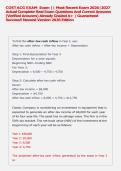
To find the after-tax cash inflow in Year 3, use:
After tax cash inflow = After-tax income + Depreciation
Step 1: Find depreciation for Year 3
Depreciation for a year equals:
Beginning NBV−Ending NBV
For Year 3:
Depreciation = 9,500 − 4,750 = 4,750
Step 2: Calculate after-tax cash inflow
Given:
After-tax income = $8,000
Depreciation = $4,750
After-tax cash inflow = 8,000 + 4,750 = $12,750
Classic Company is considering an investment in equipment that is
expected to generate an after-tax income of $8,000 for each year
of its four-year life. The asset has no salvage value. The firm is in the
50% tax bracket. The net book value (NBV) of the investment at the
beginning of each year will be as follows:
Year 1: $40,000
Year 2: 20,000
Year 3: 9,500
Year 4: 4,750
The projected after-tax cash inflow generated by the asset in Year 3
is:
,Step 1: Calculate Depreciation
(298,000 - 0)/5 = 59,600
Step 2: Calculate annual pre-tax income:
sales - expenses - depreciation
205,000 - 72,000 - 59,600 = 73,400
Step 3: calculate annual after tax income
73,400 x 50% = 36,700
73,400 - 36,700 = 36,700
Step 4: Calculate annual after tax cash flow
*add back depreciation
36,700 + 59,600 = 96,300
Step 5: calculate PV of cash inflows:
96,300 x 3.791 = 365,073
Step 6: calculate NPV
PV of inflows - initial investment
365,073 - 298,000 = 67,073
Tram Corporation wants to purchase a new machine for $298,000.
Management predicts that the machine can produce sales of
$205,000 each year for the next 5 years. Expenses are expected to
include direct materials, direct labor, and factory overhead
(excluding depreciation) totaling $72,000 per year. The firm uses
straight-line depreciation with no residual value for all depreciable
assets. Tram's combined income tax rate is 50%. Management
requires a minimum after-tax rate of return of 10% on all investments.
What is the net present value (NPV) of the investment, rounded to
the nearest whole dollar? (The PV annuity factor for 5 years, 10% is
3.791.) Assume that the cash inflows occur at year-end.
,Accounting (book) rate of return (ARR):
(average annual accounting income/initial investment) x 100
(70,,100,000) x 100 = 2.26%
Terrace Fold Corporation is considering purchasing a machine for
$3,100,000. The machine is expected to generate a constant after-
tax income of $70,000 per year for 14 years. The firm will use
straight-line (SL) depreciation for the new machine over 14 years
with no residual value.
What is the estimated accounting (book) rate of return (rounded to
two decimal places) on the initial investment?
, Step 1: calculate annual depreciation
298,000/5 = 59,600
Step 2: annual pretax income
sales - expenses - depreciation
205,000 - 68,000 - 59,600 = 77,400
Step 3: Annual after tax income
77,400 x 40% = 30,960
77,400 - 30,960 = 46,440
Step 4: add back depreciation
46,440 + 59,600 = 106,040
Step 5: payback period
initial investment/annual cash inflow
298,000/106,040 = 2.8 years
Tram Corporation wants to purchase a new machine for $298,000.
Management predicts that the machine can produce sales of
$205,000 each year for the next 5 years. Expenses are expected to
include direct materials, direct labor, and factory overhead
(excluding depreciation) totaling $68,000 per year. The firm uses
straight-line depreciation with no residual value for all depreciable
assets. Tram's combined income tax rate is 40%. Management
requires a minimum after-tax rate of return of 14% on all investments.
What is the payback period for the new machine (rounded to
nearest one-tenth of a year)? (Assume that the cash inflows occur
evenly throughout the year.)
Actual Complete Real Exam Questions And Correct Answers
(Verified Answers) Already Graded A+ | Guaranteed
Success!! Newest Version 2026 Edition
To find the after-tax cash inflow in Year 3, use:
After tax cash inflow = After-tax income + Depreciation
Step 1: Find depreciation for Year 3
Depreciation for a year equals:
Beginning NBV−Ending NBV
For Year 3:
Depreciation = 9,500 − 4,750 = 4,750
Step 2: Calculate after-tax cash inflow
Given:
After-tax income = $8,000
Depreciation = $4,750
After-tax cash inflow = 8,000 + 4,750 = $12,750
Classic Company is considering an investment in equipment that is
expected to generate an after-tax income of $8,000 for each year
of its four-year life. The asset has no salvage value. The firm is in the
50% tax bracket. The net book value (NBV) of the investment at the
beginning of each year will be as follows:
Year 1: $40,000
Year 2: 20,000
Year 3: 9,500
Year 4: 4,750
The projected after-tax cash inflow generated by the asset in Year 3
is:
,Step 1: Calculate Depreciation
(298,000 - 0)/5 = 59,600
Step 2: Calculate annual pre-tax income:
sales - expenses - depreciation
205,000 - 72,000 - 59,600 = 73,400
Step 3: calculate annual after tax income
73,400 x 50% = 36,700
73,400 - 36,700 = 36,700
Step 4: Calculate annual after tax cash flow
*add back depreciation
36,700 + 59,600 = 96,300
Step 5: calculate PV of cash inflows:
96,300 x 3.791 = 365,073
Step 6: calculate NPV
PV of inflows - initial investment
365,073 - 298,000 = 67,073
Tram Corporation wants to purchase a new machine for $298,000.
Management predicts that the machine can produce sales of
$205,000 each year for the next 5 years. Expenses are expected to
include direct materials, direct labor, and factory overhead
(excluding depreciation) totaling $72,000 per year. The firm uses
straight-line depreciation with no residual value for all depreciable
assets. Tram's combined income tax rate is 50%. Management
requires a minimum after-tax rate of return of 10% on all investments.
What is the net present value (NPV) of the investment, rounded to
the nearest whole dollar? (The PV annuity factor for 5 years, 10% is
3.791.) Assume that the cash inflows occur at year-end.
,Accounting (book) rate of return (ARR):
(average annual accounting income/initial investment) x 100
(70,,100,000) x 100 = 2.26%
Terrace Fold Corporation is considering purchasing a machine for
$3,100,000. The machine is expected to generate a constant after-
tax income of $70,000 per year for 14 years. The firm will use
straight-line (SL) depreciation for the new machine over 14 years
with no residual value.
What is the estimated accounting (book) rate of return (rounded to
two decimal places) on the initial investment?
, Step 1: calculate annual depreciation
298,000/5 = 59,600
Step 2: annual pretax income
sales - expenses - depreciation
205,000 - 68,000 - 59,600 = 77,400
Step 3: Annual after tax income
77,400 x 40% = 30,960
77,400 - 30,960 = 46,440
Step 4: add back depreciation
46,440 + 59,600 = 106,040
Step 5: payback period
initial investment/annual cash inflow
298,000/106,040 = 2.8 years
Tram Corporation wants to purchase a new machine for $298,000.
Management predicts that the machine can produce sales of
$205,000 each year for the next 5 years. Expenses are expected to
include direct materials, direct labor, and factory overhead
(excluding depreciation) totaling $68,000 per year. The firm uses
straight-line depreciation with no residual value for all depreciable
assets. Tram's combined income tax rate is 40%. Management
requires a minimum after-tax rate of return of 14% on all investments.
What is the payback period for the new machine (rounded to
nearest one-tenth of a year)? (Assume that the cash inflows occur
evenly throughout the year.)