
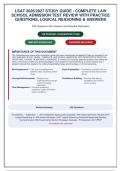
LSAT 2026/2027 STUDY GUIDE - COMPLETE LAW
SCHOOL ADMISSION TEST REVIEW WITH PRACTICE
QUESTIONS, LOGICAL REASONING & ANSWERS
230 Questions with Answers and Detailed Rationales
100 PERCENT GUARANTEED PASS
INSTANT DOWNLOAD ANSWERS INCLUDED
IMPORTANCE OF THIS DOCUMENT
This comprehensive examination preparation guide has been meticulously developed to help you succeed in the
LSAT 2026/2027 STUDY GUIDE - COMPLETE LAW SCHOOL ADMISSION TEST REVIEW WITH PRACTICE
QUESTIONS, LOGICAL REASONING & ANSWERS. It contains 230 carefully selected questions that reflect the
most current exam content and testing strategies. Each question is accompanied by a correct answer and a
detailed rationale that explains the underlying pathophysiology, pharmacology, or clinical reasoning.
Self-Assessment – Test your knowledge and Exam Preparation – Familiarize yourself with the
identify areas requiring further question format and content
study areas
Concept Reinforcement – Deepen your Confidence Building – Develop test-taking
understanding through strategies and reduce
evidence-based exam anxiety
rationales
Time Management – Practice answering
questions under simulated
exam conditions
Review Summary 230 Questions
Foundations - Application - LSAT 2026/2027 Study Guide Complete LAW School Admission Review WITH
Logical Reasoning & LAW School Admission LSAT Logical Reasoning Analytical Reasoning Reading
Comprehension AND Experimental Section Strategies Graduate / Professional LSAT PREP
All answers with rationales
,Table of Contents
Content Area Questions Key Topics
LSAT 2026/2027 Study Guide 1-39 Argument, Reasoning, Author, Because, Logical
Complete LAW School
Admission Review WITH
Logical Reasoning & LAW
School Admission LSAT
Logical Reasoning Analytical
Reasoning Reading
Comprehension AND
Experimental Section
Strategies Graduate /
Professional LSAT PREP
Because 40-78 Argument, Study, Passage, Therefore, Argues
Reasoning 79-117 Argument, Describes, Study, Logical, Because
Study 118-156 Because, Argument, Author, Argues, Reasoning
Author 157-195 Argument, Logic GAME, Cannot, Selected, Reasoning
Logic 196-230 Because, Passage, Study, Argument, States
TOTAL 230 All questions include answers and detailed rationales
,Section A - LSAT 2026/2027 Study Guide Complete LAW
School Admission Review WITH Logical Reasoning & LAW
School Admission LSAT Logical Reasoning Analytical
Reasoning Reading Comprehension AND Experimental
Section Strategies Graduate / Professional LSAT PREP
Q1.
In a flaw question, an argument concludes that a town's new recycling program will
succeed because a neighboring town's program succeeded. Which flaw is most likely at
play if the neighboring town has a younger, more environmentally conscious population?
A. Appeal to popularity B. False analogy
C. Post hoc ergo propter hoc D. Straw man
Correct: B - False analogy
Rationale:The argument relies on an analogy between two towns. Because the populations
differ significantly in environmental attitudes, the analogy is weak, making false analogy the
best flaw. Appeal to popularity would cite widespread support; post hoc would confuse
correlation with causation; straw man misrepresents an opposing view.
Q2.
If a logic game states: 'Exactly five students-A, B, C, D, E-are seated in a row. A sits next
to B. C does not sit next to D. E sits somewhere to the left of A.' Which of the following
must be true?
A. A is not in the first position. B. C is in the second position.
C. D is in the last position. D. B is to the left of E.
Correct: A - A is not in the first position.
Rationale:Since E sits to the left of A and A sits next to B, A cannot be in the first position (E
must be left of A, and there must be room for E). The other options are not necessarily true;
multiple arrangements satisfy the rules without those constraints.
Q3.
In a reading comprehension passage about legal precedent, the author describes a court's
decision as 'a departure from established doctrine, yet one that merely restores the
original balance envisioned by the framers.' Which of the following best captures the
author's attitude toward the decision?
A. Ambivalent but ultimately approving B. Critical and dismissive
Page 3
, Section A - LSAT 2026/2027 Study Guide Complete LAW School Admission Review WITH Logical Reasoning & LAW School Admission LSAT
Logical Reasoning Analytical Reasoning Reading Comprehension AND Experimental Section Strategies Graduate / Professional LSAT PREP
C. Enthusiastically supportive without D. Neutral and dispassionate
reservation
Correct: A - Ambivalent but ultimately approving
Rationale:The phrase 'departure' signals a break, but 'restores the original balance' suggests
approval. This duality indicates ambivalence resolved in favor of the decision. The author is
not wholly uncritical, nor are they dismissive or neutral.
Q4.
Which of the following is a correct application of De Morgan's Law to the statement: 'It is
not the case that both the plaintiff and the defendant were present'?
A. The plaintiff was not present and the B. The plaintiff was not present or the
defendant was not present. defendant was not present.
C. The plaintiff was present and the D. If the plaintiff was present, then the
defendant was present. defendant was not present.
Correct: B - The plaintiff was not present or the defendant was not present.
Rationale:De Morgan's Law states that the negation of a conjunction (not (P and D)) is
equivalent to the disjunction of negations (not P or not D). Thus, either the plaintiff was absent
or the defendant was absent. Option A is the negation of a disjunction; C is the original; D is a
conditional that does not follow.
Q5.
An argument claims: 'If the economy improves, unemployment will drop. Unemployment
did not drop. Therefore, the economy did not improve.' This reasoning is:
A. Valid modus tollens B. Invalid denying the antecedent
C. Valid modus ponens D. Invalid affirming the consequent
Correct: A - Valid modus tollens
Rationale:The structure is: If P then Q; not Q; therefore not P. This is modus tollens, a valid
deductive form. Denying the antecedent would be 'not P, therefore not Q'; modus ponens
would be 'P, therefore Q'; affirming the consequent would be 'Q, therefore P'.
Q6.
To maximize efficiency on a logic game, which of the following is the most effective initial
strategy after reading the rules?
A. Immediately test each answer choice B. Draw a diagram and represent each rule
against the rules. symbolically.
Page 4
SCHOOL ADMISSION TEST REVIEW WITH PRACTICE
QUESTIONS, LOGICAL REASONING & ANSWERS
230 Questions with Answers and Detailed Rationales
100 PERCENT GUARANTEED PASS
INSTANT DOWNLOAD ANSWERS INCLUDED
IMPORTANCE OF THIS DOCUMENT
This comprehensive examination preparation guide has been meticulously developed to help you succeed in the
LSAT 2026/2027 STUDY GUIDE - COMPLETE LAW SCHOOL ADMISSION TEST REVIEW WITH PRACTICE
QUESTIONS, LOGICAL REASONING & ANSWERS. It contains 230 carefully selected questions that reflect the
most current exam content and testing strategies. Each question is accompanied by a correct answer and a
detailed rationale that explains the underlying pathophysiology, pharmacology, or clinical reasoning.
Self-Assessment – Test your knowledge and Exam Preparation – Familiarize yourself with the
identify areas requiring further question format and content
study areas
Concept Reinforcement – Deepen your Confidence Building – Develop test-taking
understanding through strategies and reduce
evidence-based exam anxiety
rationales
Time Management – Practice answering
questions under simulated
exam conditions
Review Summary 230 Questions
Foundations - Application - LSAT 2026/2027 Study Guide Complete LAW School Admission Review WITH
Logical Reasoning & LAW School Admission LSAT Logical Reasoning Analytical Reasoning Reading
Comprehension AND Experimental Section Strategies Graduate / Professional LSAT PREP
All answers with rationales
,Table of Contents
Content Area Questions Key Topics
LSAT 2026/2027 Study Guide 1-39 Argument, Reasoning, Author, Because, Logical
Complete LAW School
Admission Review WITH
Logical Reasoning & LAW
School Admission LSAT
Logical Reasoning Analytical
Reasoning Reading
Comprehension AND
Experimental Section
Strategies Graduate /
Professional LSAT PREP
Because 40-78 Argument, Study, Passage, Therefore, Argues
Reasoning 79-117 Argument, Describes, Study, Logical, Because
Study 118-156 Because, Argument, Author, Argues, Reasoning
Author 157-195 Argument, Logic GAME, Cannot, Selected, Reasoning
Logic 196-230 Because, Passage, Study, Argument, States
TOTAL 230 All questions include answers and detailed rationales
,Section A - LSAT 2026/2027 Study Guide Complete LAW
School Admission Review WITH Logical Reasoning & LAW
School Admission LSAT Logical Reasoning Analytical
Reasoning Reading Comprehension AND Experimental
Section Strategies Graduate / Professional LSAT PREP
Q1.
In a flaw question, an argument concludes that a town's new recycling program will
succeed because a neighboring town's program succeeded. Which flaw is most likely at
play if the neighboring town has a younger, more environmentally conscious population?
A. Appeal to popularity B. False analogy
C. Post hoc ergo propter hoc D. Straw man
Correct: B - False analogy
Rationale:The argument relies on an analogy between two towns. Because the populations
differ significantly in environmental attitudes, the analogy is weak, making false analogy the
best flaw. Appeal to popularity would cite widespread support; post hoc would confuse
correlation with causation; straw man misrepresents an opposing view.
Q2.
If a logic game states: 'Exactly five students-A, B, C, D, E-are seated in a row. A sits next
to B. C does not sit next to D. E sits somewhere to the left of A.' Which of the following
must be true?
A. A is not in the first position. B. C is in the second position.
C. D is in the last position. D. B is to the left of E.
Correct: A - A is not in the first position.
Rationale:Since E sits to the left of A and A sits next to B, A cannot be in the first position (E
must be left of A, and there must be room for E). The other options are not necessarily true;
multiple arrangements satisfy the rules without those constraints.
Q3.
In a reading comprehension passage about legal precedent, the author describes a court's
decision as 'a departure from established doctrine, yet one that merely restores the
original balance envisioned by the framers.' Which of the following best captures the
author's attitude toward the decision?
A. Ambivalent but ultimately approving B. Critical and dismissive
Page 3
, Section A - LSAT 2026/2027 Study Guide Complete LAW School Admission Review WITH Logical Reasoning & LAW School Admission LSAT
Logical Reasoning Analytical Reasoning Reading Comprehension AND Experimental Section Strategies Graduate / Professional LSAT PREP
C. Enthusiastically supportive without D. Neutral and dispassionate
reservation
Correct: A - Ambivalent but ultimately approving
Rationale:The phrase 'departure' signals a break, but 'restores the original balance' suggests
approval. This duality indicates ambivalence resolved in favor of the decision. The author is
not wholly uncritical, nor are they dismissive or neutral.
Q4.
Which of the following is a correct application of De Morgan's Law to the statement: 'It is
not the case that both the plaintiff and the defendant were present'?
A. The plaintiff was not present and the B. The plaintiff was not present or the
defendant was not present. defendant was not present.
C. The plaintiff was present and the D. If the plaintiff was present, then the
defendant was present. defendant was not present.
Correct: B - The plaintiff was not present or the defendant was not present.
Rationale:De Morgan's Law states that the negation of a conjunction (not (P and D)) is
equivalent to the disjunction of negations (not P or not D). Thus, either the plaintiff was absent
or the defendant was absent. Option A is the negation of a disjunction; C is the original; D is a
conditional that does not follow.
Q5.
An argument claims: 'If the economy improves, unemployment will drop. Unemployment
did not drop. Therefore, the economy did not improve.' This reasoning is:
A. Valid modus tollens B. Invalid denying the antecedent
C. Valid modus ponens D. Invalid affirming the consequent
Correct: A - Valid modus tollens
Rationale:The structure is: If P then Q; not Q; therefore not P. This is modus tollens, a valid
deductive form. Denying the antecedent would be 'not P, therefore not Q'; modus ponens
would be 'P, therefore Q'; affirming the consequent would be 'Q, therefore P'.
Q6.
To maximize efficiency on a logic game, which of the following is the most effective initial
strategy after reading the rules?
A. Immediately test each answer choice B. Draw a diagram and represent each rule
against the rules. symbolically.
Page 4


