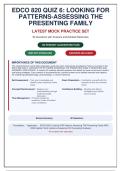
EDCO 820 QUIZ 6: LOOKING FOR
PATTERNS-ASSESSING THE
PRESENTING FAMILY
LATEST MOCK PRACTICE SET
90 Questions with Answers and Detailed Rationales
100 PERCENT GUARANTEED PASS
INSTANT DOWNLOAD ANSWERS INCLUDED
IMPORTANCE OF THIS DOCUMENT
This comprehensive examination preparation guide has been meticulously developed to help you succeed in the
EDCO 820 QUIZ 6: LOOKING FOR PATTERNS-ASSESSING THE PRESENTING FAMILY |QUESTIONS AND
ANSWERS | 2026 UPDATE. It contains 90 carefully selected questions that reflect the most current exam content
and testing strategies. Each question is accompanied by a correct answer and a detailed rationale that explains
the underlying pathophysiology, pharmacology, or clinical reasoning.
Self-Assessment – Test your knowledge and Exam Preparation – Familiarize yourself with the
identify areas requiring further question format and content
study areas
Concept Reinforcement – Deepen your Confidence Building – Develop test-taking
understanding through strategies and reduce
evidence-based exam anxiety
rationales
Time Management – Practice answering
questions under simulated
exam conditions
Review Summary 90 Questions
Foundations - Application - EDCO 820 6 Looking FOR Patterns Assessing THE Presenting Family AND
2026 Update Family Systems Assessment IN Counseling Graduate
All answers with rationales
,Table of Contents
Content Area Questions Key Topics
Family Systems Theory 1-15 Family, Therapist, Pattern, Presents, Conflict
Family LIFE Cycle AND 16-30 Family, Therapist, Presents, Model, Adolescent
Developmental Stages
Patterns OF Interaction AND 31-45 Family, Therapist, Parents, Pattern, Presents
Communication
Family Assessment Models 46-60 Family, Model, Therapist, Parents, Child
AND Tools
Identifying Dysfunctional 61-75 Family, Therapist, Parents, Concept, Member
Patterns
Cultural AND Contextual 76-90 Family, Therapist, Model, Presents, Structural
Influences ON Family
Functioning
TOTAL 90 All questions include answers and detailed rationales
,Section A - Family Systems Theory
Q1.
In a family assessment, a genogram reveals that three generations of maternal lineage
have experienced divorces following the birth of a first child. The identified patient is a
12-year-old displaying school refusal. Using intergenerational family systems theory,
which hypothesis best guides initial intervention?
A. The child's symptoms are a manifestation B. The child's behavior is reinforcing a
of the family's unresolved anxiety about cross-generational coalition against the
separation and individuation. paternal grandmother.
C. The family is exhibiting a disengagement D. The school refusal is a homeostatic
pattern that prevents emotional connection mechanism to avoid confronting the parents'
across generations. marital conflict.
Correct: A - The child's symptoms are a manifestation of the family's unresolved anxiety
about separation and individuation.
Rationale:Correct: Intergenerational theory (Bowen) suggests that symptoms often arise from
multigenerational emotional processes, particularly anxiety around differentiation and
separation. The pattern of divorces after first births indicates a family projection process. B, C,
and D are plausible but focus on structural or strategic concepts, not the intergenerational
transmission pattern.
Q2.
A couple presents with escalating conflict over parenting styles. During the session, the
wife aligns with the therapist while criticizing her husband's discipline, and the husband
withdraws. Using structural family therapy, what is the most accurate assessment of this
interaction?
A. A cross-generational coalition between B. A stable coalition between the spouses
the wife and the therapist, indicating a that is being expressed through conflict.
boundary violation.
C. A disengaged spousal subsystem with D. An inappropriate hierarchy where the
enmeshment between the wife and the husband has delegated authority to the
parental subsystem. therapist.
Correct: A - A cross-generational coalition between the wife and the therapist, indicating a
boundary violation.
Rationale:Correct: In structural therapy, an alliance between one parent and a therapist
against the other creates a cross-generational coalition, violating the generational boundary. B
is incorrect because the conflict is not a stable coalition. C misidentifies the pattern
(enmeshment is not present). D is not a structural concept.
Page 3
, Section A - Family Systems Theory
Q3.
In Milan systemic therapy, a therapist asks each family member: 'If your mother were to
stop worrying excessively, what would your father do differently?' This question is
primarily designed to:
A. Uncover the function of the symptom in B. Elicit a circular pattern by connecting
stabilizing the family's interactional patterns. behaviors across the family system.
C. Challenge the family's linear view of D. Assess the family's capacity for
causality by introducing a hypothetical. future-oriented thinking and flexibility.
Correct: B - Elicit a circular pattern by connecting behaviors across the family system.
Rationale:Correct: Circular questioning aims to reveal patterns of interaction by asking about
relationships and differences, rather than linear cause-effect. This question links the mother's
behavior to the father's response, illuminating a circular loop. A is more strategic (function of
symptom). C is a possible effect but not the primary design. D is not the focus.
Q4.
A family presents with a rigid, authoritarian father and a passive, overly accommodating
mother. Their adolescent son has been acting out. Using the circumplex model, which
combination of cohesion and flexibility best describes this family?
A. Disengaged and rigid B. Enmeshed and chaotic
C. Disengaged and chaotic D. Enmeshed and rigid
Correct: A - Disengaged and rigid
Rationale:Correct: The father's authoritarian style indicates rigidity (low flexibility), and the
mother's passivity and the son's acting out suggest emotional disengagement (low cohesion).
B and C are incorrect because the family shows rigidity, not chaos. D is incorrect because
enmeshment is not present.
Q5.
Which assessment instrument is specifically designed to measure the level of
differentiation of self within a family system, based on Bowen's theory?
A. Family Adaptability and Cohesion B. Differentiation of Self Inventory (DSI)
Evaluation Scales (FACES IV)
C. Family Assessment Device (FAD) D. Beavers Interactional Competence Scale
Correct: B - Differentiation of Self Inventory (DSI)
Page 4
PATTERNS-ASSESSING THE
PRESENTING FAMILY
LATEST MOCK PRACTICE SET
90 Questions with Answers and Detailed Rationales
100 PERCENT GUARANTEED PASS
INSTANT DOWNLOAD ANSWERS INCLUDED
IMPORTANCE OF THIS DOCUMENT
This comprehensive examination preparation guide has been meticulously developed to help you succeed in the
EDCO 820 QUIZ 6: LOOKING FOR PATTERNS-ASSESSING THE PRESENTING FAMILY |QUESTIONS AND
ANSWERS | 2026 UPDATE. It contains 90 carefully selected questions that reflect the most current exam content
and testing strategies. Each question is accompanied by a correct answer and a detailed rationale that explains
the underlying pathophysiology, pharmacology, or clinical reasoning.
Self-Assessment – Test your knowledge and Exam Preparation – Familiarize yourself with the
identify areas requiring further question format and content
study areas
Concept Reinforcement – Deepen your Confidence Building – Develop test-taking
understanding through strategies and reduce
evidence-based exam anxiety
rationales
Time Management – Practice answering
questions under simulated
exam conditions
Review Summary 90 Questions
Foundations - Application - EDCO 820 6 Looking FOR Patterns Assessing THE Presenting Family AND
2026 Update Family Systems Assessment IN Counseling Graduate
All answers with rationales
,Table of Contents
Content Area Questions Key Topics
Family Systems Theory 1-15 Family, Therapist, Pattern, Presents, Conflict
Family LIFE Cycle AND 16-30 Family, Therapist, Presents, Model, Adolescent
Developmental Stages
Patterns OF Interaction AND 31-45 Family, Therapist, Parents, Pattern, Presents
Communication
Family Assessment Models 46-60 Family, Model, Therapist, Parents, Child
AND Tools
Identifying Dysfunctional 61-75 Family, Therapist, Parents, Concept, Member
Patterns
Cultural AND Contextual 76-90 Family, Therapist, Model, Presents, Structural
Influences ON Family
Functioning
TOTAL 90 All questions include answers and detailed rationales
,Section A - Family Systems Theory
Q1.
In a family assessment, a genogram reveals that three generations of maternal lineage
have experienced divorces following the birth of a first child. The identified patient is a
12-year-old displaying school refusal. Using intergenerational family systems theory,
which hypothesis best guides initial intervention?
A. The child's symptoms are a manifestation B. The child's behavior is reinforcing a
of the family's unresolved anxiety about cross-generational coalition against the
separation and individuation. paternal grandmother.
C. The family is exhibiting a disengagement D. The school refusal is a homeostatic
pattern that prevents emotional connection mechanism to avoid confronting the parents'
across generations. marital conflict.
Correct: A - The child's symptoms are a manifestation of the family's unresolved anxiety
about separation and individuation.
Rationale:Correct: Intergenerational theory (Bowen) suggests that symptoms often arise from
multigenerational emotional processes, particularly anxiety around differentiation and
separation. The pattern of divorces after first births indicates a family projection process. B, C,
and D are plausible but focus on structural or strategic concepts, not the intergenerational
transmission pattern.
Q2.
A couple presents with escalating conflict over parenting styles. During the session, the
wife aligns with the therapist while criticizing her husband's discipline, and the husband
withdraws. Using structural family therapy, what is the most accurate assessment of this
interaction?
A. A cross-generational coalition between B. A stable coalition between the spouses
the wife and the therapist, indicating a that is being expressed through conflict.
boundary violation.
C. A disengaged spousal subsystem with D. An inappropriate hierarchy where the
enmeshment between the wife and the husband has delegated authority to the
parental subsystem. therapist.
Correct: A - A cross-generational coalition between the wife and the therapist, indicating a
boundary violation.
Rationale:Correct: In structural therapy, an alliance between one parent and a therapist
against the other creates a cross-generational coalition, violating the generational boundary. B
is incorrect because the conflict is not a stable coalition. C misidentifies the pattern
(enmeshment is not present). D is not a structural concept.
Page 3
, Section A - Family Systems Theory
Q3.
In Milan systemic therapy, a therapist asks each family member: 'If your mother were to
stop worrying excessively, what would your father do differently?' This question is
primarily designed to:
A. Uncover the function of the symptom in B. Elicit a circular pattern by connecting
stabilizing the family's interactional patterns. behaviors across the family system.
C. Challenge the family's linear view of D. Assess the family's capacity for
causality by introducing a hypothetical. future-oriented thinking and flexibility.
Correct: B - Elicit a circular pattern by connecting behaviors across the family system.
Rationale:Correct: Circular questioning aims to reveal patterns of interaction by asking about
relationships and differences, rather than linear cause-effect. This question links the mother's
behavior to the father's response, illuminating a circular loop. A is more strategic (function of
symptom). C is a possible effect but not the primary design. D is not the focus.
Q4.
A family presents with a rigid, authoritarian father and a passive, overly accommodating
mother. Their adolescent son has been acting out. Using the circumplex model, which
combination of cohesion and flexibility best describes this family?
A. Disengaged and rigid B. Enmeshed and chaotic
C. Disengaged and chaotic D. Enmeshed and rigid
Correct: A - Disengaged and rigid
Rationale:Correct: The father's authoritarian style indicates rigidity (low flexibility), and the
mother's passivity and the son's acting out suggest emotional disengagement (low cohesion).
B and C are incorrect because the family shows rigidity, not chaos. D is incorrect because
enmeshment is not present.
Q5.
Which assessment instrument is specifically designed to measure the level of
differentiation of self within a family system, based on Bowen's theory?
A. Family Adaptability and Cohesion B. Differentiation of Self Inventory (DSI)
Evaluation Scales (FACES IV)
C. Family Assessment Device (FAD) D. Beavers Interactional Competence Scale
Correct: B - Differentiation of Self Inventory (DSI)
Page 4