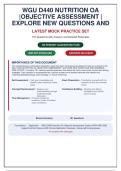
WGU D440 NUTRITION OA
|OBJECTIVE ASSESSMENT |
EXPLORE NEW QUESTIONS AND
LATEST MOCK PRACTICE SET
181 Questions with Answers and Detailed Rationales
100 PERCENT GUARANTEED PASS
INSTANT DOWNLOAD ANSWERS INCLUDED
IMPORTANCE OF THIS DOCUMENT
This comprehensive examination preparation guide has been meticulously developed to help you succeed in the
WGU D440 NUTRITION OA |OBJECTIVE ASSESSMENT | EXPLORE NEW QUESTIONS AND ANSWERS |
2026 UPDATE. It contains 181 carefully selected questions that reflect the most current exam content and testing
strategies. Each question is accompanied by a correct answer and a detailed rationale that explains the
underlying pathophysiology, pharmacology, or clinical reasoning.
Self-Assessment – Test your knowledge and Exam Preparation – Familiarize yourself with the
identify areas requiring further question format and content
study areas
Concept Reinforcement – Deepen your Confidence Building – Develop test-taking
understanding through strategies and reduce
evidence-based exam anxiety
rationales
Time Management – Practice answering
questions under simulated
exam conditions
Review Summary 181 Questions
Foundations - Application - WGU D440 Nutrition OA Objective Assessment Explore NEW AND 2026
Update Nutrition Science AND Clinical Application Graduate / Advanced Undergraduate
All answers with rationales
,Table of Contents
Content Area Questions Key Topics
Nutrition Assessment AND 1-31 Dietary, Chronic, Disease, Serum, Syndrome
Diagnosis
Nutrition Intervention AND 32-62 Dietary, Disease, Likely, Chronic, Study
Monitoring/evaluation
Macronutrients AND 63-93 Dietary, Disease, Explains, Chronic, Diabetes
Micronutrients
LIFE Cycle Nutrition 94-124 Metabolic, Explains, Dietary, Trial, Effect
Medical Nutrition Therapy 125-155 Dietary, Disease, Explains, Fatty, Likely
FOR Chronic Diseases
Nutrition Support Enteral 156-181 Nutrition, Dietary, Chronic, Parenteral, Disease
AND Parenteral
TOTAL 181 All questions include answers and detailed rationales
,Section A - Nutrition Assessment AND Diagnosis
Q1.
In a patient with untreated type 1 diabetes, which metabolic adaptation is the PRIMARY
driver of hyperglycemia and ketogenesis?
A. Increased glucagon-to-insulin ratio B. Insulin deficiency causing reduced
leading to hepatic gluconeogenesis and fatty peripheral glucose uptake and increased
acid oxidation lipolysis
C. Cortisol excess promoting protein D. Epinephrine surge stimulating
catabolism and gluconeogenesis glycogenolysis and lipolysis
Correct: A - Increased glucagon-to-insulin ratio leading to hepatic gluconeogenesis and
fatty acid oxidation
Rationale:The primary driver is the elevated glucagon-to-insulin ratio, which simultaneously
activates gluconeogenesis and ketogenesis. While insulin deficiency also reduces glucose
uptake and increases lipolysis, it is the imbalance of glucagon that orchestrates the hepatic
metabolic state. Cortisol and epinephrine contribute but are not the primary drivers.
Q2.
Which of the following best explains the paradoxical increase in LDL cholesterol observed
with a low-carbohydrate, high-saturated-fat diet in some individuals?
A. Upregulation of hepatic LDL receptor B. Increased intestinal cholesterol
expression due to reduced insulin signaling absorption and decreased bile acid
synthesis
C. Reduced hepatic LDL receptor activity D. Enhanced VLDL secretion due to
because of high saturated fat intake increased de novo lipogenesis from excess
protein
Correct: C - Reduced hepatic LDL receptor activity because of high saturated fat intake
Rationale:Saturated fat intake can downregulate LDL receptor activity, reducing LDL
clearance and raising plasma LDL. This effect is independent of insulin signaling. Increased
absorption and decreased bile acid synthesis are not primary mechanisms. VLDL secretion is
not enhanced by protein excess.
Q3.
A patient with chronic kidney disease (CKD) stage 4 has a serum phosphorus of 6.2
mg/dL. Which dietary intervention is most appropriate to manage hyperphosphatemia?
Page 3
, Section A - Nutrition Assessment AND Diagnosis
A. Increase intake of dairy products to B. Restrict intake of processed foods and
provide calcium and bind phosphorus cola beverages, and consider phosphate
binder with meals
C. Encourage high-fiber foods like whole D. Supplement with vitamin D to increase
grains and legumes to enhance phosphorus phosphorus absorption and renal excretion
excretion
Correct: B - Restrict intake of processed foods and cola beverages, and consider
phosphate binder with meals
Rationale:In CKD, hyperphosphatemia is managed by limiting dietary phosphorus, especially
from additives in processed foods and colas, and using phosphate binders with meals. Dairy
and whole grains are high in phosphorus. Vitamin D increases absorption, worsening
hyperphosphatemia.
Q4.
Which of the following micronutrient deficiencies is most likely to present with glossitis,
seborrheic dermatitis, and normocytic anemia?
A. Vitamin B12 deficiency B. Folate deficiency
C. Riboflavin deficiency D. Niacin deficiency
Correct: C - Riboflavin deficiency
Rationale:Riboflavin deficiency presents with glossitis, seborrheic dermatitis, and normocytic
anemia. B12 and folate cause megaloblastic anemia, not normocytic. Niacin deficiency
(pellagra) presents with dermatitis, diarrhea, and dementia, but not typically normocytic
anemia.
Q5.
In a randomized controlled trial, a new diet reduces LDL cholesterol by 15% but increases
HDL by 5%. Which of the following biomarkers would be the LEAST useful to assess
cardiovascular risk reduction?
A. Apolipoprotein B (apoB) B. High-sensitivity C-reactive protein
(hs-CRP)
C. Fasting triglycerides D. Lipoprotein(a) [Lp(a)]
Correct: D - Lipoprotein(a) [Lp(a)]
Rationale:Lp(a) is genetically determined and not significantly altered by diet, so it is least
useful for assessing dietary intervention effects. ApoB, hs-CRP, and triglycerides are
modifiable and reflect changes in lipid and inflammatory status.
Page 4
|OBJECTIVE ASSESSMENT |
EXPLORE NEW QUESTIONS AND
LATEST MOCK PRACTICE SET
181 Questions with Answers and Detailed Rationales
100 PERCENT GUARANTEED PASS
INSTANT DOWNLOAD ANSWERS INCLUDED
IMPORTANCE OF THIS DOCUMENT
This comprehensive examination preparation guide has been meticulously developed to help you succeed in the
WGU D440 NUTRITION OA |OBJECTIVE ASSESSMENT | EXPLORE NEW QUESTIONS AND ANSWERS |
2026 UPDATE. It contains 181 carefully selected questions that reflect the most current exam content and testing
strategies. Each question is accompanied by a correct answer and a detailed rationale that explains the
underlying pathophysiology, pharmacology, or clinical reasoning.
Self-Assessment – Test your knowledge and Exam Preparation – Familiarize yourself with the
identify areas requiring further question format and content
study areas
Concept Reinforcement – Deepen your Confidence Building – Develop test-taking
understanding through strategies and reduce
evidence-based exam anxiety
rationales
Time Management – Practice answering
questions under simulated
exam conditions
Review Summary 181 Questions
Foundations - Application - WGU D440 Nutrition OA Objective Assessment Explore NEW AND 2026
Update Nutrition Science AND Clinical Application Graduate / Advanced Undergraduate
All answers with rationales
,Table of Contents
Content Area Questions Key Topics
Nutrition Assessment AND 1-31 Dietary, Chronic, Disease, Serum, Syndrome
Diagnosis
Nutrition Intervention AND 32-62 Dietary, Disease, Likely, Chronic, Study
Monitoring/evaluation
Macronutrients AND 63-93 Dietary, Disease, Explains, Chronic, Diabetes
Micronutrients
LIFE Cycle Nutrition 94-124 Metabolic, Explains, Dietary, Trial, Effect
Medical Nutrition Therapy 125-155 Dietary, Disease, Explains, Fatty, Likely
FOR Chronic Diseases
Nutrition Support Enteral 156-181 Nutrition, Dietary, Chronic, Parenteral, Disease
AND Parenteral
TOTAL 181 All questions include answers and detailed rationales
,Section A - Nutrition Assessment AND Diagnosis
Q1.
In a patient with untreated type 1 diabetes, which metabolic adaptation is the PRIMARY
driver of hyperglycemia and ketogenesis?
A. Increased glucagon-to-insulin ratio B. Insulin deficiency causing reduced
leading to hepatic gluconeogenesis and fatty peripheral glucose uptake and increased
acid oxidation lipolysis
C. Cortisol excess promoting protein D. Epinephrine surge stimulating
catabolism and gluconeogenesis glycogenolysis and lipolysis
Correct: A - Increased glucagon-to-insulin ratio leading to hepatic gluconeogenesis and
fatty acid oxidation
Rationale:The primary driver is the elevated glucagon-to-insulin ratio, which simultaneously
activates gluconeogenesis and ketogenesis. While insulin deficiency also reduces glucose
uptake and increases lipolysis, it is the imbalance of glucagon that orchestrates the hepatic
metabolic state. Cortisol and epinephrine contribute but are not the primary drivers.
Q2.
Which of the following best explains the paradoxical increase in LDL cholesterol observed
with a low-carbohydrate, high-saturated-fat diet in some individuals?
A. Upregulation of hepatic LDL receptor B. Increased intestinal cholesterol
expression due to reduced insulin signaling absorption and decreased bile acid
synthesis
C. Reduced hepatic LDL receptor activity D. Enhanced VLDL secretion due to
because of high saturated fat intake increased de novo lipogenesis from excess
protein
Correct: C - Reduced hepatic LDL receptor activity because of high saturated fat intake
Rationale:Saturated fat intake can downregulate LDL receptor activity, reducing LDL
clearance and raising plasma LDL. This effect is independent of insulin signaling. Increased
absorption and decreased bile acid synthesis are not primary mechanisms. VLDL secretion is
not enhanced by protein excess.
Q3.
A patient with chronic kidney disease (CKD) stage 4 has a serum phosphorus of 6.2
mg/dL. Which dietary intervention is most appropriate to manage hyperphosphatemia?
Page 3
, Section A - Nutrition Assessment AND Diagnosis
A. Increase intake of dairy products to B. Restrict intake of processed foods and
provide calcium and bind phosphorus cola beverages, and consider phosphate
binder with meals
C. Encourage high-fiber foods like whole D. Supplement with vitamin D to increase
grains and legumes to enhance phosphorus phosphorus absorption and renal excretion
excretion
Correct: B - Restrict intake of processed foods and cola beverages, and consider
phosphate binder with meals
Rationale:In CKD, hyperphosphatemia is managed by limiting dietary phosphorus, especially
from additives in processed foods and colas, and using phosphate binders with meals. Dairy
and whole grains are high in phosphorus. Vitamin D increases absorption, worsening
hyperphosphatemia.
Q4.
Which of the following micronutrient deficiencies is most likely to present with glossitis,
seborrheic dermatitis, and normocytic anemia?
A. Vitamin B12 deficiency B. Folate deficiency
C. Riboflavin deficiency D. Niacin deficiency
Correct: C - Riboflavin deficiency
Rationale:Riboflavin deficiency presents with glossitis, seborrheic dermatitis, and normocytic
anemia. B12 and folate cause megaloblastic anemia, not normocytic. Niacin deficiency
(pellagra) presents with dermatitis, diarrhea, and dementia, but not typically normocytic
anemia.
Q5.
In a randomized controlled trial, a new diet reduces LDL cholesterol by 15% but increases
HDL by 5%. Which of the following biomarkers would be the LEAST useful to assess
cardiovascular risk reduction?
A. Apolipoprotein B (apoB) B. High-sensitivity C-reactive protein
(hs-CRP)
C. Fasting triglycerides D. Lipoprotein(a) [Lp(a)]
Correct: D - Lipoprotein(a) [Lp(a)]
Rationale:Lp(a) is genetically determined and not significantly altered by diet, so it is least
useful for assessing dietary intervention effects. ApoB, hs-CRP, and triglycerides are
modifiable and reflect changes in lipid and inflammatory status.
Page 4