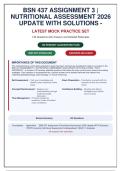
BSN 437 ASSIGNMENT 3 |
NUTRITIONAL ASSESSMENT 2026
UPDATE WITH SOLUTIONS -
LATEST MOCK PRACTICE SET
140 Questions with Answers and Detailed Rationales
100 PERCENT GUARANTEED PASS
INSTANT DOWNLOAD ANSWERS INCLUDED
IMPORTANCE OF THIS DOCUMENT
This comprehensive examination preparation guide has been meticulously developed to help you succeed in the
BSN 437 ASSIGNMENT 3 | NUTRITIONAL ASSESSMENT 2026 UPDATE WITH SOLUTIONS - POST
UNIVERSITY.. It contains 140 carefully selected questions that reflect the most current exam content and testing
strategies. Each question is accompanied by a correct answer and a detailed rationale that explains the
underlying pathophysiology, pharmacology, or clinical reasoning.
Self-Assessment – Test your knowledge and Exam Preparation – Familiarize yourself with the
identify areas requiring further question format and content
study areas
Concept Reinforcement – Deepen your Confidence Building – Develop test-taking
understanding through strategies and reduce
evidence-based exam anxiety
rationales
Time Management – Practice answering
questions under simulated
exam conditions
Review Summary 140 Questions
Foundations - Application - BSN 437 Assignment 3 Nutritional Assessment 2026 Update WITH Solutions -
POST University Nutritional Assessment Undergraduate YEAR 3 / Graduate
All answers with rationales
,Table of Contents
Content Area Questions Key Topics
Nutritional Assessment AND 1-24 Nutritional, Malnutrition, Chronic, Likely, Status
Screening Tools
Macronutrients AND 25-48 Malnutrition, Patient S, Combination, Diagnosis, Severe
Micronutrients
Nutritional Status AND BODY 49-72 Malnutrition, Nutritional, Combination, Criteria, Adult
Composition
Dietary Intake AND History 73-96 Malnutrition, Chronic Kidney Disease, Serum Albumin, KCAL
DAY, Patient S
Physical Examination AND 97-120 Malnutrition, Likely, Nutritional, Vitamin, Deficiency
Anthropometric
Measurements
Biochemical AND Laboratory 121-140 Dietary, Intake, Combination, Malnutrition, Criteria
Assessment
TOTAL 140 All questions include answers and detailed rationales
,Section A - Nutritional Assessment AND Screening Tools
Q1.
A patient with cirrhosis has a serum albumin of 2.8 g/dL and prealbumin of 12 mg/dL.
Which statement best explains the utility of these proteins in nutritional assessment?
A. Albumin is a reliable indicator of B. Prealbumin is more useful than albumin
short-term protein status because of its for assessing acute changes in nutritional
short half-life. status because of its shorter half-life.
C. Both albumin and prealbumin are acute D. Albumin and prealbumin are both reliable
phase reactants and therefore reflect markers of total body protein stores
inflammation more than nutritional status. regardless of liver function.
Correct: B - Prealbumin is more useful than albumin for assessing acute changes in
nutritional status because of its shorter half-life.
Rationale:Prealbumin has a half-life of 2-3 days, making it more sensitive to recent changes
in protein status compared to albumin (half-life ~20 days). However, both are negative acute
phase reactants, and in cirrhosis, liver synthesis is impaired, reducing their validity as
nutritional markers. Thus, option B is the best explanation.
Q2.
Which combination of findings is most consistent with the diagnosis of malnutrition in the
context of chronic illness, according to the Global Leadership Initiative on Malnutrition
(GLIM) criteria?
A. Unintentional weight loss >5% within 6 B. BMI <18.5 kg/m² alone
months and reduced muscle mass
C. Serum albumin <3.0 g/dL alone D. Inadequate dietary intake for >1 week
Correct: A - Unintentional weight loss >5% within 6 months and reduced muscle mass
Rationale:GLIM criteria require at least one phenotypic criterion (unintentional weight loss,
low BMI, or reduced muscle mass) and one etiologic criterion (reduced food
intake/assimilation, or disease burden/inflammation). Option A includes a phenotypic (weight
loss) and an etiologic (chronic illness) component. The other options are insufficient alone.
Q3.
A patient's bioelectrical impedance analysis (BIA) shows phase angle of 4.2°. How should
this be interpreted?
A. Indicates excellent cellular integrity and B. Suggests poor cellular health and
nutritional status increased mortality risk
Page 3
, Section A - Nutritional Assessment AND Screening Tools
C. Reflects high body fat percentage D. Confirms adequate hydration status
Correct: B - Suggests poor cellular health and increased mortality risk
Rationale:Phase angle is a BIA-derived measure of cellular membrane integrity and function.
Lower phase angles (<5°) are associated with impaired cellular health, malnutrition, and
increased morbidity/mortality. A value of 4.2° is low, indicating poor cellular integrity.
Q4.
When performing a 24-hour dietary recall, which technique is most effective in reducing
portion size estimation errors?
A. Asking the patient to recall foods eaten in B. Using a multiple-pass approach with
reverse order visual aids
C. Encouraging the patient to keep a food D. Relying on the patient's memory without
diary for the next 24 hours prompting
Correct: B - Using a multiple-pass approach with visual aids
Rationale:The multiple-pass method (e.g., USDA's 5-step) uses detailed probing and visual
aids (food models, portion booklets) to improve recall accuracy. Reverse order and food
diaries are alternative methods but do not specifically address portion size estimation as
effectively as visual aids.
Q5.
A patient with suspected malabsorption has a fecal fat test showing 15 g/day. Which
nutritional deficiency is most likely to develop due to this finding?
A. Iron deficiency B. Vitamin B12 deficiency
C. Fat-soluble vitamin deficiency D. Protein-energy malnutrition
Correct: C - Fat-soluble vitamin deficiency
Rationale:Fecal fat >7 g/day indicates steatorrhea, which impairs absorption of fat-soluble
vitamins (A, D, E, K). Iron and B12 deficiencies can occur with malabsorption, but steatorrhea
specifically points to fat-soluble vitamin losses.
Q6.
Which anthropometric measurement is most appropriate for assessing nutritional status
in a patient with severe ascites and peripheral edema?
A. Body weight B. Body mass index (BMI)
C. Mid-upper arm circumference (MUAC) D. Waist circumference
Page 4
NUTRITIONAL ASSESSMENT 2026
UPDATE WITH SOLUTIONS -
LATEST MOCK PRACTICE SET
140 Questions with Answers and Detailed Rationales
100 PERCENT GUARANTEED PASS
INSTANT DOWNLOAD ANSWERS INCLUDED
IMPORTANCE OF THIS DOCUMENT
This comprehensive examination preparation guide has been meticulously developed to help you succeed in the
BSN 437 ASSIGNMENT 3 | NUTRITIONAL ASSESSMENT 2026 UPDATE WITH SOLUTIONS - POST
UNIVERSITY.. It contains 140 carefully selected questions that reflect the most current exam content and testing
strategies. Each question is accompanied by a correct answer and a detailed rationale that explains the
underlying pathophysiology, pharmacology, or clinical reasoning.
Self-Assessment – Test your knowledge and Exam Preparation – Familiarize yourself with the
identify areas requiring further question format and content
study areas
Concept Reinforcement – Deepen your Confidence Building – Develop test-taking
understanding through strategies and reduce
evidence-based exam anxiety
rationales
Time Management – Practice answering
questions under simulated
exam conditions
Review Summary 140 Questions
Foundations - Application - BSN 437 Assignment 3 Nutritional Assessment 2026 Update WITH Solutions -
POST University Nutritional Assessment Undergraduate YEAR 3 / Graduate
All answers with rationales
,Table of Contents
Content Area Questions Key Topics
Nutritional Assessment AND 1-24 Nutritional, Malnutrition, Chronic, Likely, Status
Screening Tools
Macronutrients AND 25-48 Malnutrition, Patient S, Combination, Diagnosis, Severe
Micronutrients
Nutritional Status AND BODY 49-72 Malnutrition, Nutritional, Combination, Criteria, Adult
Composition
Dietary Intake AND History 73-96 Malnutrition, Chronic Kidney Disease, Serum Albumin, KCAL
DAY, Patient S
Physical Examination AND 97-120 Malnutrition, Likely, Nutritional, Vitamin, Deficiency
Anthropometric
Measurements
Biochemical AND Laboratory 121-140 Dietary, Intake, Combination, Malnutrition, Criteria
Assessment
TOTAL 140 All questions include answers and detailed rationales
,Section A - Nutritional Assessment AND Screening Tools
Q1.
A patient with cirrhosis has a serum albumin of 2.8 g/dL and prealbumin of 12 mg/dL.
Which statement best explains the utility of these proteins in nutritional assessment?
A. Albumin is a reliable indicator of B. Prealbumin is more useful than albumin
short-term protein status because of its for assessing acute changes in nutritional
short half-life. status because of its shorter half-life.
C. Both albumin and prealbumin are acute D. Albumin and prealbumin are both reliable
phase reactants and therefore reflect markers of total body protein stores
inflammation more than nutritional status. regardless of liver function.
Correct: B - Prealbumin is more useful than albumin for assessing acute changes in
nutritional status because of its shorter half-life.
Rationale:Prealbumin has a half-life of 2-3 days, making it more sensitive to recent changes
in protein status compared to albumin (half-life ~20 days). However, both are negative acute
phase reactants, and in cirrhosis, liver synthesis is impaired, reducing their validity as
nutritional markers. Thus, option B is the best explanation.
Q2.
Which combination of findings is most consistent with the diagnosis of malnutrition in the
context of chronic illness, according to the Global Leadership Initiative on Malnutrition
(GLIM) criteria?
A. Unintentional weight loss >5% within 6 B. BMI <18.5 kg/m² alone
months and reduced muscle mass
C. Serum albumin <3.0 g/dL alone D. Inadequate dietary intake for >1 week
Correct: A - Unintentional weight loss >5% within 6 months and reduced muscle mass
Rationale:GLIM criteria require at least one phenotypic criterion (unintentional weight loss,
low BMI, or reduced muscle mass) and one etiologic criterion (reduced food
intake/assimilation, or disease burden/inflammation). Option A includes a phenotypic (weight
loss) and an etiologic (chronic illness) component. The other options are insufficient alone.
Q3.
A patient's bioelectrical impedance analysis (BIA) shows phase angle of 4.2°. How should
this be interpreted?
A. Indicates excellent cellular integrity and B. Suggests poor cellular health and
nutritional status increased mortality risk
Page 3
, Section A - Nutritional Assessment AND Screening Tools
C. Reflects high body fat percentage D. Confirms adequate hydration status
Correct: B - Suggests poor cellular health and increased mortality risk
Rationale:Phase angle is a BIA-derived measure of cellular membrane integrity and function.
Lower phase angles (<5°) are associated with impaired cellular health, malnutrition, and
increased morbidity/mortality. A value of 4.2° is low, indicating poor cellular integrity.
Q4.
When performing a 24-hour dietary recall, which technique is most effective in reducing
portion size estimation errors?
A. Asking the patient to recall foods eaten in B. Using a multiple-pass approach with
reverse order visual aids
C. Encouraging the patient to keep a food D. Relying on the patient's memory without
diary for the next 24 hours prompting
Correct: B - Using a multiple-pass approach with visual aids
Rationale:The multiple-pass method (e.g., USDA's 5-step) uses detailed probing and visual
aids (food models, portion booklets) to improve recall accuracy. Reverse order and food
diaries are alternative methods but do not specifically address portion size estimation as
effectively as visual aids.
Q5.
A patient with suspected malabsorption has a fecal fat test showing 15 g/day. Which
nutritional deficiency is most likely to develop due to this finding?
A. Iron deficiency B. Vitamin B12 deficiency
C. Fat-soluble vitamin deficiency D. Protein-energy malnutrition
Correct: C - Fat-soluble vitamin deficiency
Rationale:Fecal fat >7 g/day indicates steatorrhea, which impairs absorption of fat-soluble
vitamins (A, D, E, K). Iron and B12 deficiencies can occur with malabsorption, but steatorrhea
specifically points to fat-soluble vitamin losses.
Q6.
Which anthropometric measurement is most appropriate for assessing nutritional status
in a patient with severe ascites and peripheral edema?
A. Body weight B. Body mass index (BMI)
C. Mid-upper arm circumference (MUAC) D. Waist circumference
Page 4