
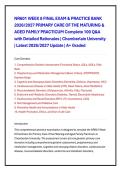
NR601 WEEK 8 FINAL EXAM & PRACTICE BANK
2026/2027 PRIMARY CARE OF THE MATURING &
AGED FAMILY PRACTICUM Complete 100 Q&A
with Detailed Rationales | Chamberlain University
| Latest 2026/2027 Update | A+ Graded
Core Domains
1. Comprehensive Geriatric Assessment (Functional Status, ADLs, IADLs, Falls
Risk)
2. Polypharmacy and Medication Management (Beers Criteria, STOPP/START,
Deprescribing)
3. Cognitive and Neuropsychiatric Disorders (Dementia, Delirium, Depression, MCI)
4. Cardiovascular Disease in Older Adults (HTN, Heart Failure, Atrial Fibrillation)
5. Musculoskeletal Disorders (Osteoporosis, Arthritis, Falls, Fractures)
6. Endocrine and Metabolic Disorders (Diabetes, Thyroid, Electrolyte Imbalances)
7. Genitourinary and Renal Disorders (BPH, UTI, Incontinence, CKD)
8. Pain Management and Palliative Care
9. Preventive Health and Immunizations in Older Adults
10. Health Promotion, Ethics, and End-of-Life Care
Introduction
This comprehensive practice examination is designed to simulate the NR601 Week
8 Final Exam for Primary Care of the Maturing and Aged Family Practicum at
Chamberlain University. The assessment covers all core geriatric primary care
domains including comprehensive geriatric assessment, polypharmacy and
medication management, cognitive and neuropsychiatric disorders, cardiovascular
disease, musculoskeletal disorders, endocrine and metabolic disorders,
, genitourinary and renal disorders, pain management, preventive health, and end-of-
life care. You will encounter multiple-choice questions and scenario-based
problems that emphasize real-world application, clinical decision-making, and
evidence-based practice in the care of older adults. The structure is designed to
challenge your critical thinking and ensure you are prepared for the complexities of
primary care management in the maturing and aged population. Mastery of these
topics is essential for any nurse practitioner seeking to validate their expertise in
geriatric primary care.
QUESTIONS 1–100
1. A 78-year-old male patient presents for a routine annual wellness visit.
Which of the following is the MOST important component of the
comprehensive geriatric assessment?
A. Complete blood count and metabolic panel
B. Functional status assessment including ADLs and IADLs
C. Chest X-ray and electrocardiogram
D. Prostate-specific antigen (PSA) screening
B. Functional status assessment including ADLs and IADLs
2026/2027 PRIMARY CARE OF THE MATURING &
AGED FAMILY PRACTICUM Complete 100 Q&A
with Detailed Rationales | Chamberlain University
| Latest 2026/2027 Update | A+ Graded
Core Domains
1. Comprehensive Geriatric Assessment (Functional Status, ADLs, IADLs, Falls
Risk)
2. Polypharmacy and Medication Management (Beers Criteria, STOPP/START,
Deprescribing)
3. Cognitive and Neuropsychiatric Disorders (Dementia, Delirium, Depression, MCI)
4. Cardiovascular Disease in Older Adults (HTN, Heart Failure, Atrial Fibrillation)
5. Musculoskeletal Disorders (Osteoporosis, Arthritis, Falls, Fractures)
6. Endocrine and Metabolic Disorders (Diabetes, Thyroid, Electrolyte Imbalances)
7. Genitourinary and Renal Disorders (BPH, UTI, Incontinence, CKD)
8. Pain Management and Palliative Care
9. Preventive Health and Immunizations in Older Adults
10. Health Promotion, Ethics, and End-of-Life Care
Introduction
This comprehensive practice examination is designed to simulate the NR601 Week
8 Final Exam for Primary Care of the Maturing and Aged Family Practicum at
Chamberlain University. The assessment covers all core geriatric primary care
domains including comprehensive geriatric assessment, polypharmacy and
medication management, cognitive and neuropsychiatric disorders, cardiovascular
disease, musculoskeletal disorders, endocrine and metabolic disorders,
, genitourinary and renal disorders, pain management, preventive health, and end-of-
life care. You will encounter multiple-choice questions and scenario-based
problems that emphasize real-world application, clinical decision-making, and
evidence-based practice in the care of older adults. The structure is designed to
challenge your critical thinking and ensure you are prepared for the complexities of
primary care management in the maturing and aged population. Mastery of these
topics is essential for any nurse practitioner seeking to validate their expertise in
geriatric primary care.
QUESTIONS 1–100
1. A 78-year-old male patient presents for a routine annual wellness visit.
Which of the following is the MOST important component of the
comprehensive geriatric assessment?
A. Complete blood count and metabolic panel
B. Functional status assessment including ADLs and IADLs
C. Chest X-ray and electrocardiogram
D. Prostate-specific antigen (PSA) screening
B. Functional status assessment including ADLs and IADLs


