

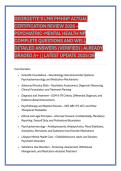
GEORGETTE'S LMR PMHNP ACTUAL
CERTIFICATION REVIEW 2026 –
PSYCHIATRIC-MENTAL HEALTH NP
COMPLETE QUESTIONS AND WELL
DETAILED ANSWERS (VERIFIED) | ALREADY
GRADED A+ | | LATEST UPDATE 2025/26
Core Domains
• Scientific Foundations – Neurobiology, Neurotransmitter Systems,
Psychopharmacology, and Medication Mechanisms
• Advanced Practice Skills – Psychiatric Assessment, Diagnostic Reasoning,
Clinical Formulation, and Treatment Planning
• Diagnosis and Treatment – DSM-5-TR Criteria, Differential Diagnosis, and
Evidence-Based Interventions
• Psychotherapy and Related Theories – CBT, DBT, IPT, ACT, and Other
Therapeutic Modalities
• Ethical and Legal Principles – Informed Consent, Confidentiality, Mandatory
Reporting, Tarasoff Duty, and Professional Boundaries
• Psychopharmacology – Antidepressants, Antipsychotics, Mood Stabilizers,
Anxiolytics, Stimulants, and Substance Use Disorder Medications
• Lifespan Mental Health Care – Child/Adolescent, Adult, and Geriatric
Psychiatric Disorders
• Substance Use Disorders – Screening, Assessment, Withdrawal
Management, and Medication-Assisted Treatment
, • Crisis Intervention and Emergency Psychiatry – Suicide Risk Assessment,
Violence Risk Assessment, and Acute Psychiatric Emergencies
• Cultural Competence and Health Equity – Culturally Responsive Care, Health
Disparities, and Social Determinants of Mental Health
Introduction
This comprehensive examination preparation guide is designed for candidates
seeking certification as a Psychiatric-Mental Health Nurse Practitioner (PMHNP)
through the American Nurses Credentialing Center (ANCC) or the American
Association of Nurse Practitioners (AANP) for the 2025/2026 testing cycle. The
exam assesses competency in scientific foundations, advanced practice skills,
diagnosis and treatment, psychotherapy, and ethical/legal principles. Candidates
must demonstrate mastery of neurobiology, psychopharmacology, DSM-5-TR
diagnostic criteria, evidence-based interventions, and clinical decision-making
across the lifespan. The multiple-choice, select-all-that-apply, and Next Generation
NCLEX (NGN)-style scenario-based structure of this guide emphasizes real-world
application, clinical judgment, and critical thinking. Each question is crafted to
reflect the content and format of the actual certification examination, ensuring
candidates are well-prepared for success. This resource is updated to reflect the
latest ANCC and AANP blueprints for the 2025/2026 exam cycle.
SECTION ONE: QUESTIONS 1–100
1. Norepinephrine (NE) is primarily synthesized in which brain structure?
A. Raphe nuclei
B. Locus coeruleus
C. Substantia nigra
D. Nucleus basalis of Meynert
B. Locus coeruleus
RATIONALE: Norepinephrine is synthesized in the locus coeruleus, located in
,the pons. It is the primary source of NE in the central nervous system and is crucial
for arousal, attention, and the stress response. The raphe nuclei synthesize
serotonin, the substantia nigra produces dopamine, and the nucleus basalis of
Meynert is the primary source of acetylcholine.
2. Which neurotransmitter is primarily associated with the reward pathway and
is implicated in schizophrenia when dysregulated?
A. Serotonin
B. Norepinephrine
C. Dopamine
D. Acetylcholine
C. Dopamine
RATIONALE: Dopamine is the primary neurotransmitter in the mesolimbic and
mesocortical reward pathways. The dopamine hypothesis of schizophrenia
proposes that hyperdopaminergic activity in the mesolimbic pathway contributes to
positive symptoms (hallucinations, delusions), while hypodopaminergic activity in
the mesocortical pathway contributes to negative symptoms and cognitive deficits.
3. A patient on clozapine presents with fever, tachycardia, and muscle rigidity.
What is the priority intervention?
A. Administer diphenhydramine
B. Draw a complete blood count with differential
C. Hold the clozapine and assess for neuroleptic malignant syndrome
D. Administer a benzodiazepine
C. Hold the clozapine and assess for neuroleptic malignant syndrome
RATIONALE: The presentation of fever, tachycardia, and muscle rigidity in a
patient on clozapine is concerning for neuroleptic malignant syndrome (NMS), a
life-threatening adverse reaction. The priority is to hold the antipsychotic and
, initiate a comprehensive assessment for NMS. Clozapine also carries a risk of
agranulocytosis, requiring routine CBC monitoring.
4. What is the normal therapeutic range for serum lithium?
A. 0.2-0.8 mEq/L
B. 0.6-1.2 mEq/L
C. 1.0-1.5 mEq/L
D. 1.5-2.0 mEq/L
B. 0.6-1.2 mEq/L
RATIONALE: The therapeutic range for lithium maintenance therapy is 0.6-1.2
mEq/L. Acute mania may require levels at the higher end of this range. Levels above
1.5 mEq/L indicate toxicity.
5. At what serum level does lithium toxicity typically occur?
A. > 0.8 mEq/L
B. > 1.0 mEq/L
C. > 1.5 mEq/L
D. > 2.0 mEq/L
C. > 1.5 mEq/L
RATIONALE: Lithium toxicity typically occurs at serum levels above 1.5 mEq/L.
Signs of toxicity include nausea, vomiting, diarrhea, tremor, ataxia, confusion, and in
severe cases, seizures and coma. Levels above 2.0 mEq/L are considered severe
and potentially life-threatening.
6. Which mood stabilizer is associated with the LEAST weight gain?
A. Lithium
B. Valproic acid (Depakote)
CERTIFICATION REVIEW 2026 –
PSYCHIATRIC-MENTAL HEALTH NP
COMPLETE QUESTIONS AND WELL
DETAILED ANSWERS (VERIFIED) | ALREADY
GRADED A+ | | LATEST UPDATE 2025/26
Core Domains
• Scientific Foundations – Neurobiology, Neurotransmitter Systems,
Psychopharmacology, and Medication Mechanisms
• Advanced Practice Skills – Psychiatric Assessment, Diagnostic Reasoning,
Clinical Formulation, and Treatment Planning
• Diagnosis and Treatment – DSM-5-TR Criteria, Differential Diagnosis, and
Evidence-Based Interventions
• Psychotherapy and Related Theories – CBT, DBT, IPT, ACT, and Other
Therapeutic Modalities
• Ethical and Legal Principles – Informed Consent, Confidentiality, Mandatory
Reporting, Tarasoff Duty, and Professional Boundaries
• Psychopharmacology – Antidepressants, Antipsychotics, Mood Stabilizers,
Anxiolytics, Stimulants, and Substance Use Disorder Medications
• Lifespan Mental Health Care – Child/Adolescent, Adult, and Geriatric
Psychiatric Disorders
• Substance Use Disorders – Screening, Assessment, Withdrawal
Management, and Medication-Assisted Treatment
, • Crisis Intervention and Emergency Psychiatry – Suicide Risk Assessment,
Violence Risk Assessment, and Acute Psychiatric Emergencies
• Cultural Competence and Health Equity – Culturally Responsive Care, Health
Disparities, and Social Determinants of Mental Health
Introduction
This comprehensive examination preparation guide is designed for candidates
seeking certification as a Psychiatric-Mental Health Nurse Practitioner (PMHNP)
through the American Nurses Credentialing Center (ANCC) or the American
Association of Nurse Practitioners (AANP) for the 2025/2026 testing cycle. The
exam assesses competency in scientific foundations, advanced practice skills,
diagnosis and treatment, psychotherapy, and ethical/legal principles. Candidates
must demonstrate mastery of neurobiology, psychopharmacology, DSM-5-TR
diagnostic criteria, evidence-based interventions, and clinical decision-making
across the lifespan. The multiple-choice, select-all-that-apply, and Next Generation
NCLEX (NGN)-style scenario-based structure of this guide emphasizes real-world
application, clinical judgment, and critical thinking. Each question is crafted to
reflect the content and format of the actual certification examination, ensuring
candidates are well-prepared for success. This resource is updated to reflect the
latest ANCC and AANP blueprints for the 2025/2026 exam cycle.
SECTION ONE: QUESTIONS 1–100
1. Norepinephrine (NE) is primarily synthesized in which brain structure?
A. Raphe nuclei
B. Locus coeruleus
C. Substantia nigra
D. Nucleus basalis of Meynert
B. Locus coeruleus
RATIONALE: Norepinephrine is synthesized in the locus coeruleus, located in
,the pons. It is the primary source of NE in the central nervous system and is crucial
for arousal, attention, and the stress response. The raphe nuclei synthesize
serotonin, the substantia nigra produces dopamine, and the nucleus basalis of
Meynert is the primary source of acetylcholine.
2. Which neurotransmitter is primarily associated with the reward pathway and
is implicated in schizophrenia when dysregulated?
A. Serotonin
B. Norepinephrine
C. Dopamine
D. Acetylcholine
C. Dopamine
RATIONALE: Dopamine is the primary neurotransmitter in the mesolimbic and
mesocortical reward pathways. The dopamine hypothesis of schizophrenia
proposes that hyperdopaminergic activity in the mesolimbic pathway contributes to
positive symptoms (hallucinations, delusions), while hypodopaminergic activity in
the mesocortical pathway contributes to negative symptoms and cognitive deficits.
3. A patient on clozapine presents with fever, tachycardia, and muscle rigidity.
What is the priority intervention?
A. Administer diphenhydramine
B. Draw a complete blood count with differential
C. Hold the clozapine and assess for neuroleptic malignant syndrome
D. Administer a benzodiazepine
C. Hold the clozapine and assess for neuroleptic malignant syndrome
RATIONALE: The presentation of fever, tachycardia, and muscle rigidity in a
patient on clozapine is concerning for neuroleptic malignant syndrome (NMS), a
life-threatening adverse reaction. The priority is to hold the antipsychotic and
, initiate a comprehensive assessment for NMS. Clozapine also carries a risk of
agranulocytosis, requiring routine CBC monitoring.
4. What is the normal therapeutic range for serum lithium?
A. 0.2-0.8 mEq/L
B. 0.6-1.2 mEq/L
C. 1.0-1.5 mEq/L
D. 1.5-2.0 mEq/L
B. 0.6-1.2 mEq/L
RATIONALE: The therapeutic range for lithium maintenance therapy is 0.6-1.2
mEq/L. Acute mania may require levels at the higher end of this range. Levels above
1.5 mEq/L indicate toxicity.
5. At what serum level does lithium toxicity typically occur?
A. > 0.8 mEq/L
B. > 1.0 mEq/L
C. > 1.5 mEq/L
D. > 2.0 mEq/L
C. > 1.5 mEq/L
RATIONALE: Lithium toxicity typically occurs at serum levels above 1.5 mEq/L.
Signs of toxicity include nausea, vomiting, diarrhea, tremor, ataxia, confusion, and in
severe cases, seizures and coma. Levels above 2.0 mEq/L are considered severe
and potentially life-threatening.
6. Which mood stabilizer is associated with the LEAST weight gain?
A. Lithium
B. Valproic acid (Depakote)


