
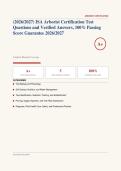
ARBORIST CERTIFICATION
(2026/2027) ISA Arborist Certification Test
Questions and Verified Answers, 100% Passing
Score Guarantee 2026/2027
A+
Complete Blueprint Coverage
A+ 5 100%
QUESTIONS VERIFIED CORE DOMAINS COVERED RATIONALES INCLUDED
CATEGORIES
Tree Biology and Physiology
Soil Science, Nutrition, and Water Management
Tree Identification, Selection, Planting, and Establishment
Pruning, Support Systems, and Tree Risk Assessment
Diagnosis, Plant Health Care, Safety, and Professional Practice
STUVIAACTUALEXAM
, TREE BIOLOGY AND PHYSIOLOGY
Question 1
A mature oak tree exhibits reduced growth in the current year after a severe drought the previous summer. The
tree has adequate soil moisture this season and no visible pests or diseases. The reduction in growth is most
directly attributable to limited production of which structure during the drought year?
A. Secondary xylem vessels formed in the previous growing season
B. Primary phloem cells produced in the current season
C. Root hairs generated during the dormant period
D. Cork cambium layers added after leaf fall
Correct Answer: A
Rationale:
Secondary xylem vessels produced in one growing season transport water in subsequent seasons. Drought stress reduces
vessel diameter and number, limiting hydraulic conductivity the following year even when moisture returns. Primary phloem is
produced annually but does not primarily limit water transport capacity.
Question 2
During a late-spring freeze, an arborist observes that the expanding buds of a sugar maple have been killed
while the older wood remains healthy. Which tissue is primarily responsible for the rapid expansion of new
shoots and is therefore most vulnerable at this stage?
A. The vascular cambium lying between xylem and phloem
B. The apical meristem within the terminal and lateral buds
C. The cork cambium producing outer bark layers
D. The ray parenchyma cells storing starch reserves
Correct Answer: B
Rationale:
Apical meristems in buds drive primary growth and shoot elongation in spring. These actively dividing cells lack protective
structures and are highly susceptible to freeze injury. Vascular cambium and cork cambium are more protected within the
stem and become active later.
Question 3
A large branch on a mature beech tree was pruned three years ago. A cross-section of the branch collar now
shows a distinct barrier zone of darkened wood surrounding the pruning wound. This barrier zone is part of
which defensive process?
A. CODIT wall 4 formed by the vascular cambium after wounding
B. CODIT wall 1 restricting axial spread through vessel plugging
C. CODIT wall 2 limiting radial spread via latewood density
D. CODIT wall 3 blocking tangential movement with ray cells
Correct Answer: A
Rationale:
CODIT wall 4 is the strongest barrier, formed by the vascular cambium after injury and consisting of chemically altered wood
that resists decay spread into new growth. Walls 1-3 are weaker, pre-existing anatomical features that only slow pathogen
movement.
STUVIAACTUALEXAM 2026/2027
, (2026/2027) ISA Arborist Certification Test Questions and Ve... Page 3
Question 4
An arborist examines a ring-porous species such as ash and notes that the large earlywood vessels formed at
the start of the season are now non-functional due to embolism. The tree continues to transport water effectively
later in the summer. Which anatomical feature allows continued conduction?
A. Continuous production of new latewood vessels throughout the season
B. Reliance on the previous year's intact earlywood vessels only
C. Increased activity of the cork cambium generating new bark pathways
D. Conversion of phloem sieve tubes into secondary water conduits
Correct Answer: A
Rationale:
Ring-porous trees produce large earlywood vessels that are efficient but prone to embolism; smaller latewood vessels formed
later in the season provide safer, ongoing water transport. Diffuse-porous species behave differently, but ash relies on the
seasonal progression of vessel size.
Question 5
A client reports that a young maple planted two years earlier is producing leaves that are smaller than normal
and chlorotic despite regular watering. Soil tests show adequate nutrients. The most likely physiological cause
related to the tree's establishment is impairment of which process?
A. Photosynthetic carbon fixation limited by insufficient leaf area expansion
B. Transpiration pull reduced by incomplete root-soil contact after planting
C. Respiration rates elevated by excessive nighttime temperatures only
D. Stomatal opening restricted solely by high atmospheric humidity
Correct Answer: B
Rationale:
Poor root-soil contact after planting creates air gaps that limit water uptake even when soil moisture is present, reducing
turgor and nutrient delivery and causing chlorosis and small leaves. Leaf area expansion follows from adequate water status
rather than being the primary cause.
Question 6
In late autumn, a deciduous tree begins to form an abscission layer at the base of each leaf petiole. Which
primary physiological benefit does this process provide to the tree before winter?
A. Recovery of mobile nutrients from the leaves before they are shed
B. Immediate increase in photosynthetic efficiency during short days
C. Strengthening of the vascular cambium against freeze-thaw cycles
D. Expansion of the root system through redirected carbohydrate flow
Correct Answer: A
Rationale:
Abscission allows the tree to resorb nitrogen, phosphorus, and other mobile nutrients from leaves into woody tissues and
roots before leaf drop, conserving resources for spring growth. Photosynthesis declines with shorter days, and cambium
activity ceases independently.
STUVIAACTUALEXAM 2026/2027
(2026/2027) ISA Arborist Certification Test
Questions and Verified Answers, 100% Passing
Score Guarantee 2026/2027
A+
Complete Blueprint Coverage
A+ 5 100%
QUESTIONS VERIFIED CORE DOMAINS COVERED RATIONALES INCLUDED
CATEGORIES
Tree Biology and Physiology
Soil Science, Nutrition, and Water Management
Tree Identification, Selection, Planting, and Establishment
Pruning, Support Systems, and Tree Risk Assessment
Diagnosis, Plant Health Care, Safety, and Professional Practice
STUVIAACTUALEXAM
, TREE BIOLOGY AND PHYSIOLOGY
Question 1
A mature oak tree exhibits reduced growth in the current year after a severe drought the previous summer. The
tree has adequate soil moisture this season and no visible pests or diseases. The reduction in growth is most
directly attributable to limited production of which structure during the drought year?
A. Secondary xylem vessels formed in the previous growing season
B. Primary phloem cells produced in the current season
C. Root hairs generated during the dormant period
D. Cork cambium layers added after leaf fall
Correct Answer: A
Rationale:
Secondary xylem vessels produced in one growing season transport water in subsequent seasons. Drought stress reduces
vessel diameter and number, limiting hydraulic conductivity the following year even when moisture returns. Primary phloem is
produced annually but does not primarily limit water transport capacity.
Question 2
During a late-spring freeze, an arborist observes that the expanding buds of a sugar maple have been killed
while the older wood remains healthy. Which tissue is primarily responsible for the rapid expansion of new
shoots and is therefore most vulnerable at this stage?
A. The vascular cambium lying between xylem and phloem
B. The apical meristem within the terminal and lateral buds
C. The cork cambium producing outer bark layers
D. The ray parenchyma cells storing starch reserves
Correct Answer: B
Rationale:
Apical meristems in buds drive primary growth and shoot elongation in spring. These actively dividing cells lack protective
structures and are highly susceptible to freeze injury. Vascular cambium and cork cambium are more protected within the
stem and become active later.
Question 3
A large branch on a mature beech tree was pruned three years ago. A cross-section of the branch collar now
shows a distinct barrier zone of darkened wood surrounding the pruning wound. This barrier zone is part of
which defensive process?
A. CODIT wall 4 formed by the vascular cambium after wounding
B. CODIT wall 1 restricting axial spread through vessel plugging
C. CODIT wall 2 limiting radial spread via latewood density
D. CODIT wall 3 blocking tangential movement with ray cells
Correct Answer: A
Rationale:
CODIT wall 4 is the strongest barrier, formed by the vascular cambium after injury and consisting of chemically altered wood
that resists decay spread into new growth. Walls 1-3 are weaker, pre-existing anatomical features that only slow pathogen
movement.
STUVIAACTUALEXAM 2026/2027
, (2026/2027) ISA Arborist Certification Test Questions and Ve... Page 3
Question 4
An arborist examines a ring-porous species such as ash and notes that the large earlywood vessels formed at
the start of the season are now non-functional due to embolism. The tree continues to transport water effectively
later in the summer. Which anatomical feature allows continued conduction?
A. Continuous production of new latewood vessels throughout the season
B. Reliance on the previous year's intact earlywood vessels only
C. Increased activity of the cork cambium generating new bark pathways
D. Conversion of phloem sieve tubes into secondary water conduits
Correct Answer: A
Rationale:
Ring-porous trees produce large earlywood vessels that are efficient but prone to embolism; smaller latewood vessels formed
later in the season provide safer, ongoing water transport. Diffuse-porous species behave differently, but ash relies on the
seasonal progression of vessel size.
Question 5
A client reports that a young maple planted two years earlier is producing leaves that are smaller than normal
and chlorotic despite regular watering. Soil tests show adequate nutrients. The most likely physiological cause
related to the tree's establishment is impairment of which process?
A. Photosynthetic carbon fixation limited by insufficient leaf area expansion
B. Transpiration pull reduced by incomplete root-soil contact after planting
C. Respiration rates elevated by excessive nighttime temperatures only
D. Stomatal opening restricted solely by high atmospheric humidity
Correct Answer: B
Rationale:
Poor root-soil contact after planting creates air gaps that limit water uptake even when soil moisture is present, reducing
turgor and nutrient delivery and causing chlorosis and small leaves. Leaf area expansion follows from adequate water status
rather than being the primary cause.
Question 6
In late autumn, a deciduous tree begins to form an abscission layer at the base of each leaf petiole. Which
primary physiological benefit does this process provide to the tree before winter?
A. Recovery of mobile nutrients from the leaves before they are shed
B. Immediate increase in photosynthetic efficiency during short days
C. Strengthening of the vascular cambium against freeze-thaw cycles
D. Expansion of the root system through redirected carbohydrate flow
Correct Answer: A
Rationale:
Abscission allows the tree to resorb nitrogen, phosphorus, and other mobile nutrients from leaves into woody tissues and
roots before leaf drop, conserving resources for spring growth. Photosynthesis declines with shorter days, and cambium
activity ceases independently.
STUVIAACTUALEXAM 2026/2027


