

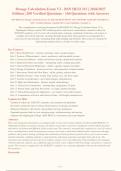
Dosage Calculation Exam V2 - BSN HESI 215 | 2026/2027
Edition | 200 Verified Questions - 160 Questions with Answers
BSN HESI 215 Dosage Calculation Exam V2 2026-160 QUESTIONS AND ANSWERS ALREADY GRADED A+.
100% Verified Solutions | Updated Per Latest Guidelines | Graded A+
This comprehensive exam prep document for BSN HESI 215 Dosage Calculation Exam V2 at
Nightingale College contains 200 verified questions and answers, meticulously curated to reflect the
2026/2027 academic year. It covers all essential topics in dosage calculation, from basic conversions to
complex intravenous infusions, ensuring thorough preparation. Each question is accompanied by a
correct answer and rationale, facilitating deep understanding and retention. This resource is designed to
help nursing students achieve a Grade A on their exam.
Key Features:
Unit 1: Basic Math Review - fractions, decimals, ratios, and percentages
Unit 2: Systems of Measurement - metric, apothecary, and household systems
Unit 3: Conversion Methods - within and between systems, dimensional analysis
Unit 4: Medication Orders and Labels - interpreting orders, reading drug labels
Unit 5: Oral and Parenteral Medications - tablets, capsules, liquids, injectables
Unit 6: Dosage Calculations - desired over have, ratio-proportion, formula method
Unit 7: Intravenous Fluids and Flow Rates - mL/hr, gtt/min, infusion time
Unit 8: Pediatric Dosages - body weight, body surface area, safe dose ranges
Unit 9: Geriatric Considerations - age-related changes, polypharmacy
Unit 10: High-Alert Medications - heparin, insulin, chemotherapy
Unit 11: Critical Care Calculations - titrating drips, mcg/kg/min, IV push
Unit 12: Patient Safety and Error Prevention - six rights, double-checking
Unit 13: Clinical Reasoning and Application - case studies, real-world scenarios
Unit 14: Comprehensive Review and Practice Exams - full-length simulated tests
Updates for 2026:
- Updated to reflect the 2026/2027 academic year standards and guidelines
- Revised to include the latest evidence-based practices in dosage calculation
- Enhanced rationales with step-by-step problem-solving explanations
- Expanded question bank to cover emerging topics in pharmacology and nursing
- Aligned with Nightingale College's BSN HESI 215 curriculum and exam blueprint
Abstract:
This exam preparation document is an indispensable resource for nursing students enrolled in BSN HESI 215 at
Nightingale College, focusing on dosage calculation. It provides a rigorous compilation of 200 verified questions
that mirror the format and difficulty of the actual exam. The content is systematically organized to cover all critical
areas, including basic math, measurement systems, conversions, medication administration, intravenous therapy,
pediatric and geriatric dosing, and high-alert medications. Each question is paired with a correct answer and a
detailed rationale, enabling students to understand the underlying principles and apply them effectively. The
document also includes practical tips for avoiding common errors and enhancing clinical judgment. By engaging
with this material, students can confidently approach their exam, reinforce their knowledge, and achieve a superior
grade. This resource is updated for the 2026/2027 academic year, ensuring alignment with current standards and
best practices.
Keywords:
Page 1
,Dosage Calculation, BSN HESI 215, Nightingale College, Nursing Exam Prep, Medication Math, IV Flow Rates,
Pediatric Dosing, High-Alert Medications
Answer Format:
Each question is presented in a multiple-choice format with four options. The correct answer is clearly indicated,
followed by a comprehensive rationale that explains the step-by-step calculation and the clinical reasoning behind
the correct choice. Distractor explanations are also provided to clarify why the other options are incorrect,
reinforcing understanding and preventing future mistakes.
Compliance Checklist:
Verified questions and answers aligned with the latest HESI exam blueprint
Updated for the 2026/2027 academic year per Nightingale College standards
Includes rationales for every answer to promote deep learning
Covers all major topics and subtopics in dosage calculation
Designed to help students achieve a Grade A on the exam
Content Area Overview:
Content Area Questions Key Topics Weight
Basic Math Review 1-15 Fractions, Decimals, Ratios, Percentages, 7.5%
Order of Operations
Systems of Measurement 16-30 Metric System, Apothecary System, 7.5%
Household System, Equivalents
Conversion Methods 31-50 Within-System Conversion, 10%
Between-System Conversion, Dimensional
Analysis
Medication Orders and Labels 51-65 Reading Orders, Drug Labels, 7.5%
Abbreviations, Safety Checks
Oral and Parenteral Medications 66-85 Tablets, Capsules, Liquids, Injectables, 10%
Reconstitution
Dosage Calculations 86-105 Desired Over Have, Ratio-Proportion, 10%
Formula Method, Complex Calculations
Intravenous Fluids and Flow 106-125 mL/hr, gtt/min, Infusion Time, IV Pumps, 10%
Rates Drop Factors
Pediatric Dosages 126-140 Body Weight, Body Surface Area, Safe Dose 7.5%
Ranges, Pediatric Considerations
Geriatric Considerations 141-150 Age-Related Changes, Polypharmacy, 5%
Renal/Hepatic Function, Dosing
Adjustments
High-Alert Medications 151-165 Heparin, Insulin, Chemotherapy, Narcotics, 7.5%
Anticoagulants
Critical Care Calculations 166-180 Titrating Drips, mcg/kg/min, IV Push, 7.5%
Emergency Medications
Patient Safety and Error 181-190 Six Rights, Double-Checking, Error 5%
Prevention Prevention Strategies, Reporting
Clinical Reasoning and 191-200 Case Studies, Real-World Scenarios, 5%
Application Prioritization, Clinical Judgment
Page 2
,Q1. A provider orders 0.9% sodium chloride at 75 mL/hr. The drop factor is 15
gtt/mL. How many gtt/min should the nurse regulate the infusion?
A. 18.75 gtt/min
B. 19 gtt/min
C. 20 gtt/min
D. 17 gtt/min
Correct Answer: A. 18.75 gtt/min
Rationale: Using the formula: (75 mL/hr × 15 gtt/mL) / 60 min/hr = 18.75 gtt/min.
Rounding to the nearest whole number gives 19, but since the question asks for the
calculated rate, 18.75 is the exact answer.
Why Wrong:
B - This is the rounded whole number, but the exact calculated value is 18.75.
C - This would result from using 16 gtt/mL or incorrect rounding.
D - This results from misplacing the decimal or using 14 gtt/mL.
Reference: Gray Morris, D. (2026). Calculate with Confidence, 8th ed., Ch. 13.
Q2. A patient is receiving dopamine at 5 mcg/kg/min. The patient weighs 70 kg. The
concentration is 400 mg in 250 mL. At what rate (mL/hr) should the infusion pump be
set?
A. 13.1 mL/hr
B. 15.0 mL/hr
C. 10.5 mL/hr
D. 12.0 mL/hr
Correct Answer: A. 13.1 mL/hr
Rationale: First, calculate dose per hour: 5 mcg/kg/min × 70 kg × 60 min = 21,000 mcg/hr
= 21 mg/hr. Then, concentration: 400 mg/250 mL = 1.6 mg/mL. Rate = 21 mg/hr ÷ 1.6
mg/mL = 13.125 mL/hr 13.1 mL/hr.
Why Wrong:
B - This might result from using 400 mg/250 mL incorrectly or rounding up too early.
C - This would occur if the patient weight was omitted or miscalculated.
D - This could result from using 4 mg/kg/min or a wrong conversion.
Reference: Lehne, R.A. (2026). Pharmacology for Nursing Care, 12th ed., Ch. 18.
Q3. A medication order reads: 'Give 500 mg of a drug that is available as 250 mg per
5 mL. How many mL will you administer?'
A. 5 mL
B. 10 mL
C. 2.5 mL
Page 3
, D. 7.5 mL
Correct Answer: B. 10 mL
Rationale: Using ratio: 250 mg/5 mL = 500 mg/x mL. Cross-multiply: 250x = 2500, x =
10 mL.
Why Wrong:
A - This is the volume for 250 mg, not 500 mg.
C - This would be the volume if the concentration were 500 mg/5 mL.
D - This results from an arithmetic error in cross-multiplication.
Reference: Gray Morris, D. (2026). Calculate with Confidence, 8th ed., Ch. 9.
Q4. A patient is to receive 1 L of lactated Ringer's over 8 hours. The drop factor is 20
gtt/mL. What is the flow rate in gtt/min?
A. 42 gtt/min
B. 40 gtt/min
C. 45 gtt/min
D. 38 gtt/min
Correct Answer: A. 42 gtt/min
Rationale: Volume per hour = 1000 mL / 8 hr = 125 mL/hr. Then, (125 mL/hr × 20 gtt/mL)
/ 60 min/hr = 41.67 gtt/min, which rounds to 42 gtt/min.
Why Wrong:
B - This would result from rounding down to 40 without proper calculation.
C - This might come from using 1.5 L or a drop factor of 22.
D - This could result from using 15 gtt/mL or incorrect division.
Reference: Gray Morris, D. (2026). Calculate with Confidence, 8th ed., Ch. 14.
Q5. A child weighs 30 lb. The order is for 5 mg/kg of a medication. The concentration
is 50 mg/mL. How many mL should be administered?
A. 1.36 mL
B. 1.5 mL
C. 2.0 mL
D. 0.68 mL
Correct Answer: A. 1.36 mL
Rationale: Convert weight: 30 lb ÷ 2.2 = 13.64 kg. Dose = 5 mg/kg × 13.64 kg = 68.2 mg.
Volume = 68.2 mg ÷ 50 mg/mL = 1.36 mL.
Why Wrong:
B - This would result from rounding kg to 14 and using 70 mg.
C - This would occur if the dose was calculated as 10 mg/kg or using the wrong
concentration.
Page 4
Edition | 200 Verified Questions - 160 Questions with Answers
BSN HESI 215 Dosage Calculation Exam V2 2026-160 QUESTIONS AND ANSWERS ALREADY GRADED A+.
100% Verified Solutions | Updated Per Latest Guidelines | Graded A+
This comprehensive exam prep document for BSN HESI 215 Dosage Calculation Exam V2 at
Nightingale College contains 200 verified questions and answers, meticulously curated to reflect the
2026/2027 academic year. It covers all essential topics in dosage calculation, from basic conversions to
complex intravenous infusions, ensuring thorough preparation. Each question is accompanied by a
correct answer and rationale, facilitating deep understanding and retention. This resource is designed to
help nursing students achieve a Grade A on their exam.
Key Features:
Unit 1: Basic Math Review - fractions, decimals, ratios, and percentages
Unit 2: Systems of Measurement - metric, apothecary, and household systems
Unit 3: Conversion Methods - within and between systems, dimensional analysis
Unit 4: Medication Orders and Labels - interpreting orders, reading drug labels
Unit 5: Oral and Parenteral Medications - tablets, capsules, liquids, injectables
Unit 6: Dosage Calculations - desired over have, ratio-proportion, formula method
Unit 7: Intravenous Fluids and Flow Rates - mL/hr, gtt/min, infusion time
Unit 8: Pediatric Dosages - body weight, body surface area, safe dose ranges
Unit 9: Geriatric Considerations - age-related changes, polypharmacy
Unit 10: High-Alert Medications - heparin, insulin, chemotherapy
Unit 11: Critical Care Calculations - titrating drips, mcg/kg/min, IV push
Unit 12: Patient Safety and Error Prevention - six rights, double-checking
Unit 13: Clinical Reasoning and Application - case studies, real-world scenarios
Unit 14: Comprehensive Review and Practice Exams - full-length simulated tests
Updates for 2026:
- Updated to reflect the 2026/2027 academic year standards and guidelines
- Revised to include the latest evidence-based practices in dosage calculation
- Enhanced rationales with step-by-step problem-solving explanations
- Expanded question bank to cover emerging topics in pharmacology and nursing
- Aligned with Nightingale College's BSN HESI 215 curriculum and exam blueprint
Abstract:
This exam preparation document is an indispensable resource for nursing students enrolled in BSN HESI 215 at
Nightingale College, focusing on dosage calculation. It provides a rigorous compilation of 200 verified questions
that mirror the format and difficulty of the actual exam. The content is systematically organized to cover all critical
areas, including basic math, measurement systems, conversions, medication administration, intravenous therapy,
pediatric and geriatric dosing, and high-alert medications. Each question is paired with a correct answer and a
detailed rationale, enabling students to understand the underlying principles and apply them effectively. The
document also includes practical tips for avoiding common errors and enhancing clinical judgment. By engaging
with this material, students can confidently approach their exam, reinforce their knowledge, and achieve a superior
grade. This resource is updated for the 2026/2027 academic year, ensuring alignment with current standards and
best practices.
Keywords:
Page 1
,Dosage Calculation, BSN HESI 215, Nightingale College, Nursing Exam Prep, Medication Math, IV Flow Rates,
Pediatric Dosing, High-Alert Medications
Answer Format:
Each question is presented in a multiple-choice format with four options. The correct answer is clearly indicated,
followed by a comprehensive rationale that explains the step-by-step calculation and the clinical reasoning behind
the correct choice. Distractor explanations are also provided to clarify why the other options are incorrect,
reinforcing understanding and preventing future mistakes.
Compliance Checklist:
Verified questions and answers aligned with the latest HESI exam blueprint
Updated for the 2026/2027 academic year per Nightingale College standards
Includes rationales for every answer to promote deep learning
Covers all major topics and subtopics in dosage calculation
Designed to help students achieve a Grade A on the exam
Content Area Overview:
Content Area Questions Key Topics Weight
Basic Math Review 1-15 Fractions, Decimals, Ratios, Percentages, 7.5%
Order of Operations
Systems of Measurement 16-30 Metric System, Apothecary System, 7.5%
Household System, Equivalents
Conversion Methods 31-50 Within-System Conversion, 10%
Between-System Conversion, Dimensional
Analysis
Medication Orders and Labels 51-65 Reading Orders, Drug Labels, 7.5%
Abbreviations, Safety Checks
Oral and Parenteral Medications 66-85 Tablets, Capsules, Liquids, Injectables, 10%
Reconstitution
Dosage Calculations 86-105 Desired Over Have, Ratio-Proportion, 10%
Formula Method, Complex Calculations
Intravenous Fluids and Flow 106-125 mL/hr, gtt/min, Infusion Time, IV Pumps, 10%
Rates Drop Factors
Pediatric Dosages 126-140 Body Weight, Body Surface Area, Safe Dose 7.5%
Ranges, Pediatric Considerations
Geriatric Considerations 141-150 Age-Related Changes, Polypharmacy, 5%
Renal/Hepatic Function, Dosing
Adjustments
High-Alert Medications 151-165 Heparin, Insulin, Chemotherapy, Narcotics, 7.5%
Anticoagulants
Critical Care Calculations 166-180 Titrating Drips, mcg/kg/min, IV Push, 7.5%
Emergency Medications
Patient Safety and Error 181-190 Six Rights, Double-Checking, Error 5%
Prevention Prevention Strategies, Reporting
Clinical Reasoning and 191-200 Case Studies, Real-World Scenarios, 5%
Application Prioritization, Clinical Judgment
Page 2
,Q1. A provider orders 0.9% sodium chloride at 75 mL/hr. The drop factor is 15
gtt/mL. How many gtt/min should the nurse regulate the infusion?
A. 18.75 gtt/min
B. 19 gtt/min
C. 20 gtt/min
D. 17 gtt/min
Correct Answer: A. 18.75 gtt/min
Rationale: Using the formula: (75 mL/hr × 15 gtt/mL) / 60 min/hr = 18.75 gtt/min.
Rounding to the nearest whole number gives 19, but since the question asks for the
calculated rate, 18.75 is the exact answer.
Why Wrong:
B - This is the rounded whole number, but the exact calculated value is 18.75.
C - This would result from using 16 gtt/mL or incorrect rounding.
D - This results from misplacing the decimal or using 14 gtt/mL.
Reference: Gray Morris, D. (2026). Calculate with Confidence, 8th ed., Ch. 13.
Q2. A patient is receiving dopamine at 5 mcg/kg/min. The patient weighs 70 kg. The
concentration is 400 mg in 250 mL. At what rate (mL/hr) should the infusion pump be
set?
A. 13.1 mL/hr
B. 15.0 mL/hr
C. 10.5 mL/hr
D. 12.0 mL/hr
Correct Answer: A. 13.1 mL/hr
Rationale: First, calculate dose per hour: 5 mcg/kg/min × 70 kg × 60 min = 21,000 mcg/hr
= 21 mg/hr. Then, concentration: 400 mg/250 mL = 1.6 mg/mL. Rate = 21 mg/hr ÷ 1.6
mg/mL = 13.125 mL/hr 13.1 mL/hr.
Why Wrong:
B - This might result from using 400 mg/250 mL incorrectly or rounding up too early.
C - This would occur if the patient weight was omitted or miscalculated.
D - This could result from using 4 mg/kg/min or a wrong conversion.
Reference: Lehne, R.A. (2026). Pharmacology for Nursing Care, 12th ed., Ch. 18.
Q3. A medication order reads: 'Give 500 mg of a drug that is available as 250 mg per
5 mL. How many mL will you administer?'
A. 5 mL
B. 10 mL
C. 2.5 mL
Page 3
, D. 7.5 mL
Correct Answer: B. 10 mL
Rationale: Using ratio: 250 mg/5 mL = 500 mg/x mL. Cross-multiply: 250x = 2500, x =
10 mL.
Why Wrong:
A - This is the volume for 250 mg, not 500 mg.
C - This would be the volume if the concentration were 500 mg/5 mL.
D - This results from an arithmetic error in cross-multiplication.
Reference: Gray Morris, D. (2026). Calculate with Confidence, 8th ed., Ch. 9.
Q4. A patient is to receive 1 L of lactated Ringer's over 8 hours. The drop factor is 20
gtt/mL. What is the flow rate in gtt/min?
A. 42 gtt/min
B. 40 gtt/min
C. 45 gtt/min
D. 38 gtt/min
Correct Answer: A. 42 gtt/min
Rationale: Volume per hour = 1000 mL / 8 hr = 125 mL/hr. Then, (125 mL/hr × 20 gtt/mL)
/ 60 min/hr = 41.67 gtt/min, which rounds to 42 gtt/min.
Why Wrong:
B - This would result from rounding down to 40 without proper calculation.
C - This might come from using 1.5 L or a drop factor of 22.
D - This could result from using 15 gtt/mL or incorrect division.
Reference: Gray Morris, D. (2026). Calculate with Confidence, 8th ed., Ch. 14.
Q5. A child weighs 30 lb. The order is for 5 mg/kg of a medication. The concentration
is 50 mg/mL. How many mL should be administered?
A. 1.36 mL
B. 1.5 mL
C. 2.0 mL
D. 0.68 mL
Correct Answer: A. 1.36 mL
Rationale: Convert weight: 30 lb ÷ 2.2 = 13.64 kg. Dose = 5 mg/kg × 13.64 kg = 68.2 mg.
Volume = 68.2 mg ÷ 50 mg/mL = 1.36 mL.
Why Wrong:
B - This would result from rounding kg to 14 and using 70 mg.
C - This would occur if the dose was calculated as 10 mg/kg or using the wrong
concentration.
Page 4


