
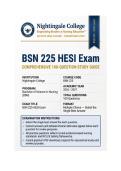
,BSN 225 HESI Exam – Fundamentals of Nursing –
Q&A (2026/2027) | Nightingale College
1. Which phase of the nurse-patient relationship occurs before the nurse meets
the client?
A) Pre-interaction phase
B) Orientation phase
C) Working phase
D) Termination phase
Correct Answer: A) Pre-interaction phase
Rationale: The pre-interaction phase occurs before meeting the client, when the
nurse reviews records and prepares. Orientation is the first meeting, working is
implementation, and termination is closure.
2. During which phase does the nurse establish trust and define boundaries?
A) Working phase
B) Pre-interaction phase
C) Orientation phase
D) Termination phase
Correct Answer: C) Orientation phase
,Rationale: The orientation phase involves building rapport, establishing trust,
setting goals, and defining relationship boundaries. The working phase follows
after trust is established.
3. In SBAR, which component includes the nurse's opinion about what should
happen next?
A) Situation
B) Background
C) Assessment
D) Recommendation
Correct Answer: D) Recommendation
Rationale: Recommendation is the final component where the nurse suggests a
specific action. Assessment is the nurse's interpretation, not the requested
action.
4. What is the primary purpose of SBAR?
A) To document nursing interventions
B) To provide a standardized framework for sharing patient information quickly
and clearly
C) To replace progress notes
D) To evaluate staff performance
Correct Answer: B) To provide a standardized framework for sharing patient
information quickly and clearly
, Rationale: SBAR creates a concise, consistent structure for communication,
improving patient safety. It is not used for documentation or evaluation only.
5. Which is an example of an open-ended question?
A) "Can you tell me more about the pain you are experiencing?"
B) "Are you feeling better today?"
C) "Did you take your medication?"
D) "Do you have any allergies?"
Correct Answer: A) "Can you tell me more about the pain you are
experiencing?"
Rationale: Open-ended questions invite descriptive, detailed answers. The other
options are closed-ended, requiring yes/no or short responses.
6. Which is an example of a closed-ended question?
A) "What brings you to the clinic?"
B) "Are you having chest pain right now?"
C) "Tell me about your diet."
D) "How do you cope with stress?"
Correct Answer: B) "Are you having chest pain right now?"
Rationale: Closed-ended questions elicit brief, specific answers. The other
options are open-ended and encourage elaboration.
Q&A (2026/2027) | Nightingale College
1. Which phase of the nurse-patient relationship occurs before the nurse meets
the client?
A) Pre-interaction phase
B) Orientation phase
C) Working phase
D) Termination phase
Correct Answer: A) Pre-interaction phase
Rationale: The pre-interaction phase occurs before meeting the client, when the
nurse reviews records and prepares. Orientation is the first meeting, working is
implementation, and termination is closure.
2. During which phase does the nurse establish trust and define boundaries?
A) Working phase
B) Pre-interaction phase
C) Orientation phase
D) Termination phase
Correct Answer: C) Orientation phase
,Rationale: The orientation phase involves building rapport, establishing trust,
setting goals, and defining relationship boundaries. The working phase follows
after trust is established.
3. In SBAR, which component includes the nurse's opinion about what should
happen next?
A) Situation
B) Background
C) Assessment
D) Recommendation
Correct Answer: D) Recommendation
Rationale: Recommendation is the final component where the nurse suggests a
specific action. Assessment is the nurse's interpretation, not the requested
action.
4. What is the primary purpose of SBAR?
A) To document nursing interventions
B) To provide a standardized framework for sharing patient information quickly
and clearly
C) To replace progress notes
D) To evaluate staff performance
Correct Answer: B) To provide a standardized framework for sharing patient
information quickly and clearly
, Rationale: SBAR creates a concise, consistent structure for communication,
improving patient safety. It is not used for documentation or evaluation only.
5. Which is an example of an open-ended question?
A) "Can you tell me more about the pain you are experiencing?"
B) "Are you feeling better today?"
C) "Did you take your medication?"
D) "Do you have any allergies?"
Correct Answer: A) "Can you tell me more about the pain you are
experiencing?"
Rationale: Open-ended questions invite descriptive, detailed answers. The other
options are closed-ended, requiring yes/no or short responses.
6. Which is an example of a closed-ended question?
A) "What brings you to the clinic?"
B) "Are you having chest pain right now?"
C) "Tell me about your diet."
D) "How do you cope with stress?"
Correct Answer: B) "Are you having chest pain right now?"
Rationale: Closed-ended questions elicit brief, specific answers. The other
options are open-ended and encourage elaboration.


