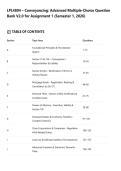
LPL4804 – Conveyancing: Advanced Multiple-Choice Question
Bank V2.0 for Assignment 1 (Semester 1, 2026)
📚 TABLE OF CONTENTS
Section Topic Area Questions
Foundational Principles & The Abstract
A 1–15
System
Section 15 & 15A – Conveyancer's
B 16–30
Responsibilities & Liability
Section 4(1)(b) – Rectification of Errors in
C 31–45
Vesting Clauses
Mortgage Bonds – Registration, Ranking &
D 46–60
Cancellation (ss 56–57)
Sectional Titles – Section 15B(3) Certificates &
E 61–75
Complex Issues
Powers of Attorney – Execution, Validity &
F 76–90
Section 102
Deceased Estates & Insolvency Transfers –
G 91–105
Complex Scenarios
Close Corporations & Companies – Regulation
H 106–120
44 & Related Duties
I Case Law & Delictual Liability of Conveyancers 121–135
Advanced Scenarios & Examiners' Favourite
J 136–150
Traps
,SECTION A: FOUNDATIONAL PRINCIPLES & THE ABSTRACT SYSTEM
🟢 1. Which of the following statements best describes the relationship between the abstract
system of transfer and the registrar's duties under section 3(1)(b) of the Deeds Registries Act 47 of
1937?
A. The registrar must investigate the validity of the underlying causa before registration, as the
abstract system requires certainty of the underlying transaction.
B. The registrar examines the deed for formal compliance only, and the abstract system means
ownership passes upon registration regardless of defects in the underlying causa.
C. The registrar is required to reject any deed where the underlying contract appears to be invalid,
as the abstract system does not protect against fraudulent transactions.
D. The registrar must satisfy himself that the purchase price has been fully paid before registration,
as the abstract system requires consideration to have passed.
🔴🔴 Correct Answer: B – Rationale: South Africa follows the abstract system of transfer, meaning
ownership passes upon registration of the deed, independent of the underlying causa. The registrar's
duty under section 3(1)(b) is to examine deeds for formal compliance, not to investigate the validity of
underlying contracts. The registrar does not adjudicate ownership disputes or investigate the validity of
underlying contracts.
🟢 2. The principle of nemo plus iuris ad alium transferre potest quam ipse habet operates in the
South African deeds registration system to mean that:
A. A bona fide purchaser for value without notice always acquires good title, even from a non-
owner.
B. The registrar's signature on a deed of transfer cures all defects in the transferor's title.
C. A transferor cannot transfer better title to the property than what the transferor themselves
possesses.
D. The State guarantees the title of all registered owners, regardless of how they acquired it.
🔴🔴 Correct Answer: C – Rationale: The maxim means that no one can transfer more rights to
another than they themselves possess. This is a fundamental principle of South African property law
that underpins the deeds registration system—a transferor can only transfer the rights they actually
hold.
🟢 3. Which of the following constitutes a negative characteristic of the South African deeds
registration system that directly impacts the conveyancer's duty of care?
A. The system provides security of title through a public record accessible to all.
B. The registrar examines all deeds prior to registration, creating a administrative bottleneck that
can delay transactions.
C. Registration confers ownership retroactively to the date of lodgement of the deed.
D. The system guarantees compensation for any person who suffers loss due to an error in the
registry.
, 🔴🔴 Correct Answer: B – Rationale: The examination of deeds by the registrar prior to registration is
considered a negative characteristic because it creates delay and administrative burden. This is a
negative characteristic as opposed to positive systems where the state guarantees title. Conveyancers
must be fastidious in document preparation to avoid rejections that cause delays.
🟢 4. In terms of section 13 of the Deeds Registries Act 47 of 1937, a deed is deemed to be
registered when:
A. The conveyancer signs the preparation certificate on the deed.
B. The deed is lodged at the deeds registry and the lodgement fee is paid.
C. The registrar's signature is affixed to the deed.
D. The transfer duty receipt is produced to the registrar.
🔴🔴 Correct Answer: C – Rationale: Section 13 of the Deeds Registries Act 47 of 1937 provides that
deeds are deemed to be registered when the registrar's signature is affixed thereto. This is the moment
at which registration takes effect and ownership passes under the abstract system.
🟢 5. The linking of deeds for simultaneous registration is achieved by:
A. The conveyancer submitting all deeds in a single physical bundle with a covering letter.
B. Numerical coding on the lodgement covers of the affected deeds, which links related
transactions.
C. The registrar manually cross-referencing all deeds on the day of lodgement.
D. Electronic tagging of all deeds in the deeds registry's computer system.
🔴🔴 Correct Answer: B – Rationale: Linking of deeds is done by numerical coding on the lodgement
covers of the affected deeds. This system ensures that all related deeds (e.g., transfer and bond) are
processed together and that the registrar can trace the chain of title.
🟢 6. Which statement accurately distinguishes between the roles of the conveyancer and the
registrar in the South African deeds registration system?
A. The conveyancer investigates title and prepares the deed; the registrar adjudicates any disputes
regarding the validity of the deed.
B. The conveyancer prepares the deed and signs the preparation certificate; the registrar examines
the deed for formal compliance and attests to execution.
C. The conveyancer is responsible for paying transfer duty; the registrar is responsible for calculating
the duty.
D. The conveyancer represents the transferee only; the registrar represents the interests of the State.
🔴🔴 Correct Answer: B – Rationale: The conveyancer prepares the deed and signs the preparation
certificate, accepting responsibility for the accuracy of prescribed facts. The registrar examines the deed
for formal compliance and attests to execution. The registrar does not adjudicate disputes or calculate
transfer duty.
🟢 7. The execution clause in a deed of transfer must, in terms of the Deeds Registries Act, contain:
A. The full names and identity numbers of all parties to the transaction.
, B. The date and place of execution and the official before whom the deed was executed.
C. A full description of the property and all encumbrances affecting it.
D. The consideration or purchase price and the transfer duty paid.
🔴🔴 Correct Answer: B – Rationale: The execution clause must include the date and place of
execution and identify the official (registrar or magistrate) before whom the deed was executed. This is
essential for the validity and authentication of the deed.
🟢 8. A deed of transfer must be executed before:
A. A conveyancer who has prepared the deed.
B. A registrar of deeds or a magistrate.
C. A notary public who has attested the power of attorney.
D. Any attorney who is a member of the Legal Practice Council.
🔴🔴 Correct Answer: B – Rationale: A deed of transfer must be executed before a registrar of deeds
or a magistrate. The registrar or magistrate attests to the execution of the deed by the transferor and
ensures that the formalities of execution are complied with.
🟢 9. Which of the following is NOT a general format requirement for deeds and documents
lodged in a South African deeds registry?
A. The deed must be prepared on good quality A4 paper.
B. Only black ink may be used in the preparation of the deed.
C. All pages of the deed must be consecutively numbered.
D. The deed must be typed in Arial font, size 12, with 1.5 line spacing.
🔴🔴 Correct Answer: D – Rationale: While there are specific format requirements for deeds and
documents, the use of Arial font size 12 with 1.5 line spacing is not a prescribed requirement. The
prescribed requirements include the use of good quality A4 paper, signature by a conveyancer, use of
black ink, and numbering of pages.
🟢 10. The preparation certificate on a deed must be signed:
A. After the deed has been executed by the transferor before the registrar.
B. Before the deed is executed by the transferor.
C. At the same time as the deed is lodged for registration.
D. After the deed has been examined by the registrar.
🔴🔴 Correct Answer: B – Rationale: The preparation certificate must be signed before the deed is
executed by the transferor. This ensures that the deed is in proper form before it is presented for
execution and registration.
🟢 11. In terms of the Deeds Registries Act, the registrar's examination of a deed under section 3(1)
(b) is:
A. Conclusive proof that the deed is valid and that the underlying transaction is lawful.
Bank V2.0 for Assignment 1 (Semester 1, 2026)
📚 TABLE OF CONTENTS
Section Topic Area Questions
Foundational Principles & The Abstract
A 1–15
System
Section 15 & 15A – Conveyancer's
B 16–30
Responsibilities & Liability
Section 4(1)(b) – Rectification of Errors in
C 31–45
Vesting Clauses
Mortgage Bonds – Registration, Ranking &
D 46–60
Cancellation (ss 56–57)
Sectional Titles – Section 15B(3) Certificates &
E 61–75
Complex Issues
Powers of Attorney – Execution, Validity &
F 76–90
Section 102
Deceased Estates & Insolvency Transfers –
G 91–105
Complex Scenarios
Close Corporations & Companies – Regulation
H 106–120
44 & Related Duties
I Case Law & Delictual Liability of Conveyancers 121–135
Advanced Scenarios & Examiners' Favourite
J 136–150
Traps
,SECTION A: FOUNDATIONAL PRINCIPLES & THE ABSTRACT SYSTEM
🟢 1. Which of the following statements best describes the relationship between the abstract
system of transfer and the registrar's duties under section 3(1)(b) of the Deeds Registries Act 47 of
1937?
A. The registrar must investigate the validity of the underlying causa before registration, as the
abstract system requires certainty of the underlying transaction.
B. The registrar examines the deed for formal compliance only, and the abstract system means
ownership passes upon registration regardless of defects in the underlying causa.
C. The registrar is required to reject any deed where the underlying contract appears to be invalid,
as the abstract system does not protect against fraudulent transactions.
D. The registrar must satisfy himself that the purchase price has been fully paid before registration,
as the abstract system requires consideration to have passed.
🔴🔴 Correct Answer: B – Rationale: South Africa follows the abstract system of transfer, meaning
ownership passes upon registration of the deed, independent of the underlying causa. The registrar's
duty under section 3(1)(b) is to examine deeds for formal compliance, not to investigate the validity of
underlying contracts. The registrar does not adjudicate ownership disputes or investigate the validity of
underlying contracts.
🟢 2. The principle of nemo plus iuris ad alium transferre potest quam ipse habet operates in the
South African deeds registration system to mean that:
A. A bona fide purchaser for value without notice always acquires good title, even from a non-
owner.
B. The registrar's signature on a deed of transfer cures all defects in the transferor's title.
C. A transferor cannot transfer better title to the property than what the transferor themselves
possesses.
D. The State guarantees the title of all registered owners, regardless of how they acquired it.
🔴🔴 Correct Answer: C – Rationale: The maxim means that no one can transfer more rights to
another than they themselves possess. This is a fundamental principle of South African property law
that underpins the deeds registration system—a transferor can only transfer the rights they actually
hold.
🟢 3. Which of the following constitutes a negative characteristic of the South African deeds
registration system that directly impacts the conveyancer's duty of care?
A. The system provides security of title through a public record accessible to all.
B. The registrar examines all deeds prior to registration, creating a administrative bottleneck that
can delay transactions.
C. Registration confers ownership retroactively to the date of lodgement of the deed.
D. The system guarantees compensation for any person who suffers loss due to an error in the
registry.
, 🔴🔴 Correct Answer: B – Rationale: The examination of deeds by the registrar prior to registration is
considered a negative characteristic because it creates delay and administrative burden. This is a
negative characteristic as opposed to positive systems where the state guarantees title. Conveyancers
must be fastidious in document preparation to avoid rejections that cause delays.
🟢 4. In terms of section 13 of the Deeds Registries Act 47 of 1937, a deed is deemed to be
registered when:
A. The conveyancer signs the preparation certificate on the deed.
B. The deed is lodged at the deeds registry and the lodgement fee is paid.
C. The registrar's signature is affixed to the deed.
D. The transfer duty receipt is produced to the registrar.
🔴🔴 Correct Answer: C – Rationale: Section 13 of the Deeds Registries Act 47 of 1937 provides that
deeds are deemed to be registered when the registrar's signature is affixed thereto. This is the moment
at which registration takes effect and ownership passes under the abstract system.
🟢 5. The linking of deeds for simultaneous registration is achieved by:
A. The conveyancer submitting all deeds in a single physical bundle with a covering letter.
B. Numerical coding on the lodgement covers of the affected deeds, which links related
transactions.
C. The registrar manually cross-referencing all deeds on the day of lodgement.
D. Electronic tagging of all deeds in the deeds registry's computer system.
🔴🔴 Correct Answer: B – Rationale: Linking of deeds is done by numerical coding on the lodgement
covers of the affected deeds. This system ensures that all related deeds (e.g., transfer and bond) are
processed together and that the registrar can trace the chain of title.
🟢 6. Which statement accurately distinguishes between the roles of the conveyancer and the
registrar in the South African deeds registration system?
A. The conveyancer investigates title and prepares the deed; the registrar adjudicates any disputes
regarding the validity of the deed.
B. The conveyancer prepares the deed and signs the preparation certificate; the registrar examines
the deed for formal compliance and attests to execution.
C. The conveyancer is responsible for paying transfer duty; the registrar is responsible for calculating
the duty.
D. The conveyancer represents the transferee only; the registrar represents the interests of the State.
🔴🔴 Correct Answer: B – Rationale: The conveyancer prepares the deed and signs the preparation
certificate, accepting responsibility for the accuracy of prescribed facts. The registrar examines the deed
for formal compliance and attests to execution. The registrar does not adjudicate disputes or calculate
transfer duty.
🟢 7. The execution clause in a deed of transfer must, in terms of the Deeds Registries Act, contain:
A. The full names and identity numbers of all parties to the transaction.
, B. The date and place of execution and the official before whom the deed was executed.
C. A full description of the property and all encumbrances affecting it.
D. The consideration or purchase price and the transfer duty paid.
🔴🔴 Correct Answer: B – Rationale: The execution clause must include the date and place of
execution and identify the official (registrar or magistrate) before whom the deed was executed. This is
essential for the validity and authentication of the deed.
🟢 8. A deed of transfer must be executed before:
A. A conveyancer who has prepared the deed.
B. A registrar of deeds or a magistrate.
C. A notary public who has attested the power of attorney.
D. Any attorney who is a member of the Legal Practice Council.
🔴🔴 Correct Answer: B – Rationale: A deed of transfer must be executed before a registrar of deeds
or a magistrate. The registrar or magistrate attests to the execution of the deed by the transferor and
ensures that the formalities of execution are complied with.
🟢 9. Which of the following is NOT a general format requirement for deeds and documents
lodged in a South African deeds registry?
A. The deed must be prepared on good quality A4 paper.
B. Only black ink may be used in the preparation of the deed.
C. All pages of the deed must be consecutively numbered.
D. The deed must be typed in Arial font, size 12, with 1.5 line spacing.
🔴🔴 Correct Answer: D – Rationale: While there are specific format requirements for deeds and
documents, the use of Arial font size 12 with 1.5 line spacing is not a prescribed requirement. The
prescribed requirements include the use of good quality A4 paper, signature by a conveyancer, use of
black ink, and numbering of pages.
🟢 10. The preparation certificate on a deed must be signed:
A. After the deed has been executed by the transferor before the registrar.
B. Before the deed is executed by the transferor.
C. At the same time as the deed is lodged for registration.
D. After the deed has been examined by the registrar.
🔴🔴 Correct Answer: B – Rationale: The preparation certificate must be signed before the deed is
executed by the transferor. This ensures that the deed is in proper form before it is presented for
execution and registration.
🟢 11. In terms of the Deeds Registries Act, the registrar's examination of a deed under section 3(1)
(b) is:
A. Conclusive proof that the deed is valid and that the underlying transaction is lawful.