
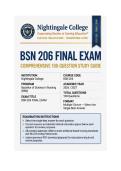
,BSN 206 Final Exam – Foundations of Nursing
Fundamentals – Q&A (2026) | Nightingale College
1. Florence Nightingale's Environmental Theory primarily focused on:
A) Manipulating the patient's environment to facilitate natural healing
B) Administering medications to cure disease
C) Advancing surgical techniques
D) Studying the genetic basis of illness
Correct Answer: A) Manipulating the patient's environment to facilitate natural
healing
Rationale: Nightingale believed that ventilation, light, cleanliness, warmth,
quiet, and diet support the body's natural healing processes. Her theory did not
focus on medications, surgery, or genetics. Environmental manipulation remains
a foundational nursing concept.
2. Which set of roles accurately reflects the interrelated roles of professional
nurses?
A) Pharmacist, radiologist, dietitian, social worker
B) Communicator, teacher, counselor, leader, researcher, advocate, collaborator
C) Surgeon, anesthetist, pathologist, oncologist
D) Administrator, accountant, lawyer, engineer
Correct Answer: B) Communicator, teacher, counselor, leader, researcher,
advocate, collaborator
,Rationale: Nurses function in many roles including communication, teaching,
counseling, leadership, research, advocacy, and collaboration. The other options
list roles outside nursing or not comprehensive. This broad scope supports
holistic patient care.
3. Which criterion is essential for nursing to be considered a profession?
A) A well-defined body of specific and unique knowledge and a strong service
orientation
B) The ability to prescribe medications independently
C) A focus only on hospital-based care
D) Minimal educational requirements
Correct Answer: C) A well-defined body of specific and unique knowledge and a
strong service orientation
Rationale: Professions have a distinct body of knowledge, service orientation,
autonomy, and a code of ethics. Nursing meets these criteria. The other options
are inaccurate; prescribing is not universal and education is rigorous.
4. Which statement accurately describes the purpose of Nurse Practice Acts?
A) They standardize hospital billing procedures
B) They define the legal scope of nursing practice and create state boards of
nursing
C) They regulate the sale of medical supplies
D) They provide clinical practice guidelines for specific diseases
, Correct Answer: D) They define the legal scope of nursing practice and create
state boards of nursing
Rationale: Nurse Practice Acts are state laws that define nursing scope, establish
boards of nursing, set licensure requirements, and protect the public. They do
not address billing, supplies, or disease-specific guidelines directly.
5. A nurse supports a client's right to refuse a prescribed blood transfusion.
Which ethical principle is being upheld?
A) Autonomy
B) Beneficence
C) Nonmaleficence
D) Justice
Correct Answer: A) Autonomy
Rationale: Autonomy is the right of individuals to make their own decisions
about healthcare, including refusal. Beneficence is doing good, nonmaleficence
is avoiding harm, and justice is fairness. The scenario directly illustrates
autonomy.
6. Which ethical principle requires the nurse to act in the patient's best interest?
A) Autonomy
B) Beneficence
C) Nonmaleficence
D) Justice
Fundamentals – Q&A (2026) | Nightingale College
1. Florence Nightingale's Environmental Theory primarily focused on:
A) Manipulating the patient's environment to facilitate natural healing
B) Administering medications to cure disease
C) Advancing surgical techniques
D) Studying the genetic basis of illness
Correct Answer: A) Manipulating the patient's environment to facilitate natural
healing
Rationale: Nightingale believed that ventilation, light, cleanliness, warmth,
quiet, and diet support the body's natural healing processes. Her theory did not
focus on medications, surgery, or genetics. Environmental manipulation remains
a foundational nursing concept.
2. Which set of roles accurately reflects the interrelated roles of professional
nurses?
A) Pharmacist, radiologist, dietitian, social worker
B) Communicator, teacher, counselor, leader, researcher, advocate, collaborator
C) Surgeon, anesthetist, pathologist, oncologist
D) Administrator, accountant, lawyer, engineer
Correct Answer: B) Communicator, teacher, counselor, leader, researcher,
advocate, collaborator
,Rationale: Nurses function in many roles including communication, teaching,
counseling, leadership, research, advocacy, and collaboration. The other options
list roles outside nursing or not comprehensive. This broad scope supports
holistic patient care.
3. Which criterion is essential for nursing to be considered a profession?
A) A well-defined body of specific and unique knowledge and a strong service
orientation
B) The ability to prescribe medications independently
C) A focus only on hospital-based care
D) Minimal educational requirements
Correct Answer: C) A well-defined body of specific and unique knowledge and a
strong service orientation
Rationale: Professions have a distinct body of knowledge, service orientation,
autonomy, and a code of ethics. Nursing meets these criteria. The other options
are inaccurate; prescribing is not universal and education is rigorous.
4. Which statement accurately describes the purpose of Nurse Practice Acts?
A) They standardize hospital billing procedures
B) They define the legal scope of nursing practice and create state boards of
nursing
C) They regulate the sale of medical supplies
D) They provide clinical practice guidelines for specific diseases
, Correct Answer: D) They define the legal scope of nursing practice and create
state boards of nursing
Rationale: Nurse Practice Acts are state laws that define nursing scope, establish
boards of nursing, set licensure requirements, and protect the public. They do
not address billing, supplies, or disease-specific guidelines directly.
5. A nurse supports a client's right to refuse a prescribed blood transfusion.
Which ethical principle is being upheld?
A) Autonomy
B) Beneficence
C) Nonmaleficence
D) Justice
Correct Answer: A) Autonomy
Rationale: Autonomy is the right of individuals to make their own decisions
about healthcare, including refusal. Beneficence is doing good, nonmaleficence
is avoiding harm, and justice is fairness. The scenario directly illustrates
autonomy.
6. Which ethical principle requires the nurse to act in the patient's best interest?
A) Autonomy
B) Beneficence
C) Nonmaleficence
D) Justice


