

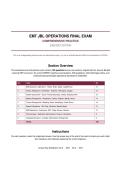
EMT JBL OPERATIONS FINAL EXAM
COMPREHENSIVE PRACTICE
2026/2027 EDITION
This is an independent practice exam for educational study; it is not an official Elsevier HESI exit examination or NCLEX.
Section Overview
This comprehensive final practice exam contains 100 questions across nine sections, aligned with the Jones & Bartlett
Learning EMT curriculum, the current NREMT cognitive exam blueprint, AHA guidelines, CDC field triage criteria, and
evidence-based prehospital operational standards for 2026/2027.
Sec Topic Qs
1 EMS Systems & Operations - History, Roles, Safety, Legal/Ethical 15
2 Airway, Respiration, & Ventilation - Anatomy, Techniques, Oxygen 12
3 Patient Assessment - Scene, Primary/Secondary, History, Reassessment 12
4 Medical Emergencies - Respiratory, Cardiac, Diabetic, Allergic, Neuro 14
5 Trauma Emergencies - Bleeding, Shock, Head/Spine, Chest, Burns 14
6 Special Populations - OB, Peds, Geriatrics, Special Needs 10
7 EMS Operations - Ambulance, MCI, Triage, Rescue, Hazmat 12
8 Pharmacology - Medication Administration, Routes, Calculations 6
9 Integrated Scenarios - Complex, Multi-System Emergencies 5
TOTAL 100
Instructions
For each question, select the single best answer. Use the answer key at the end of the exam to check your work. Each
item includes a brief rationale explaining the correct response.
Answer Key Distribution: 25 A · 25 B · 25 C · 25 D
, Section 1: EMS Systems & Operations - History, Roles, Safety, Wellness, and Legal/Ethical
Issues
Q1: Which of the following is a primary responsibility of an EMT?
A. Diagnosing medical conditions
B. Ensuring scene safety and providing patient care [CORRECT]
C. Prescribing medications
D. Making a definitive diagnosis
Correct Answer: B
Rationale: The EMT ensures scene safety and provides patient care. The other actions are outside the EMT scope.
Q2: Which type of consent is used for an unconscious patient who needs emergency care?
A. Implied consent [CORRECT]
B. Expressed consent
C. Involuntary consent
D. No consent needed
Correct Answer: A
Rationale: Implied consent is used for unconscious patients who cannot give expressed consent. The other options are incorrect.
Q3: Which type of consent is given by a conscious, oriented patient?
A. Implied consent
B. Involuntary consent
C. Refusal
D. Expressed consent [CORRECT]
Correct Answer: D
Rationale: Expressed consent is given by a conscious, oriented patient. The other options are incorrect.
Q4: A patient who is alert and refuses care must:
A. Be forced to accept care
B. Be transported against their will
C. Be informed of the risks and have the refusal documented [CORRECT]
D. Be ignored
Correct Answer: C
Rationale: A competent patient's refusal is honored, with risks explained and documented. The other options are incorrect.
Q5: Which of the following protects a rescuer from liability for providing emergency care in good faith?
A. Good Samaritan laws [CORRECT]
B. HIPAA
C. The OSHA Act
D. The DNR law
Correct Answer: A
Rationale: Good Samaritan laws protect rescuers providing emergency care in good faith. The other options are different.
Q6: Which is a legal responsibility of an EMT?
A. Ignoring abuse
B. Mandatory reporting of suspected abuse [CORRECT]
C. Hiding injuries
D. Avoiding documentation
Correct Answer: B
Rationale: EMTs have a legal duty to report suspected abuse. The other options are incorrect.
Q7: HIPAA requires EMTs to:
A. Share patient information freely
B. Post patient details
C. Discuss cases publicly
EMT JBL Operations Final Exam - 2026/2027 Page 2
, D. Protect patient confidentiality [CORRECT]
Correct Answer: D
Rationale: HIPAA requires protecting patient confidentiality. The other options violate it.
Q8: An advance directive (e.g., a DNR) indicates:
A. The patient's wishes regarding resuscitation [CORRECT]
B. The patient's insurance
C. The hospital of choice
D. The medication list
Correct Answer: A
Rationale: An advance directive documents resuscitation wishes. The other options are incorrect.
Q9: Which is a component of EMT wellness?
A. Managing stress and critical incident stress [CORRECT]
B. Ignoring stress
C. Skipping rest
D. Avoiding debriefing
Correct Answer: A
Rationale: EMT wellness includes stress management and critical incident stress management. The other options are unsafe.
Q10: Which is appropriate for scene safety?
A. Entering an unsafe scene
B. Ignoring hazards
C. Ensuring the scene is safe before entering [CORRECT]
D. Rushing in
Correct Answer: C
Rationale: The EMT ensures scene safety before entering. The other options are unsafe.
Q11: Which is an appropriate action at a crime scene?
A. Destroy evidence
B. Move everything
C. Ignore the scene
D. Preserve evidence and provide care without disturbing it unnecessarily [CORRECT]
Correct Answer: D
Rationale: EMTs preserve evidence while providing care. The other options are incorrect.
Q12: Which is a component of quality improvement (QI) in EMS?
A. Ignoring errors
B. Hiding mistakes
C. Avoiding feedback
D. Reviewing calls to improve patient care [CORRECT]
Correct Answer: D
Rationale: QI reviews calls to improve care. The other options are incorrect.
Q13: Negligence by an EMT requires:
A. A duty to act, a breach, an injury, and causation [CORRECT]
B. Only a duty to act
C. Only an injury
D. No elements
Correct Answer: A
Rationale: Negligence requires duty, breach, injury, and causation. The other options are incomplete.
Q14: Which is appropriate for lifting and moving a patient?
A. Using proper body mechanics and equipment [CORRECT]
B. Lifting with the back
C. Twisting while lifting
EMT JBL Operations Final Exam - 2026/2027 Page 3
COMPREHENSIVE PRACTICE
2026/2027 EDITION
This is an independent practice exam for educational study; it is not an official Elsevier HESI exit examination or NCLEX.
Section Overview
This comprehensive final practice exam contains 100 questions across nine sections, aligned with the Jones & Bartlett
Learning EMT curriculum, the current NREMT cognitive exam blueprint, AHA guidelines, CDC field triage criteria, and
evidence-based prehospital operational standards for 2026/2027.
Sec Topic Qs
1 EMS Systems & Operations - History, Roles, Safety, Legal/Ethical 15
2 Airway, Respiration, & Ventilation - Anatomy, Techniques, Oxygen 12
3 Patient Assessment - Scene, Primary/Secondary, History, Reassessment 12
4 Medical Emergencies - Respiratory, Cardiac, Diabetic, Allergic, Neuro 14
5 Trauma Emergencies - Bleeding, Shock, Head/Spine, Chest, Burns 14
6 Special Populations - OB, Peds, Geriatrics, Special Needs 10
7 EMS Operations - Ambulance, MCI, Triage, Rescue, Hazmat 12
8 Pharmacology - Medication Administration, Routes, Calculations 6
9 Integrated Scenarios - Complex, Multi-System Emergencies 5
TOTAL 100
Instructions
For each question, select the single best answer. Use the answer key at the end of the exam to check your work. Each
item includes a brief rationale explaining the correct response.
Answer Key Distribution: 25 A · 25 B · 25 C · 25 D
, Section 1: EMS Systems & Operations - History, Roles, Safety, Wellness, and Legal/Ethical
Issues
Q1: Which of the following is a primary responsibility of an EMT?
A. Diagnosing medical conditions
B. Ensuring scene safety and providing patient care [CORRECT]
C. Prescribing medications
D. Making a definitive diagnosis
Correct Answer: B
Rationale: The EMT ensures scene safety and provides patient care. The other actions are outside the EMT scope.
Q2: Which type of consent is used for an unconscious patient who needs emergency care?
A. Implied consent [CORRECT]
B. Expressed consent
C. Involuntary consent
D. No consent needed
Correct Answer: A
Rationale: Implied consent is used for unconscious patients who cannot give expressed consent. The other options are incorrect.
Q3: Which type of consent is given by a conscious, oriented patient?
A. Implied consent
B. Involuntary consent
C. Refusal
D. Expressed consent [CORRECT]
Correct Answer: D
Rationale: Expressed consent is given by a conscious, oriented patient. The other options are incorrect.
Q4: A patient who is alert and refuses care must:
A. Be forced to accept care
B. Be transported against their will
C. Be informed of the risks and have the refusal documented [CORRECT]
D. Be ignored
Correct Answer: C
Rationale: A competent patient's refusal is honored, with risks explained and documented. The other options are incorrect.
Q5: Which of the following protects a rescuer from liability for providing emergency care in good faith?
A. Good Samaritan laws [CORRECT]
B. HIPAA
C. The OSHA Act
D. The DNR law
Correct Answer: A
Rationale: Good Samaritan laws protect rescuers providing emergency care in good faith. The other options are different.
Q6: Which is a legal responsibility of an EMT?
A. Ignoring abuse
B. Mandatory reporting of suspected abuse [CORRECT]
C. Hiding injuries
D. Avoiding documentation
Correct Answer: B
Rationale: EMTs have a legal duty to report suspected abuse. The other options are incorrect.
Q7: HIPAA requires EMTs to:
A. Share patient information freely
B. Post patient details
C. Discuss cases publicly
EMT JBL Operations Final Exam - 2026/2027 Page 2
, D. Protect patient confidentiality [CORRECT]
Correct Answer: D
Rationale: HIPAA requires protecting patient confidentiality. The other options violate it.
Q8: An advance directive (e.g., a DNR) indicates:
A. The patient's wishes regarding resuscitation [CORRECT]
B. The patient's insurance
C. The hospital of choice
D. The medication list
Correct Answer: A
Rationale: An advance directive documents resuscitation wishes. The other options are incorrect.
Q9: Which is a component of EMT wellness?
A. Managing stress and critical incident stress [CORRECT]
B. Ignoring stress
C. Skipping rest
D. Avoiding debriefing
Correct Answer: A
Rationale: EMT wellness includes stress management and critical incident stress management. The other options are unsafe.
Q10: Which is appropriate for scene safety?
A. Entering an unsafe scene
B. Ignoring hazards
C. Ensuring the scene is safe before entering [CORRECT]
D. Rushing in
Correct Answer: C
Rationale: The EMT ensures scene safety before entering. The other options are unsafe.
Q11: Which is an appropriate action at a crime scene?
A. Destroy evidence
B. Move everything
C. Ignore the scene
D. Preserve evidence and provide care without disturbing it unnecessarily [CORRECT]
Correct Answer: D
Rationale: EMTs preserve evidence while providing care. The other options are incorrect.
Q12: Which is a component of quality improvement (QI) in EMS?
A. Ignoring errors
B. Hiding mistakes
C. Avoiding feedback
D. Reviewing calls to improve patient care [CORRECT]
Correct Answer: D
Rationale: QI reviews calls to improve care. The other options are incorrect.
Q13: Negligence by an EMT requires:
A. A duty to act, a breach, an injury, and causation [CORRECT]
B. Only a duty to act
C. Only an injury
D. No elements
Correct Answer: A
Rationale: Negligence requires duty, breach, injury, and causation. The other options are incomplete.
Q14: Which is appropriate for lifting and moving a patient?
A. Using proper body mechanics and equipment [CORRECT]
B. Lifting with the back
C. Twisting while lifting
EMT JBL Operations Final Exam - 2026/2027 Page 3


