

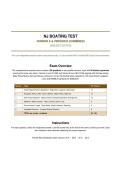
NJ BOATING TEST
VERSION A & VERSION B (COMBINED)
2026/2027 EDITION
This is an independent practice exam for educational study; it is not an official APCO Institute EMD course final examination.
Exam Overview
This comprehensive practice exam contains 120 questions in two parallel versions, each with 60 distinct questions
covering the same core topics. Version A runs Q1-Q60 and Version B runs Q61-Q120, aligned with the New Jersey
State Police Marine Services Bureau curriculum, current NJ boating safety regulations, US Coast Guard navigation
rules, and NASBLA standards for 2026/2027.
Section Topic Per Version
1 Vessel Requirements & Equipment - Registration, Capacity, Safety Gear 12
2 Navigation Rules & Aids - Buoys, Markers, Right-of-Way, Night Nav 12
3 Safe Vessel Operation - Speed, Alcohol, Distracted Operation, Emergencies 12
4 Weather & Water Hazards - Tides, Currents, Storms, Fog 8
5 Environmental & Legal - Clean Water, Invasive Species, Reporting 8
6 Integrated Scenarios - Complex Boating Situations 8
TOTAL per version / combined
Instructions
For each question, select the single best answer. Use the answer key at the end of the exam to check your work. Each
item includes a brief rationale explaining the correct response.
Answer Key Distribution (each version): 25 A · 25 B · 25 C · 25 D
, VERSION A (Questions 1 - 60)
Section 1: Vessel Requirements & Equipment - Registration, Capacity, Safety Gear
Q1: In New Jersey, which vessels are required to be registered?
A. Only motorized vessels
B. Only sailboats
C. No vessels
D. Motorized vessels and non-motorized vessels over 12 feet [CORRECT]
Correct Answer: D
Rationale: NJ requires registration for motorized vessels and non-motorized vessels over 12 feet. The other options are incorrect.
Q2: The hull identification number (HIN) is used to:
A. Set the speed limit
B. Determine the crew
C. Measure the depth
D. Identify a specific vessel [CORRECT]
Correct Answer: D
Rationale: The HIN uniquely identifies a vessel. The other options are incorrect.
Q3: A capacity plate indicates:
A. The maximum number of persons and total weight [CORRECT]
B. The maximum speed
C. The registration fee
D. The fuel type
Correct Answer: A
Rationale: The capacity plate states maximum persons/weight. The other options are incorrect.
Q4: All vessels must carry at least how many wearable PFDs (life jackets)?
A. One total
B. One for each person on board [CORRECT]
C. Two total
D. None
Correct Answer: B
Rationale: There must be at least one wearable PFD for each person on board. The other options are incorrect.
Q5: Children under what age must wear an approved PFD while underway in New Jersey?
A. 16
B. 18
C. 5
D. 13 [CORRECT]
Correct Answer: D
Rationale: Children under 13 must wear an approved PFD while underway in NJ. The other options are incorrect.
Q6: Which type of fire extinguisher is required on most recreational vessels?
A. A marine-rated (Type B) extinguisher [CORRECT]
B. A household extinguisher
C. No extinguisher
D. Only a water bucket
Correct Answer: A
Rationale: A marine-rated Type B extinguisher is required. The other options are not acceptable.
Q7: A vessel over 26 feet is generally required to carry:
A. No safety gear
B. Only a flag
C. At least one fire extinguisher and appropriate safety gear [CORRECT]
NJ Boating Test - Version A & B - 2026/2027 Page 2
, D. Only a radio
Correct Answer: C
Rationale: Vessels over 26 feet require fire extinguishers and safety gear. The other options are incorrect.
Q8: Sound-producing devices (e.g., a horn) are required on vessels to:
A. Entertain passengers
B. Measure speed
C. Warn other vessels and signal in reduced visibility [CORRECT]
D. Detect fish
Correct Answer: C
Rationale: Sound devices signal and warn other vessels. The other options are incorrect.
Q9: A backfire flame arrestor is required on:
A. Sailboats only
B. Paddles
C. Gasoline-powered inboard engines [CORRECT]
D. No engines
Correct Answer: C
Rationale: A backfire flame arrestor is required on gasoline-powered inboard engines. The other options are incorrect.
Q10: Which is a requirement for ventilation of the engine compartment?
A. Proper ventilation to remove flammable vapors [CORRECT]
B. No ventilation
C. Sealed compartments
D. Open hatches only
Correct Answer: A
Rationale: Ventilation removes flammable vapors from the engine compartment. The other options are unsafe.
Q11: Navigation lights must be displayed:
A. Only during the day
B. Only when anchored
C. Between sunset and sunrise and in reduced visibility [CORRECT]
D. Never
Correct Answer: C
Rationale: Navigation lights are shown at night and in reduced visibility. The other options are incorrect.
Q12: Which PFD type is a throwable device (not worn)?
A. Type I
B. Type IV [CORRECT]
C. Type II
D. Type III
Correct Answer: B
Rationale: A Type IV PFD is a throwable device. Types I-III are wearable. The other options are incorrect.
Section 2: Navigation Rules & Aids - Buoys, Markers, Right-of-Way, Night Navigation
Q13: 'Red right returning' means that when returning from the sea, red buoys are kept on the:
A. Left (port) side
B. Right (starboard) side of the vessel [CORRECT]
C. Center
D. Rear
Correct Answer: B
Rationale: Red right returning means red buoys are kept on the right when returning from sea. The other options are incorrect.
Q14: Green buoys are numbered with:
A. Even numbers
B. Odd numbers [CORRECT]
NJ Boating Test - Version A & B - 2026/2027 Page 3
VERSION A & VERSION B (COMBINED)
2026/2027 EDITION
This is an independent practice exam for educational study; it is not an official APCO Institute EMD course final examination.
Exam Overview
This comprehensive practice exam contains 120 questions in two parallel versions, each with 60 distinct questions
covering the same core topics. Version A runs Q1-Q60 and Version B runs Q61-Q120, aligned with the New Jersey
State Police Marine Services Bureau curriculum, current NJ boating safety regulations, US Coast Guard navigation
rules, and NASBLA standards for 2026/2027.
Section Topic Per Version
1 Vessel Requirements & Equipment - Registration, Capacity, Safety Gear 12
2 Navigation Rules & Aids - Buoys, Markers, Right-of-Way, Night Nav 12
3 Safe Vessel Operation - Speed, Alcohol, Distracted Operation, Emergencies 12
4 Weather & Water Hazards - Tides, Currents, Storms, Fog 8
5 Environmental & Legal - Clean Water, Invasive Species, Reporting 8
6 Integrated Scenarios - Complex Boating Situations 8
TOTAL per version / combined
Instructions
For each question, select the single best answer. Use the answer key at the end of the exam to check your work. Each
item includes a brief rationale explaining the correct response.
Answer Key Distribution (each version): 25 A · 25 B · 25 C · 25 D
, VERSION A (Questions 1 - 60)
Section 1: Vessel Requirements & Equipment - Registration, Capacity, Safety Gear
Q1: In New Jersey, which vessels are required to be registered?
A. Only motorized vessels
B. Only sailboats
C. No vessels
D. Motorized vessels and non-motorized vessels over 12 feet [CORRECT]
Correct Answer: D
Rationale: NJ requires registration for motorized vessels and non-motorized vessels over 12 feet. The other options are incorrect.
Q2: The hull identification number (HIN) is used to:
A. Set the speed limit
B. Determine the crew
C. Measure the depth
D. Identify a specific vessel [CORRECT]
Correct Answer: D
Rationale: The HIN uniquely identifies a vessel. The other options are incorrect.
Q3: A capacity plate indicates:
A. The maximum number of persons and total weight [CORRECT]
B. The maximum speed
C. The registration fee
D. The fuel type
Correct Answer: A
Rationale: The capacity plate states maximum persons/weight. The other options are incorrect.
Q4: All vessels must carry at least how many wearable PFDs (life jackets)?
A. One total
B. One for each person on board [CORRECT]
C. Two total
D. None
Correct Answer: B
Rationale: There must be at least one wearable PFD for each person on board. The other options are incorrect.
Q5: Children under what age must wear an approved PFD while underway in New Jersey?
A. 16
B. 18
C. 5
D. 13 [CORRECT]
Correct Answer: D
Rationale: Children under 13 must wear an approved PFD while underway in NJ. The other options are incorrect.
Q6: Which type of fire extinguisher is required on most recreational vessels?
A. A marine-rated (Type B) extinguisher [CORRECT]
B. A household extinguisher
C. No extinguisher
D. Only a water bucket
Correct Answer: A
Rationale: A marine-rated Type B extinguisher is required. The other options are not acceptable.
Q7: A vessel over 26 feet is generally required to carry:
A. No safety gear
B. Only a flag
C. At least one fire extinguisher and appropriate safety gear [CORRECT]
NJ Boating Test - Version A & B - 2026/2027 Page 2
, D. Only a radio
Correct Answer: C
Rationale: Vessels over 26 feet require fire extinguishers and safety gear. The other options are incorrect.
Q8: Sound-producing devices (e.g., a horn) are required on vessels to:
A. Entertain passengers
B. Measure speed
C. Warn other vessels and signal in reduced visibility [CORRECT]
D. Detect fish
Correct Answer: C
Rationale: Sound devices signal and warn other vessels. The other options are incorrect.
Q9: A backfire flame arrestor is required on:
A. Sailboats only
B. Paddles
C. Gasoline-powered inboard engines [CORRECT]
D. No engines
Correct Answer: C
Rationale: A backfire flame arrestor is required on gasoline-powered inboard engines. The other options are incorrect.
Q10: Which is a requirement for ventilation of the engine compartment?
A. Proper ventilation to remove flammable vapors [CORRECT]
B. No ventilation
C. Sealed compartments
D. Open hatches only
Correct Answer: A
Rationale: Ventilation removes flammable vapors from the engine compartment. The other options are unsafe.
Q11: Navigation lights must be displayed:
A. Only during the day
B. Only when anchored
C. Between sunset and sunrise and in reduced visibility [CORRECT]
D. Never
Correct Answer: C
Rationale: Navigation lights are shown at night and in reduced visibility. The other options are incorrect.
Q12: Which PFD type is a throwable device (not worn)?
A. Type I
B. Type IV [CORRECT]
C. Type II
D. Type III
Correct Answer: B
Rationale: A Type IV PFD is a throwable device. Types I-III are wearable. The other options are incorrect.
Section 2: Navigation Rules & Aids - Buoys, Markers, Right-of-Way, Night Navigation
Q13: 'Red right returning' means that when returning from the sea, red buoys are kept on the:
A. Left (port) side
B. Right (starboard) side of the vessel [CORRECT]
C. Center
D. Rear
Correct Answer: B
Rationale: Red right returning means red buoys are kept on the right when returning from sea. The other options are incorrect.
Q14: Green buoys are numbered with:
A. Even numbers
B. Odd numbers [CORRECT]
NJ Boating Test - Version A & B - 2026/2027 Page 3


