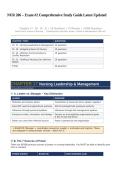
NUR 206 – Exam #2 Comprehensive Study Guide Latest Updated
Chapters 17 · 18 · 19 · 21 | 50 Questions | 75 Minutes | 4 NGN Questions
Saint Paul's School of Nursing – Contemporary Nursing: Issues, Trends & Management (9th ed.)
CHAPTER / TOPIC QUESTIONS
Ch. 17 – Nursing Leadership & Management 15 questions
Ch. 18 – Budgeting Basics for Nurses 10 questions
Ch. 19 – Effective Communication & 15 questions
Conflict Resolution
Ch. 21 – Staffing & Nursing Care Delivery 10 questions
Models
TOTAL 50 questions
CHAPTER 17 Nursing Leadership & Management
15 Questions on the Exam
① A. Leader vs. Manager – Key Distinction
LEADER MANAGER
Motivates and inspires others Coordinator of resources (time, people, supplies)
Does NOT need formal/positional authority HAS formal/legitimate positional authority
Influences through personal qualities Influences through the management position
Focuses on vision, innovation, and change Focuses on accomplishing organizational goals
& day-to-day operations
Power can come from informal sources Power is granted by the organization
✦ EXAM TIP: Manager = coordinates resources. Leader = motivates and inspires. These
are swapped in wrong answer choices – watch for it!
➁ B. The 7 Sources of Power
There are SEVEN primary sources of power in nursing leadership. You MUST be able to identify each
from a scenario.
POWER SOURCE BASED ON EXAM SCENARIO CLUE
, Expert Knowledge, RN with excellent
skills, assessment/psychomotor skills; clinical
information expertise
Referent Followers' admiration; Others observe how she manages
desire to emulate the time/care; staff wants to be like
leader her
Legitimate Formal position / official Committee coordinator; official title or
role in the organization appointment to a role
Connection Knowing or associating Nurse dines with CMO & hospital
with powerful people president; knows upper administration
Coercive Fear of punishment or Authoritative manager who dictates
failure to comply work; suspensions; punishments
Reward Ability to give recognition, Manager controls salary increases;
promotions, pay raises controls bonuses or recognition
Informational Access to or control of Nurse controls data flow; holds
important information information others need
✦ EXAM TIP: Authoritative managers → COERCIVE power. Admired nurse others want to
emulate
→ REFERENT. Clinical skills/expertise → EXPERT. Formal committee position →
LEGITIMATE. Knows the boss → CONNECTION.
③
C. Leadership Theories
THEORY CORE CONCEPT & EXAM CLUE
Trait Theory Leaders are BORN with traits; intrinsic
characteristics. Traits: intelligence, alertness,
dependability, energy, drive, enthusiasm,
ambition, decisiveness, self-confidence,
cooperativeness, technical mastery.
Florence Nightingale = classic example
Behavioral Theory Leaders are MADE through learned behaviors,
not innate traits
Situational / Contingency Theory Leadership effectiveness depends on the
situation; leader adapts style to match follower
readiness
Chaos Theory Leadership in complex, unpredictable, rapidly
changing environments
Bureaucratic Theory Authority based on impersonal rules and formal
structure; rules applied uniformly to all
(authoritative discipline scenario)
Systems Theory (Open/Closed) Open systems: interact with the environment;
Closed systems: self-contained, no external
interaction
✦ EXAM TIP: Florence Nightingale described as intelligent, dependable, ambitious =
TRAIT THEORY. Nurse suspended under a written policy applied to everyone =
AUTHORITATIVE/BUREAUCRATIC theory.
, ④
D. Leadership & Management Styles
Chapters 17 · 18 · 19 · 21 | 50 Questions | 75 Minutes | 4 NGN Questions
Saint Paul's School of Nursing – Contemporary Nursing: Issues, Trends & Management (9th ed.)
CHAPTER / TOPIC QUESTIONS
Ch. 17 – Nursing Leadership & Management 15 questions
Ch. 18 – Budgeting Basics for Nurses 10 questions
Ch. 19 – Effective Communication & 15 questions
Conflict Resolution
Ch. 21 – Staffing & Nursing Care Delivery 10 questions
Models
TOTAL 50 questions
CHAPTER 17 Nursing Leadership & Management
15 Questions on the Exam
① A. Leader vs. Manager – Key Distinction
LEADER MANAGER
Motivates and inspires others Coordinator of resources (time, people, supplies)
Does NOT need formal/positional authority HAS formal/legitimate positional authority
Influences through personal qualities Influences through the management position
Focuses on vision, innovation, and change Focuses on accomplishing organizational goals
& day-to-day operations
Power can come from informal sources Power is granted by the organization
✦ EXAM TIP: Manager = coordinates resources. Leader = motivates and inspires. These
are swapped in wrong answer choices – watch for it!
➁ B. The 7 Sources of Power
There are SEVEN primary sources of power in nursing leadership. You MUST be able to identify each
from a scenario.
POWER SOURCE BASED ON EXAM SCENARIO CLUE
, Expert Knowledge, RN with excellent
skills, assessment/psychomotor skills; clinical
information expertise
Referent Followers' admiration; Others observe how she manages
desire to emulate the time/care; staff wants to be like
leader her
Legitimate Formal position / official Committee coordinator; official title or
role in the organization appointment to a role
Connection Knowing or associating Nurse dines with CMO & hospital
with powerful people president; knows upper administration
Coercive Fear of punishment or Authoritative manager who dictates
failure to comply work; suspensions; punishments
Reward Ability to give recognition, Manager controls salary increases;
promotions, pay raises controls bonuses or recognition
Informational Access to or control of Nurse controls data flow; holds
important information information others need
✦ EXAM TIP: Authoritative managers → COERCIVE power. Admired nurse others want to
emulate
→ REFERENT. Clinical skills/expertise → EXPERT. Formal committee position →
LEGITIMATE. Knows the boss → CONNECTION.
③
C. Leadership Theories
THEORY CORE CONCEPT & EXAM CLUE
Trait Theory Leaders are BORN with traits; intrinsic
characteristics. Traits: intelligence, alertness,
dependability, energy, drive, enthusiasm,
ambition, decisiveness, self-confidence,
cooperativeness, technical mastery.
Florence Nightingale = classic example
Behavioral Theory Leaders are MADE through learned behaviors,
not innate traits
Situational / Contingency Theory Leadership effectiveness depends on the
situation; leader adapts style to match follower
readiness
Chaos Theory Leadership in complex, unpredictable, rapidly
changing environments
Bureaucratic Theory Authority based on impersonal rules and formal
structure; rules applied uniformly to all
(authoritative discipline scenario)
Systems Theory (Open/Closed) Open systems: interact with the environment;
Closed systems: self-contained, no external
interaction
✦ EXAM TIP: Florence Nightingale described as intelligent, dependable, ambitious =
TRAIT THEORY. Nurse suspended under a written policy applied to everyone =
AUTHORITATIVE/BUREAUCRATIC theory.
, ④
D. Leadership & Management Styles