

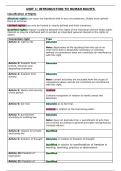
UNIT 1: INTRODUCTION TO HUMAN RIGHTS
Classification of Rights
Absolute rights: can never be interfered with in any circumstances. States must uphold
them at all times.
Limited rights: can only be limited in clearly defined and finite situations.
Qualified rights: require a balance between the rights of the individual and the wider public
interest so may be interfered with to protect an important general interest or the rights of
others.
Convention right Type
Article 2: right to life Absolute
Note: deprivation of life resulting from the use of no
more force than is absolutely necessary in narrowly
defined circumstances does not constitute an interference
with this right
Article 3: freedom from Absolute
torture, inhuman and
degrading treatment
Article 4: freedom from Absolute
slavery
Note: certain activities are excluded from the scope of
compulsory labour and do not constitute an interference
with this right.
Article 5: liberty and security Limited
of the person
Contains exceptions in relation to lawful arrest and
detention.
Article 6: fair trial Absolute as to fair trial.
Limited in relation to the trial being public.
Article 7: punishment Absolute
according to existing law
Note: does not preclude trial + punishment of acts that
are criminal according to general principles recognised by
civilised nations.
Article 8: respect for private Qualified
and family life
Article 9: freedom of thought Absolute in relation to freedom of thought.
Qualified in relation to manifestation of freedom in
worship, teaching, practice or observation
Article 10: freedom of Qualified
expression
Article 11: freedom of Qualified
, assembly
and association
Article 12: right to marry Absolute but according to national law governing the
exercise of the right.
Article 1 of Protocol 1: right Qualified
to peaceful enjoyment of
possessions
Article 14: Protection from discrimination
All of the rights and freedoms set out in the ECHR must be protected and applied without
direct or indirect discrimination on any ground
To rely on this right, a victim must show that the discrimination has affected their enjoyment
of one or more of the other rights in the Convention.
This means that the issue ‘must be within the ambit of another right’, but the applicant
does not need to show that the state has breached that right - Inze v Austria (1988) 10
EHRR 394.
Article 15: Derogations
A state may derogate from part of the Convention in 'time of war or other public emergency
threatening the life of the nation.'
There are limits: no derogation possible in respect of Articles 3 (torture, etc), 4(1) (slavery), or
7 (retrospective criminal offences), or from Article 2 (right to life) except in respect of deaths
resulting from lawful acts of war.
Section 14 Human Rights Act 1998 creates a statutory procedure for enacting a derogation
as part of UK law.
s 1 states that Convention rights are to be read subject to any such derogation.
As a result, a UK court will not be able to enforce Convention rights where a derogation is
in operation.
General principles under the ECHR
Subsidiarity Principle that human rights should primarily be protected at national level
and the system under the ECHR is subordinate to this
Margin of Initially developed under ECtHR, included in ECHR from August 2021 under
appreciation Protocol 15.
doctrine
National authorities are better placed than ECtHR to evaluate local
needs and conditions.
ECtHR will respect judgement of member state as to what public
interest requires where member states may legitimately reach different
conclusions on a particular issue.
Narrow/no margin where principle to be upheld is an important one.
Wider margin where there are diverging views, eg morality issues.
Handyside v UK (1979) 1 EHRR 737: ECtHR held that UK had not
breached Article 10 when its obscenity laws prohibited publication of a
sex education manual for children.
, SAS v France (2014) 36 BHRC 617: Ban on face-covering clothing in
public challenged under Art 8 (private life) and Art 9 (manifestation of
religion). ECtHR held no breach as ban justified on basis of upholding
rights/freedoms of others.
Living ECHR interpreted dynamically.
instrument Rights evolve with societal change → no strong system of precedent.
Controversial as concern it gives too much power to unelected judges.
Procedure to bring a case before the ECtHR
, Two ways proceedings may commence:
Classification of Rights
Absolute rights: can never be interfered with in any circumstances. States must uphold
them at all times.
Limited rights: can only be limited in clearly defined and finite situations.
Qualified rights: require a balance between the rights of the individual and the wider public
interest so may be interfered with to protect an important general interest or the rights of
others.
Convention right Type
Article 2: right to life Absolute
Note: deprivation of life resulting from the use of no
more force than is absolutely necessary in narrowly
defined circumstances does not constitute an interference
with this right
Article 3: freedom from Absolute
torture, inhuman and
degrading treatment
Article 4: freedom from Absolute
slavery
Note: certain activities are excluded from the scope of
compulsory labour and do not constitute an interference
with this right.
Article 5: liberty and security Limited
of the person
Contains exceptions in relation to lawful arrest and
detention.
Article 6: fair trial Absolute as to fair trial.
Limited in relation to the trial being public.
Article 7: punishment Absolute
according to existing law
Note: does not preclude trial + punishment of acts that
are criminal according to general principles recognised by
civilised nations.
Article 8: respect for private Qualified
and family life
Article 9: freedom of thought Absolute in relation to freedom of thought.
Qualified in relation to manifestation of freedom in
worship, teaching, practice or observation
Article 10: freedom of Qualified
expression
Article 11: freedom of Qualified
, assembly
and association
Article 12: right to marry Absolute but according to national law governing the
exercise of the right.
Article 1 of Protocol 1: right Qualified
to peaceful enjoyment of
possessions
Article 14: Protection from discrimination
All of the rights and freedoms set out in the ECHR must be protected and applied without
direct or indirect discrimination on any ground
To rely on this right, a victim must show that the discrimination has affected their enjoyment
of one or more of the other rights in the Convention.
This means that the issue ‘must be within the ambit of another right’, but the applicant
does not need to show that the state has breached that right - Inze v Austria (1988) 10
EHRR 394.
Article 15: Derogations
A state may derogate from part of the Convention in 'time of war or other public emergency
threatening the life of the nation.'
There are limits: no derogation possible in respect of Articles 3 (torture, etc), 4(1) (slavery), or
7 (retrospective criminal offences), or from Article 2 (right to life) except in respect of deaths
resulting from lawful acts of war.
Section 14 Human Rights Act 1998 creates a statutory procedure for enacting a derogation
as part of UK law.
s 1 states that Convention rights are to be read subject to any such derogation.
As a result, a UK court will not be able to enforce Convention rights where a derogation is
in operation.
General principles under the ECHR
Subsidiarity Principle that human rights should primarily be protected at national level
and the system under the ECHR is subordinate to this
Margin of Initially developed under ECtHR, included in ECHR from August 2021 under
appreciation Protocol 15.
doctrine
National authorities are better placed than ECtHR to evaluate local
needs and conditions.
ECtHR will respect judgement of member state as to what public
interest requires where member states may legitimately reach different
conclusions on a particular issue.
Narrow/no margin where principle to be upheld is an important one.
Wider margin where there are diverging views, eg morality issues.
Handyside v UK (1979) 1 EHRR 737: ECtHR held that UK had not
breached Article 10 when its obscenity laws prohibited publication of a
sex education manual for children.
, SAS v France (2014) 36 BHRC 617: Ban on face-covering clothing in
public challenged under Art 8 (private life) and Art 9 (manifestation of
religion). ECtHR held no breach as ban justified on basis of upholding
rights/freedoms of others.
Living ECHR interpreted dynamically.
instrument Rights evolve with societal change → no strong system of precedent.
Controversial as concern it gives too much power to unelected judges.
Procedure to bring a case before the ECtHR
, Two ways proceedings may commence:


