

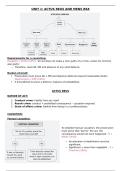
UNIT 1: ACTUS REUS AND MENS REA
Requirements for a conviction:
Haughton v Smith [1975]: ‘an act does not make a man guilty of a crime, unless his mind be
also guilty’
Therefore, need AR, MR and absence of any valid defence.
Burden of proof:
Prosecution must prove AR + MR and disprove defences beyond reasonable doubt:
Woolmington v DPP [1935]
If D burdened to prove a defence: balance of probabilities.
ACTUS REUS
NATURE OF ACT:
1. Conduct crime: liability from act itself.
2. Result crime: conduct + prohibited consequence – causation required.
3. State of affairs crime: liability from being in a condition/status.
CAUSATION:
Factual causation:
To establish factual causation, the prosecution
must prove that ‘but for’ the act, the
consequence would not have happened - R v
White [1910].
Acceleration of death/harm must be
significant.
Significant = more than negligible – R v
Cheshire [1991].
,Legal causation:
1. Was D’s conduct an operating and substantial cause of the result?
R v Dalloway [1847] Consequence must be attributable to a culpable act or
omission.
R v Smith [1959] Conduct must be more than a minimal cause, must be an
operating and substantial cause of the result.
R v Malcherek and Steel Turning off life support – original wound was still the operating
[1981] and substantial cause of death.
R v Benge [1865] The culpable act need not be the sole cause.
R v Pagett [1983] D held his girlfriend hostage and used her as human shield
when police fired back. He was found guilty of manslaughter
as his act contributed significantly to that result.
R v Blaue [1974] Eggshell skull rule – take victim as you find them.
Victim refused blood transfusion for religious reasons
R v Watson [1989] Eggshell skull – Ds convicted of manslaughter as they threw
brick through window of home of elderly man suffering from a
serious heart condition and he subsequently died of heart
attack.
If the jury is properly directed, it is open to them to decide that D’s act caused the result for
victim.
,2. Chain of causation must not be broken:
There must be no novus actus intervenius. Whether the chain is broken is a question of fact
for the jury, applying common sense, subject to guidelines.
The chain may be broken by:
1. An act of the victim.
2. An act of a third party.
3. A natural or other intervening event.
However, the chain will not be broken where:
1. D’s conduct remains an operating and substantial cause of the result.
2. The intervening act or event was foreseen or reasonably foreseeable.
Victim escape R v Roberts Court will consider how foreseeable the victim’s
[1971] response was. No break if reasonable, proportionate +
instinctive.
Chain broken if victim’s act was ‘so daft as to make it
[the victim’s] own voluntary act.
Victim suicide R v Wallace Does not necessarily break the chain if linked to act. Will
[2018] ask whether it was reasonably foreseeable that the
victim would commit suicide as a result of injuries.
Third party R v Pagett Victim’s death caused by police officer firing at D.
intervention [1983] Officer’s action was not free, deliberate and informed as
he was acting instinctively in self-defence – reasonably
foreseeable as D was firing at officer.
Breaks only if unforeseeable, eg ambulance crash
whilst transporting stabbing victim.
Intervening Eg earthquake. No direct binding authority as rare, but
events general view is that same reasonable foreseeability test
would apply.
Medical R v Jordan Exceptional case: victim died after being stabbed due to
negligence [1956] waterlogged lungs due to negligent medical treatment.
Treatment was ‘palpably wrong.’
Medical R v Smith D will find it difficult to argue a break in the chain of
negligence [1959] causation if the injury they inflicted is still operating at
the time of death. As a result, even cases of quite
serious medical negligence may not be enough to
enable the defendant who inflicted the initial injury to
escape liability
Medical R v Cheshire Only breaks chain if so independent of the defendant’s
negligence (leading act’ and ‘so potent in causing death’ that the
authority) contribution made by the defendant was rendered
[1991] insignificant.
, Eggshell R v McKechnie D had head injury but could not operate on ulcer they
skull/medical [1992] found because of head injury. Died from ulcer. Held that
treatment assault prevented the ulcer operation which would have
saved life, decision not to operate was reasonable.
MENS REA
INTENTION
1. Direct: D’s aim is to cause consequence – R v Moloney [1985].
Judge should leave matter to jury’s good sense.
2. Indirect: Result was not D’s aim, but a virtually certain consequence + D appreciated
this – R v Woollin [1999].
Criminal Justice Act 1967, s8: assistance for jurors on what D foresaw at time of act -
test is what the D themselves foresaw, not what a reasonable person would have
foreseen; but what a reasonable person would have foreseen is a good indication, which
a jury can take into account, in deciding what this particular defendant did foresee.
RECKLESSNESS: conscious taking of an unjustified risk
R v G [2004] confirmed definition of recklessness:
1. Did D personally foresee the risk? → subjective – R v Cunningham [1957].
2. Did D go on to take the risk?
3. Was the risk unjustified? → objective (reasonable person).
o All 3 met = reckless.
Requirements for a conviction:
Haughton v Smith [1975]: ‘an act does not make a man guilty of a crime, unless his mind be
also guilty’
Therefore, need AR, MR and absence of any valid defence.
Burden of proof:
Prosecution must prove AR + MR and disprove defences beyond reasonable doubt:
Woolmington v DPP [1935]
If D burdened to prove a defence: balance of probabilities.
ACTUS REUS
NATURE OF ACT:
1. Conduct crime: liability from act itself.
2. Result crime: conduct + prohibited consequence – causation required.
3. State of affairs crime: liability from being in a condition/status.
CAUSATION:
Factual causation:
To establish factual causation, the prosecution
must prove that ‘but for’ the act, the
consequence would not have happened - R v
White [1910].
Acceleration of death/harm must be
significant.
Significant = more than negligible – R v
Cheshire [1991].
,Legal causation:
1. Was D’s conduct an operating and substantial cause of the result?
R v Dalloway [1847] Consequence must be attributable to a culpable act or
omission.
R v Smith [1959] Conduct must be more than a minimal cause, must be an
operating and substantial cause of the result.
R v Malcherek and Steel Turning off life support – original wound was still the operating
[1981] and substantial cause of death.
R v Benge [1865] The culpable act need not be the sole cause.
R v Pagett [1983] D held his girlfriend hostage and used her as human shield
when police fired back. He was found guilty of manslaughter
as his act contributed significantly to that result.
R v Blaue [1974] Eggshell skull rule – take victim as you find them.
Victim refused blood transfusion for religious reasons
R v Watson [1989] Eggshell skull – Ds convicted of manslaughter as they threw
brick through window of home of elderly man suffering from a
serious heart condition and he subsequently died of heart
attack.
If the jury is properly directed, it is open to them to decide that D’s act caused the result for
victim.
,2. Chain of causation must not be broken:
There must be no novus actus intervenius. Whether the chain is broken is a question of fact
for the jury, applying common sense, subject to guidelines.
The chain may be broken by:
1. An act of the victim.
2. An act of a third party.
3. A natural or other intervening event.
However, the chain will not be broken where:
1. D’s conduct remains an operating and substantial cause of the result.
2. The intervening act or event was foreseen or reasonably foreseeable.
Victim escape R v Roberts Court will consider how foreseeable the victim’s
[1971] response was. No break if reasonable, proportionate +
instinctive.
Chain broken if victim’s act was ‘so daft as to make it
[the victim’s] own voluntary act.
Victim suicide R v Wallace Does not necessarily break the chain if linked to act. Will
[2018] ask whether it was reasonably foreseeable that the
victim would commit suicide as a result of injuries.
Third party R v Pagett Victim’s death caused by police officer firing at D.
intervention [1983] Officer’s action was not free, deliberate and informed as
he was acting instinctively in self-defence – reasonably
foreseeable as D was firing at officer.
Breaks only if unforeseeable, eg ambulance crash
whilst transporting stabbing victim.
Intervening Eg earthquake. No direct binding authority as rare, but
events general view is that same reasonable foreseeability test
would apply.
Medical R v Jordan Exceptional case: victim died after being stabbed due to
negligence [1956] waterlogged lungs due to negligent medical treatment.
Treatment was ‘palpably wrong.’
Medical R v Smith D will find it difficult to argue a break in the chain of
negligence [1959] causation if the injury they inflicted is still operating at
the time of death. As a result, even cases of quite
serious medical negligence may not be enough to
enable the defendant who inflicted the initial injury to
escape liability
Medical R v Cheshire Only breaks chain if so independent of the defendant’s
negligence (leading act’ and ‘so potent in causing death’ that the
authority) contribution made by the defendant was rendered
[1991] insignificant.
, Eggshell R v McKechnie D had head injury but could not operate on ulcer they
skull/medical [1992] found because of head injury. Died from ulcer. Held that
treatment assault prevented the ulcer operation which would have
saved life, decision not to operate was reasonable.
MENS REA
INTENTION
1. Direct: D’s aim is to cause consequence – R v Moloney [1985].
Judge should leave matter to jury’s good sense.
2. Indirect: Result was not D’s aim, but a virtually certain consequence + D appreciated
this – R v Woollin [1999].
Criminal Justice Act 1967, s8: assistance for jurors on what D foresaw at time of act -
test is what the D themselves foresaw, not what a reasonable person would have
foreseen; but what a reasonable person would have foreseen is a good indication, which
a jury can take into account, in deciding what this particular defendant did foresee.
RECKLESSNESS: conscious taking of an unjustified risk
R v G [2004] confirmed definition of recklessness:
1. Did D personally foresee the risk? → subjective – R v Cunningham [1957].
2. Did D go on to take the risk?
3. Was the risk unjustified? → objective (reasonable person).
o All 3 met = reckless.


