
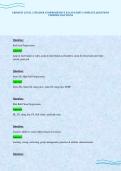
CROSSFIT LEVEL 2 TRAINER COMPREHENSIVE EXAM SCRIPT COMPLETE QUESTIONS
VERIFIED SOLUTIONS
Question:
Push Jerk Progressions.
Answer:
jump & land (hands at sides), jump & land (hands at shoulders), jump & extend arms after hips
extend, push jerk
Question:
Sumo DL High Pull Progressions.
Answer:
Sumo DL, Sumo DL shrug slow, sumo DL shrug fast, SDHP
Question:
Med Ball Clean Progressions.
Answer:
DL, DL shrug fast, FS, Pull Under, med ball clean
Question:
Trainer's ability to coach others (based on 6 areas).
Answer:
teaching, seeing, correcting, group management, presence & attitude, demonstration
Question:
, Teaching.
Answer:
the ability to effectively articulate & instruct the mechanics of each movement
Question:
Seeing.
Answer:
The ability to discern good from poor movement mechanics and identify both gross and subtle faults
whether athlete is in motion or static
Question:
Static Faults.
Answer:
faults that occur near end ranges of motion- starting, receiving, or finishing-
Question:
Dynamic Faults.
Answer:
athlete moving btw the static positions- ex. not reaching full hip extension in drive of the clean, push
early in push press, initiating squat with knees
Question:
Profile view.
Answer:
most useful view to watch an athlete
Question:
VERIFIED SOLUTIONS
Question:
Push Jerk Progressions.
Answer:
jump & land (hands at sides), jump & land (hands at shoulders), jump & extend arms after hips
extend, push jerk
Question:
Sumo DL High Pull Progressions.
Answer:
Sumo DL, Sumo DL shrug slow, sumo DL shrug fast, SDHP
Question:
Med Ball Clean Progressions.
Answer:
DL, DL shrug fast, FS, Pull Under, med ball clean
Question:
Trainer's ability to coach others (based on 6 areas).
Answer:
teaching, seeing, correcting, group management, presence & attitude, demonstration
Question:
, Teaching.
Answer:
the ability to effectively articulate & instruct the mechanics of each movement
Question:
Seeing.
Answer:
The ability to discern good from poor movement mechanics and identify both gross and subtle faults
whether athlete is in motion or static
Question:
Static Faults.
Answer:
faults that occur near end ranges of motion- starting, receiving, or finishing-
Question:
Dynamic Faults.
Answer:
athlete moving btw the static positions- ex. not reaching full hip extension in drive of the clean, push
early in push press, initiating squat with knees
Question:
Profile view.
Answer:
most useful view to watch an athlete
Question:


