

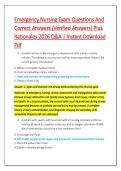
Emergency Nursing Exam Questions And
Correct Answers (Verified Answers) Plus
Rationales 2026 Q&A | Instant Download
Pdf
1. A patient arrives in the emergency department after a motor vehicle
collision. The patient is unconscious and has noisy respirations. What is the
nurse's priority intervention?
A. Obtain a complete medical history
B. Insert an indwelling urinary catheter
C. Open and maintain the airway while protecting the cervical spine
D. Obtain a chest x-ray
Answer: C. Open and maintain the airway while protecting the cervical spine
Rationale: In emergency nursing, airway assessment and management take priority
because airway obstruction can rapidly cause hypoxia, brain injury, cardiac arrest,
and death. In a trauma patient, the cervical spine must be protected during airway
management because an unstable cervical injury may be present. A complete
history, urinary catheterization, and diagnostic imaging are secondary until
immediate threats to life are addressed.
2. A patient with severe asthma arrives with increasing respiratory distress,
inability to speak in complete sentences, and an oxygen saturation of 84%.
Which intervention should the nurse implement first?
A. Encourage oral fluids
B. Administer supplemental oxygen and prepare for rapid bronchodilator therapy
C. Place the patient flat in bed
D. Obtain a detailed allergy history
,Answer: B. Administer supplemental oxygen and prepare for rapid bronchodilator
therapy
Rationale: Severe asthma can produce life-threatening airway obstruction and
hypoxemia. Oxygen should be administered promptly while rapid-acting
bronchodilator therapy is initiated according to emergency protocols. The patient
should generally remain upright or in a position that facilitates breathing. Oral
fluids and a detailed history are not priorities when the patient is critically
hypoxemic.
3. A patient presents with crushing substernal chest pain, diaphoresis, and
nausea. Which action should the emergency nurse prioritize?
A. Ask the patient to ambulate to the bathroom
B. Delay treatment until laboratory results are available
C. Obtain a rapid 12-lead ECG and initiate acute coronary syndrome assessment
D. Administer an antacid and reassess in 30 minutes
Answer: C. Obtain a rapid 12-lead ECG and initiate acute coronary syndrome
assessment
Rationale: Crushing chest pain with diaphoresis and nausea is highly concerning for
acute coronary syndrome. Rapid ECG assessment helps identify myocardial
ischemia or infarction and guides urgent treatment. Emergency nursing priorities
include rapid recognition, cardiac monitoring, intravenous access, appropriate
laboratory testing, and timely evidence-based therapy. Treatment should not be
delayed simply because the patient has not yet received laboratory results.
4. A patient with suspected opioid overdose is found unconscious with slow,
shallow respirations. Which medication is most appropriate?
A. Flumazenil
B. Atropine
C. Adenosine
D. Naloxone
Answer: D. Naloxone
,Rationale: Naloxone is an opioid antagonist used to reverse opioid-induced
respiratory depression. The immediate priority remains airway and ventilation
support. Naloxone can restore respiratory drive in patients with opioid toxicity, but
repeated doses or continuous monitoring may be necessary because some opioids
have longer durations of action than naloxone. Flumazenil is associated with
benzodiazepine reversal and is not routinely appropriate in undifferentiated
overdose.
5. A patient arrives after a fall with severe neck pain and weakness in all four
extremities. What is the nurse's priority?
A. Encourage neck movement to assess range of motion
B. Maintain spinal alignment and immobilization while assessing airway, breathing,
and circulation
C. Place a pillow beneath the patient's neck
D. Allow the patient to sit upright independently
Answer: B. Maintain spinal alignment and immobilization while assessing airway,
breathing, and circulation
Rationale: Neurologic deficits following trauma suggest possible cervical spinal cord
injury. Movement can worsen spinal cord damage. Emergency care requires
protection of the spine while the nurse simultaneously addresses the primary ABC
priorities. The patient should not be encouraged to move independently or have the
neck manipulated unnecessarily.
6. A patient with a suspected myocardial infarction suddenly becomes
unresponsive and pulseless. What should the nurse do first?
A. Obtain a detailed history
B. Administer oral aspirin
C. Begin high-quality CPR and activate the cardiac arrest response
D. Obtain a chest x-ray
Answer: C. Begin high-quality CPR and activate the cardiac arrest response
, Rationale: An unresponsive patient without a pulse is in cardiac arrest. Immediate
high-quality CPR and activation of the emergency response system are essential.
Defibrillation should be performed rapidly when a shockable rhythm is identified.
Diagnostic testing and history-taking are not priorities during cardiac arrest.
7. Which finding is most characteristic of hypovolemic shock?
A. Bounding peripheral pulses
B. Bradycardia with warm skin
C. Tachycardia, cool clammy skin, and decreased urine output
D. Severe hypertension
Answer: C. Tachycardia, cool clammy skin, and decreased urine output
Rationale: Hypovolemic shock occurs when circulating intravascular volume is
inadequate to maintain tissue perfusion. Compensatory mechanisms commonly
produce tachycardia and peripheral vasoconstriction, resulting in cool, pale,
clammy skin. Reduced renal perfusion causes decreased urine output. Hypotension
may develop as shock progresses. Early recognition is essential because untreated
hypovolemia can progress to irreversible organ dysfunction.
8. A patient arrives after a house fire with facial burns, soot around the mouth,
and a hoarse voice. What is the priority nursing action?
A. Apply moisturizing cream to the face
B. Prepare for early airway management and administer high-concentration oxygen
C. Give oral fluids
D. Delay treatment until burn size is calculated
Answer: B. Prepare for early airway management and administer high-
concentration oxygen
Rationale: Facial burns, soot, and hoarseness suggest inhalation injury. Airway
edema can progress rapidly and may make later intubation extremely difficult.
High-concentration oxygen is appropriate when inhalation injury or carbon
monoxide exposure is suspected. Airway protection takes priority over detailed burn
assessment and fluid calculations.
Correct Answers (Verified Answers) Plus
Rationales 2026 Q&A | Instant Download
1. A patient arrives in the emergency department after a motor vehicle
collision. The patient is unconscious and has noisy respirations. What is the
nurse's priority intervention?
A. Obtain a complete medical history
B. Insert an indwelling urinary catheter
C. Open and maintain the airway while protecting the cervical spine
D. Obtain a chest x-ray
Answer: C. Open and maintain the airway while protecting the cervical spine
Rationale: In emergency nursing, airway assessment and management take priority
because airway obstruction can rapidly cause hypoxia, brain injury, cardiac arrest,
and death. In a trauma patient, the cervical spine must be protected during airway
management because an unstable cervical injury may be present. A complete
history, urinary catheterization, and diagnostic imaging are secondary until
immediate threats to life are addressed.
2. A patient with severe asthma arrives with increasing respiratory distress,
inability to speak in complete sentences, and an oxygen saturation of 84%.
Which intervention should the nurse implement first?
A. Encourage oral fluids
B. Administer supplemental oxygen and prepare for rapid bronchodilator therapy
C. Place the patient flat in bed
D. Obtain a detailed allergy history
,Answer: B. Administer supplemental oxygen and prepare for rapid bronchodilator
therapy
Rationale: Severe asthma can produce life-threatening airway obstruction and
hypoxemia. Oxygen should be administered promptly while rapid-acting
bronchodilator therapy is initiated according to emergency protocols. The patient
should generally remain upright or in a position that facilitates breathing. Oral
fluids and a detailed history are not priorities when the patient is critically
hypoxemic.
3. A patient presents with crushing substernal chest pain, diaphoresis, and
nausea. Which action should the emergency nurse prioritize?
A. Ask the patient to ambulate to the bathroom
B. Delay treatment until laboratory results are available
C. Obtain a rapid 12-lead ECG and initiate acute coronary syndrome assessment
D. Administer an antacid and reassess in 30 minutes
Answer: C. Obtain a rapid 12-lead ECG and initiate acute coronary syndrome
assessment
Rationale: Crushing chest pain with diaphoresis and nausea is highly concerning for
acute coronary syndrome. Rapid ECG assessment helps identify myocardial
ischemia or infarction and guides urgent treatment. Emergency nursing priorities
include rapid recognition, cardiac monitoring, intravenous access, appropriate
laboratory testing, and timely evidence-based therapy. Treatment should not be
delayed simply because the patient has not yet received laboratory results.
4. A patient with suspected opioid overdose is found unconscious with slow,
shallow respirations. Which medication is most appropriate?
A. Flumazenil
B. Atropine
C. Adenosine
D. Naloxone
Answer: D. Naloxone
,Rationale: Naloxone is an opioid antagonist used to reverse opioid-induced
respiratory depression. The immediate priority remains airway and ventilation
support. Naloxone can restore respiratory drive in patients with opioid toxicity, but
repeated doses or continuous monitoring may be necessary because some opioids
have longer durations of action than naloxone. Flumazenil is associated with
benzodiazepine reversal and is not routinely appropriate in undifferentiated
overdose.
5. A patient arrives after a fall with severe neck pain and weakness in all four
extremities. What is the nurse's priority?
A. Encourage neck movement to assess range of motion
B. Maintain spinal alignment and immobilization while assessing airway, breathing,
and circulation
C. Place a pillow beneath the patient's neck
D. Allow the patient to sit upright independently
Answer: B. Maintain spinal alignment and immobilization while assessing airway,
breathing, and circulation
Rationale: Neurologic deficits following trauma suggest possible cervical spinal cord
injury. Movement can worsen spinal cord damage. Emergency care requires
protection of the spine while the nurse simultaneously addresses the primary ABC
priorities. The patient should not be encouraged to move independently or have the
neck manipulated unnecessarily.
6. A patient with a suspected myocardial infarction suddenly becomes
unresponsive and pulseless. What should the nurse do first?
A. Obtain a detailed history
B. Administer oral aspirin
C. Begin high-quality CPR and activate the cardiac arrest response
D. Obtain a chest x-ray
Answer: C. Begin high-quality CPR and activate the cardiac arrest response
, Rationale: An unresponsive patient without a pulse is in cardiac arrest. Immediate
high-quality CPR and activation of the emergency response system are essential.
Defibrillation should be performed rapidly when a shockable rhythm is identified.
Diagnostic testing and history-taking are not priorities during cardiac arrest.
7. Which finding is most characteristic of hypovolemic shock?
A. Bounding peripheral pulses
B. Bradycardia with warm skin
C. Tachycardia, cool clammy skin, and decreased urine output
D. Severe hypertension
Answer: C. Tachycardia, cool clammy skin, and decreased urine output
Rationale: Hypovolemic shock occurs when circulating intravascular volume is
inadequate to maintain tissue perfusion. Compensatory mechanisms commonly
produce tachycardia and peripheral vasoconstriction, resulting in cool, pale,
clammy skin. Reduced renal perfusion causes decreased urine output. Hypotension
may develop as shock progresses. Early recognition is essential because untreated
hypovolemia can progress to irreversible organ dysfunction.
8. A patient arrives after a house fire with facial burns, soot around the mouth,
and a hoarse voice. What is the priority nursing action?
A. Apply moisturizing cream to the face
B. Prepare for early airway management and administer high-concentration oxygen
C. Give oral fluids
D. Delay treatment until burn size is calculated
Answer: B. Prepare for early airway management and administer high-
concentration oxygen
Rationale: Facial burns, soot, and hoarseness suggest inhalation injury. Airway
edema can progress rapidly and may make later intubation extremely difficult.
High-concentration oxygen is appropriate when inhalation injury or carbon
monoxide exposure is suspected. Airway protection takes priority over detailed burn
assessment and fluid calculations.


